
Key Takeaways
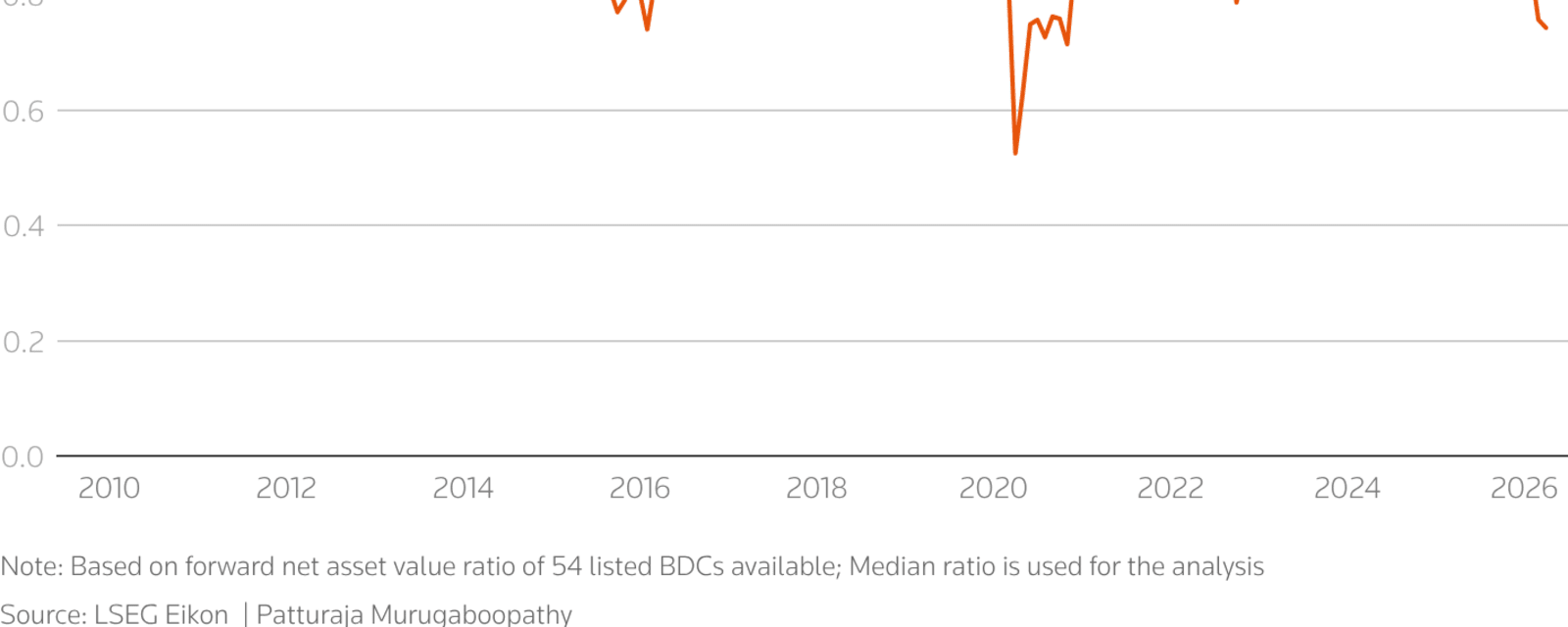
- • Private credit BDCs traded at a median price-to-forward 12-month NAV ratio of 0.74 at end-March 2026, representing a 26% discount—the deepest since October 2020—signaling investor skepticism about valuation accuracy.
- • Internal valuation models and fair-value estimates used by BDCs lag real-time market conditions, creating a potential gap between reported NAVs and true underlying credit stress, particularly in software and technology-exposed portfolios.
- • BDCs with material software exposure have experienced significant share price declines below NAV, constraining their ability to raise new equity capital and limiting financial flexibility, according to Moody's Ratings.
- • Redemption pressures have intensified in non-traded BDCs, with Barings Private Credit Corp. experiencing redemption requests that exceeded available tender offer capacity, highlighting constrained exit liquidity for investors.
- • The valuation concerns reflect growing market anxiety about how private lending portfolios will weather potential artificial intelligence-driven disruption and broader credit deterioration in underwriting standards.
Summary
Private credit business development companies are trading at their steepest discounts to net asset value in more than five years, with LSEG data showing a median price-to-forward 12-month NAV ratio of approximately 0.74 as of March 31, 2026. This 26% discount represents the widest gap since October 2020 and signals a significant shift in institutional investor confidence toward the sector. The widening gap reflects heightened skepticism about whether internally calculated NAVs accurately reflect current credit conditions and underlying portfolio stress in the private lending market.
The core tension driving these discounts stems from a structural mismatch between how BDCs are valued and how market conditions move. Unlike publicly traded equities and bonds, BDC portfolios rely on fair-value estimates and internal valuation models rather than market-determined prices. This methodology can create meaningful lags in capturing deteriorating credit conditions, leading investors to view reported NAVs with increased caution. Concerns have sharpened around exposure to software-heavy and technology-linked borrowers, where potential disruption from artificial intelligence adoption introduces additional uncertainty into credit quality assessments.
Moody's Ratings has explicitly highlighted the constraints facing listed BDCs with significant software exposure, noting that share prices for these vehicles have fallen well below NAV levels. This dynamic directly impairs their ability to raise new equity capital, a critical mechanism for funding growth and maintaining financial flexibility. The problem extends beyond listed vehicles: non-traded BDCs have also experienced visible redemption pressures, exemplified by Barings Private Credit Corp.'s recent tender offer, which saw redemption requests exceed the available capacity—a clear indicator of constrained exit liquidity for investors seeking to withdraw capital.
The convergence of valuation uncertainty, technology sector exposure concerns, and redemption pressures has created a challenging environment for BDC fundraising and portfolio management. Market participants remain focused on whether internal valuation practices adequately reflect emerging weaknesses in the private credit ecosystem, particularly as credit cycles extend and underlying borrower stress becomes more apparent across certain subsectors.
Go deeper than the headline
Research every firm in this story, track the ones that matter and get the daily briefing — free for 7 days.