
Key Takeaways
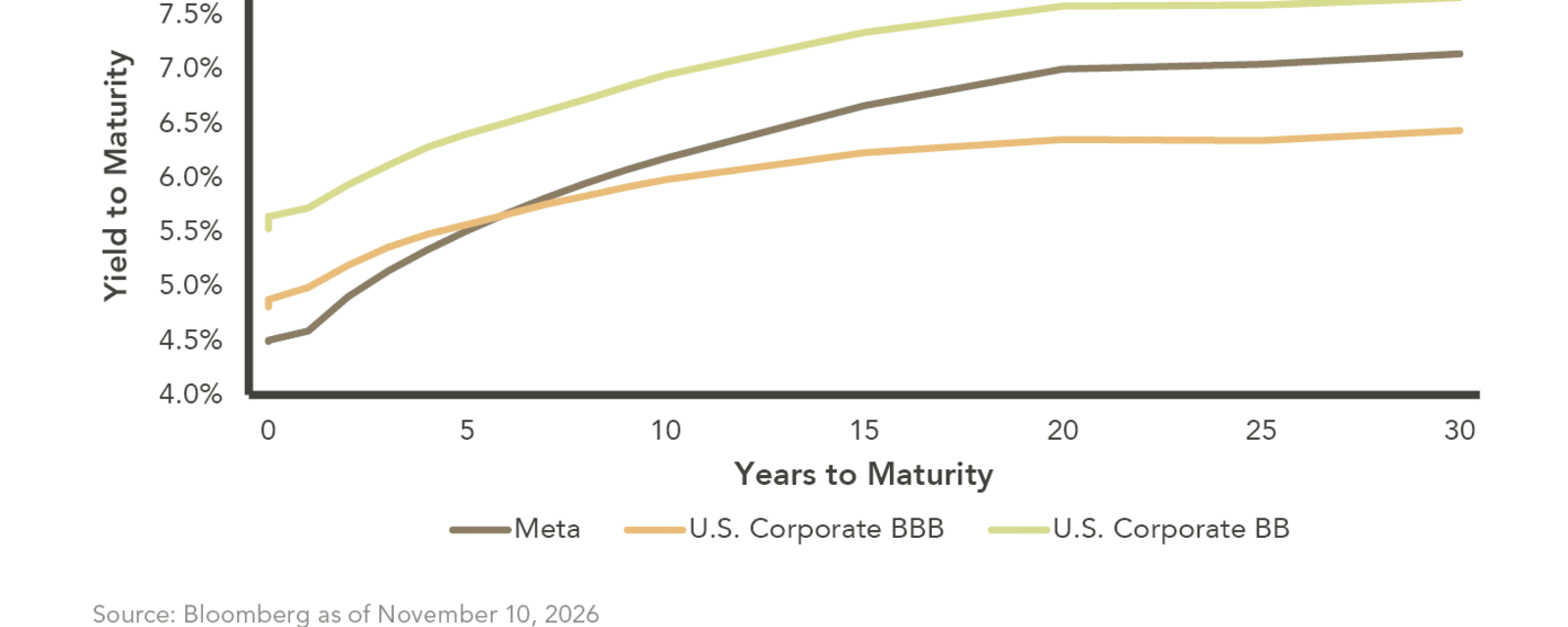
- • Meta's corporate bond curve spans roughly 240 basis points of option-adjusted steepness, from 41 bps at 1 year to 282 bps at 40 years, according to Marquette Associates research.
- • As an AA-rated issuer, Meta trades inside the BBB curve at maturities under 6 years but approaches the BB curve at longer maturities.
- • Meta's public debt has grown to roughly $84 billion, with weighted-average maturity extended to nearly 20 years and a weighted-average coupon of nearly 5.2%.
- • S&P Global cut its Meta outlook to negative, citing elevated spending, negative free operating cash flow, and rising leverage risk; Meta's CDS spread has widened by more than 20 bps over the last 12 months.
- • Marquette expects continued dispersion and potentially steeper credit curves across investment-grade technology issuers as AI-related capex drives higher borrowing needs.
Summary
Marquette Associates research argues that corporate bond spreads are not uniform across the yield curve, using Meta Platforms as its primary example. Meta's curve spans roughly 240 basis points of option-adjusted steepness, from 41 basis points at one year to 282 basis points at 40 years. As an AA-rated credit, Meta trades inside the BBB curve at maturities below six years but approaches the BB curve at longer maturities, a pattern Marquette summarizes as the investment-grade "business" of the front end giving way to the high-yield "party" in the back end.
Supply is one driver of this shape. Meta has issued bonds at an extraordinary pace this year, extending its weighted-average maturity to nearly 20 years and lifting public debt to roughly $84 billion. Its weighted-average coupon of nearly 5.2% sits above those of peers such as Amazon, Microsoft, and Alphabet. Marquette notes that in the most recent week Meta raised $15 billion in U.S. dollars and an additional EUR 9 billion, paying significantly larger new-issue concessions than peers and pricing new long-dated bonds wide of its existing secondary curve.
Investor behavior also contributes. Investors have been reducing long-end technology exposure and becoming more selective about AI-related credit, and long-end bonds have underperformed, requiring larger concessions and greater funding transparency for new issues. Fundamentals add to the steepening. S&P Global cut its outlook on Meta to negative at the end of the prior month, citing uncertainty about elevated spending, negative free operating cash flow, and the risk of higher leverage. Meta's CDS spread has widened by more than 20 basis points over the last 12 months, and the bond issued to fund its Louisiana data center project has traded lower amid concerns about its growing debt load and financing needs. Marquette also notes that longer-dated bonds are generally more sensitive to credit deterioration, so investors there demand a larger risk premium.
Marquette states the pattern is not specific to Meta. It expects continued dispersion and potentially steeper credit curves across investment-grade technology issuers as elevated AI-related capital expenditures drive higher borrowing needs and closer scrutiny of balance sheets. The firm sees opportunities to capture incremental yield at the long end but advises selectivity given the sensitivity of long-dated bonds to leverage, cash flow deterioration, and shifting sentiment toward AI-related credit.
Supply is one driver of this shape. Meta has issued bonds at an extraordinary pace this year, extending its weighted-average maturity to nearly 20 years and lifting public debt to roughly $84 billion. Its weighted-average coupon of nearly 5.2% sits above those of peers such as Amazon, Microsoft, and Alphabet. Marquette notes that in the most recent week Meta raised $15 billion in U.S. dollars and an additional EUR 9 billion, paying significantly larger new-issue concessions than peers and pricing new long-dated bonds wide of its existing secondary curve.
Investor behavior also contributes. Investors have been reducing long-end technology exposure and becoming more selective about AI-related credit, and long-end bonds have underperformed, requiring larger concessions and greater funding transparency for new issues. Fundamentals add to the steepening. S&P Global cut its outlook on Meta to negative at the end of the prior month, citing uncertainty about elevated spending, negative free operating cash flow, and the risk of higher leverage. Meta's CDS spread has widened by more than 20 basis points over the last 12 months, and the bond issued to fund its Louisiana data center project has traded lower amid concerns about its growing debt load and financing needs. Marquette also notes that longer-dated bonds are generally more sensitive to credit deterioration, so investors there demand a larger risk premium.
Marquette states the pattern is not specific to Meta. It expects continued dispersion and potentially steeper credit curves across investment-grade technology issuers as elevated AI-related capital expenditures drive higher borrowing needs and closer scrutiny of balance sheets. The firm sees opportunities to capture incremental yield at the long end but advises selectivity given the sensitivity of long-dated bonds to leverage, cash flow deterioration, and shifting sentiment toward AI-related credit.
Go deeper than the headline
Research every firm in this story, track the ones that matter and get the daily briefing — free for 7 days.