
Key Takeaways
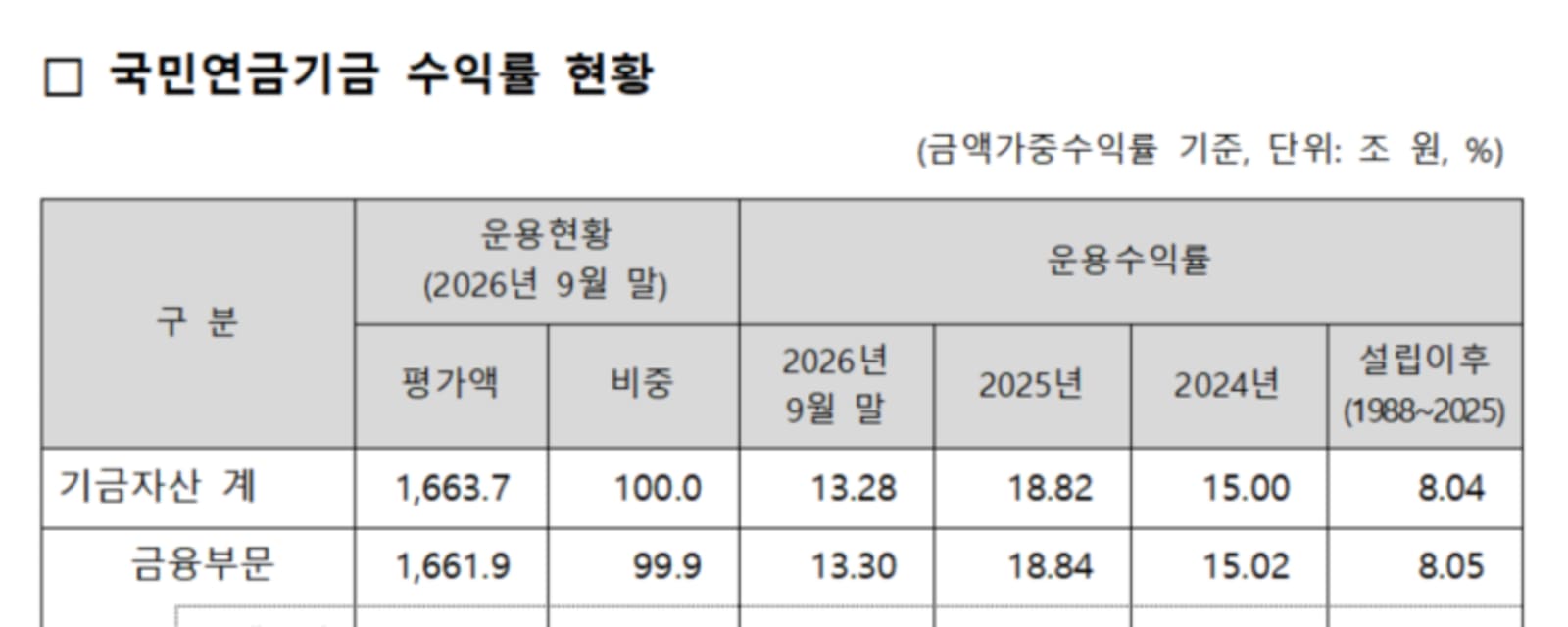
- • The National Pension Fund's reserves fell 201.9 trillion won, or 10.8%, from 1,865.6 trillion won at end-June to a provisional 1,663.7 trillion won at end-September, according to the National Pension Service Investment Management division.
- • Cumulative year-to-date return dropped 13.94 percentage points, from 27.22% to 13.28%, after a record first-half performance driven by the domestic equity boom.
- • Domestic equity holdings declined from 543.2 trillion won to 435.2 trillion won, accounting for more than half of the total reserve decline; domestic equity year-to-date return fell from 107.37% to 66.38%.
- • Critics link the drawdown to the fund's decision to raise its domestic equity target allocation twice in 2026 (to 14.9% in January and 20.8% in May) while postponing rebalancing, which left domestic stocks above 29% of total assets at end-June.
- • Foreign equity, foreign bond and alternative investment returns also deteriorated, with foreign bonds and alternatives turning negative, attributed to rising interest rates and a weaker won against the dollar.
Summary
The National Pension Fund's reserves contracted by more than 200 trillion won in the third quarter of 2026, a decline that followed a record-high return in the first half of the year. According to the National Pension Service Investment Management division, reserves stood at a provisional 1,663.7 trillion won at the end of September, down 201.9 trillion won, or 10.8%, from 1,865.6 trillion won at the end of June. The fund's cumulative return since the start of the year fell from 27.22% to 13.28% over the same period.
The domestic equity book drove most of the loss. Domestic stock holdings fell from 543.2 trillion won to 435.2 trillion won between June and September, and more than half of the overall reserve decline came from this segment. Year-to-date domestic equity returns dropped from 107.37% to 66.38%. Other asset classes also weakened: foreign equity returns fell from 17.81% to 6.61%, while foreign bond and alternative investment returns moved from 9.22% and 9.60% to -7.20% and -1.24%, respectively. The article cites rising interest rates and a decline in the won-dollar exchange rate as contributing factors.
The losses have drawn scrutiny because they coincided with changes to the fund's asset allocation policy. In January, the National Pension Fund Management Committee raised the 2026 domestic stock target from 14.4% to 14.9% and temporarily postponed rebalancing. In May, it raised the target again to 20.8% and expanded the permissible range for strategic asset allocation. Rebalancing is designed to cap concentration and keep portfolio risk within set limits, and the article notes that domestic stocks accounted for more than 29% of total assets at end-June as a result of the delayed rebalancing. The committee said the decisions reflected potential structural changes in the domestic stock market and the market impact of large-scale stock sales. Chairman Kim Seong-ju told a parliamentary audit last month that postponing rebalancing had effectively helped returns.
The article notes that the National Pension Service is a long-term investor and that reserve declines do not necessarily equal realized losses. It adds, however, that whether the fund adequately weighed downside risk when it changed its allocation principles is a separate question, and that some observers call for comparing actual performance against a scenario in which the original allocation framework had been maintained.
Go deeper than the headline
Research every firm in this story, track the ones that matter and get the daily briefing.