
Key Takeaways
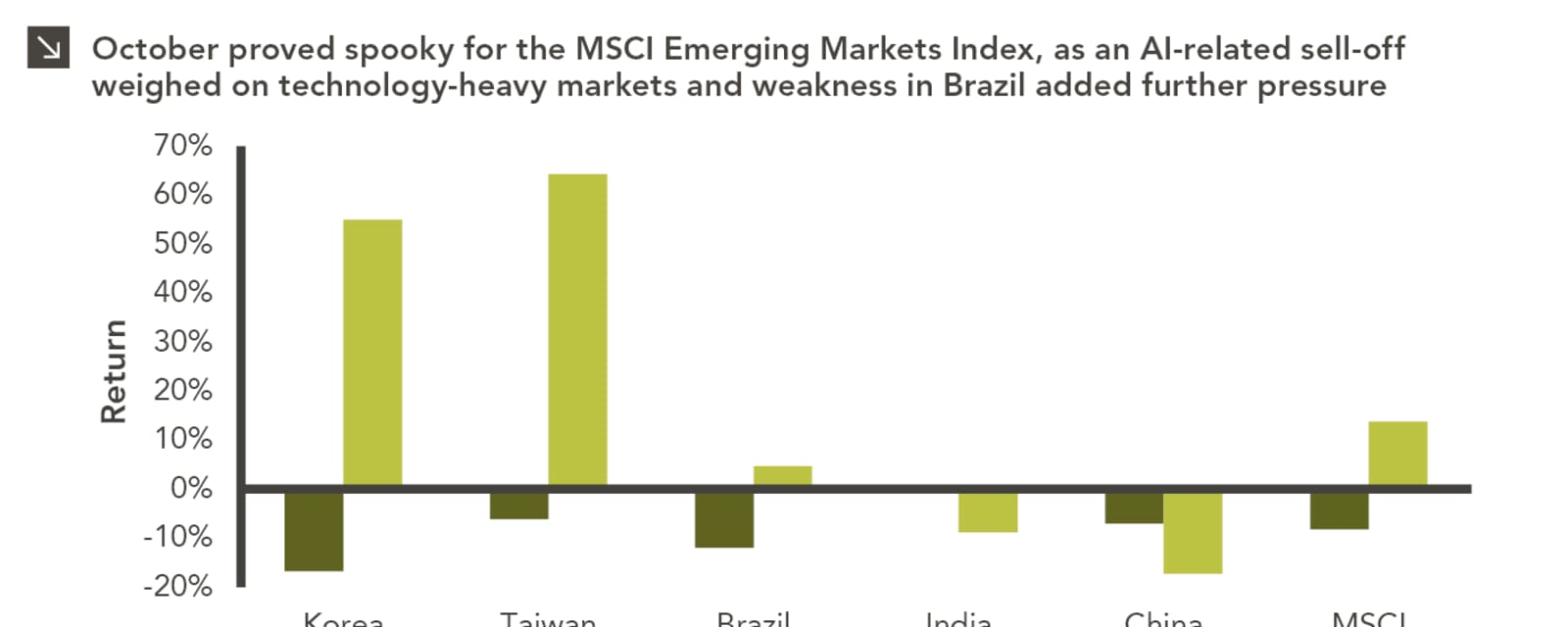
- • Emerging markets declined roughly 8.3% in October 2026, driven by renewed doubts over the sustainability of AI-related investment and elevated technology valuations, according to Marquette Associates research.
- • The MSCI Korea index fell about 16.8% and the MSCI Taiwan index fell about 6.2% in October, reversing earlier-year gains in semiconductor-heavy markets.
- • Brazil's index dropped roughly 12.0% after President Luiz Inácio Lula da Silva defeated Flávio Bolsonaro in the presidential runoff, raising fiscal concerns with public debt above 80% of GDP.
- • India posted a modest 0.3% gain in October, relatively insulated from the semiconductor sell-off but exposed to elevated oil prices and foreign investor outflows.
- • Analysts see the performance divergence as evidence of dispersion within emerging markets and of the risks tied to concentrated market leadership.
Summary
Emerging markets declined by around 8.3% in October 2026, according to Marquette Associates, as renewed concerns over the sustainability of AI-related investment and elevated technology valuations weighed on the asset class. Semiconductor-oriented markets were hit hardest, with the MSCI Korea and MSCI Taiwan indices falling roughly 16.8% and 6.2% respectively during the month, reversing part of the strong gains those markets had posted earlier in the year.
The sell-off intensified after disappointing U.S. technology earnings raised questions about whether the large sums being invested in artificial intelligence would translate into adequate shareholder value. Weakness at Google, Amazon, and Intel added to concerns about the scale of AI infrastructure spending and the timing of potential returns. The pressure spread to Asian semiconductor companies, which have been major contributors to equity performance in Korea and Taiwan. Marquette argues the pullback does not necessarily signal weakening fundamentals, noting that Asian semiconductor suppliers continue to report strong AI-related demand, and that the reaction may reflect a reassessment of valuations, capital spending requirements and expected returns. The heavy concentration of recent gains in technology names nonetheless leaves these markets sensitive to shifts in investor sentiment.
Brazil faced a separate, country-specific shock. The index fell approximately 12.0% after the reelection of left-wing incumbent Luiz Inácio Lula da Silva, who defeated right-wing challenger Flávio Bolsonaro. Investors had earlier priced in a potential shift toward a more market-oriented administration focused on fiscal consolidation and pro-business reforms following Bolsonaro's strong first-round showing. Brazilian equities fell sharply after the result, the real weakened, and government bond yields rose as investors reassessed the fiscal outlook and unwound pre-election positions. Public debt already exceeds 80% of GDP, and elevated interest costs limit fiscal flexibility. Although Lula has kept an existing fiscal framework meant to constrain spending, investors worry that additional social programs and public investment could outpace revenue growth. Domestically oriented, rate-sensitive companies are seen as particularly exposed if fiscal credibility deteriorates.
India was comparatively insulated from the semiconductor-led sell-off given its limited exposure to the AI rally, posting a modest 0.3% gain in October. Its resilience, however, is tempered by elevated oil prices and continued foreign investor outflows. As a major energy importer, India faces potential pressure on corporate margins, inflation and its trade balance from higher oil prices.
Looking ahead, Marquette expects the sustainability of AI investment and the returns it generates to remain key drivers for Korea and Taiwan, with a semiconductor demand recovery possible if confidence in earnings returns. Brazilian equities are likely to remain sensitive to fiscal policy developments, while oil prices and foreign capital flows should weigh heavily on India. Overall, the report highlights considerable dispersion across emerging markets and the importance of diversification, distinguishing markets with structural growth from those facing persistent economic or political headwinds.
The sell-off intensified after disappointing U.S. technology earnings raised questions about whether the large sums being invested in artificial intelligence would translate into adequate shareholder value. Weakness at Google, Amazon, and Intel added to concerns about the scale of AI infrastructure spending and the timing of potential returns. The pressure spread to Asian semiconductor companies, which have been major contributors to equity performance in Korea and Taiwan. Marquette argues the pullback does not necessarily signal weakening fundamentals, noting that Asian semiconductor suppliers continue to report strong AI-related demand, and that the reaction may reflect a reassessment of valuations, capital spending requirements and expected returns. The heavy concentration of recent gains in technology names nonetheless leaves these markets sensitive to shifts in investor sentiment.
Brazil faced a separate, country-specific shock. The index fell approximately 12.0% after the reelection of left-wing incumbent Luiz Inácio Lula da Silva, who defeated right-wing challenger Flávio Bolsonaro. Investors had earlier priced in a potential shift toward a more market-oriented administration focused on fiscal consolidation and pro-business reforms following Bolsonaro's strong first-round showing. Brazilian equities fell sharply after the result, the real weakened, and government bond yields rose as investors reassessed the fiscal outlook and unwound pre-election positions. Public debt already exceeds 80% of GDP, and elevated interest costs limit fiscal flexibility. Although Lula has kept an existing fiscal framework meant to constrain spending, investors worry that additional social programs and public investment could outpace revenue growth. Domestically oriented, rate-sensitive companies are seen as particularly exposed if fiscal credibility deteriorates.
India was comparatively insulated from the semiconductor-led sell-off given its limited exposure to the AI rally, posting a modest 0.3% gain in October. Its resilience, however, is tempered by elevated oil prices and continued foreign investor outflows. As a major energy importer, India faces potential pressure on corporate margins, inflation and its trade balance from higher oil prices.
Looking ahead, Marquette expects the sustainability of AI investment and the returns it generates to remain key drivers for Korea and Taiwan, with a semiconductor demand recovery possible if confidence in earnings returns. Brazilian equities are likely to remain sensitive to fiscal policy developments, while oil prices and foreign capital flows should weigh heavily on India. Overall, the report highlights considerable dispersion across emerging markets and the importance of diversification, distinguishing markets with structural growth from those facing persistent economic or political headwinds.
Go deeper than the headline
Research every firm in this story, track the ones that matter and get the daily briefing — free for 7 days.