
Key Takeaways
- • The global alternatives industry is projected to grow to $24 trillion in assets by 2028, up from $15 trillion in 2022, yet will still represent less than 2.4% of total global financial assets, indicating substantial runway for market expansion and investor penetration.
- • A $3.7 trillion annual infrastructure investment gap exists through 2035 to support global GDP growth, far exceeding public sector capacity and creating an outsized need for private capital deployment across multiple industries.
- • Alternative investments encompass multiple distinct asset classes—each with unique risk/return profiles, liquidity characteristics, and capital requirements—serving different portfolio functions including growth, capital appreciation, inflation protection, and stable income generation.
- • Democratization of alternatives access is expanding beyond traditional pensions and endowments to individual investors through innovative fund structures and traditional drawdown vehicles, broadening the investor base.
- • KKR operates as a leading global alternative asset manager with 36 years of operational history, managing a diversified private equity portfolio spanning 30+ countries across private equity, credit, real estate, and infrastructure strategies.
Summary
The alternatives industry stands at an inflection point as institutional and individual investors increasingly seek exposure to private markets. According to KKR's Global Macro, Balance Sheet & Risk team analysis, the broad alternatives sector is expected to expand to more than $24 trillion in assets by 2028 from $15 trillion in 2022—representing a 60% increase over six years. Despite this substantial growth trajectory, alternatives will continue to represent less than 2.4% of total global financial assets, underscoring both the scale of the opportunity and the significant room for capital reallocation into private markets.
The fundamental driver for alternatives growth centers on a critical infrastructure and investment gap. Governments face stretched budgets constrained by rising debt, aging populations, and competing national priorities such as defense spending. This fiscal reality creates an outsized funding need: approximately $3.7 trillion in annual infrastructure investment will be required to support global GDP growth through 2035—a sum far exceeding the public sector capacity of most countries. This structural shortfall necessitates mobilization of private capital across multiple industries to provide both financial and operating resources for high-impact, long-term projects.
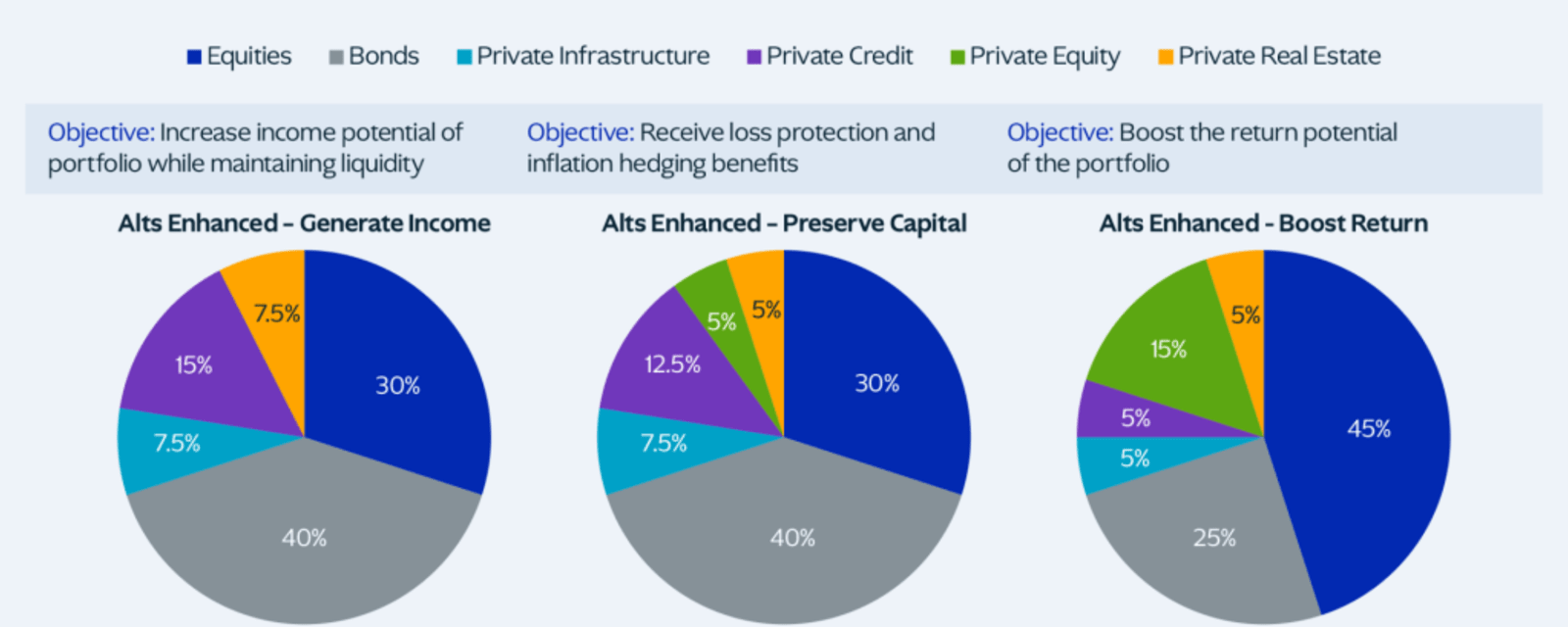
Alternatives comprise multiple distinct asset classes, each with differentiated characteristics across expected return, risk, yield, liquidity, and capital requirements. Some alternative strategies prioritize growth and capital appreciation, while others protect portfolios against inflation or provide stable income streams. Many strategies offer combinations of these benefits. This heterogeneity means institutional and individual investors can construct alternatives allocations tailored to specific portfolio objectives and liability structures.
Access to alternatives has historically been limited to pensions, endowments, and ultra-high-net-worth investors. However, market evolution is democratizing these opportunities through innovative fund structures and traditional drawdown vehicles, enabling broader individual investor participation. This accessibility expansion, combined with wealth managers' growing sophistication in alternatives education and placement, is reshaping the composition of capital flowing into private markets. KKR, operating with 36 years of investment history across 30+ countries, exemplifies the institutional infrastructure supporting this shift—managing diversified strategies in private equity, credit, real estate, and infrastructure with an integrated operational approach.
Go deeper than the headline
Research every firm in this story, track the ones that matter and get the daily briefing — free for 7 days.