
Key Takeaways
- • Shekhar Daga, Head of Private Capital at ICICI Prudential Asset Management, suggests investors consider allocating roughly 10% to 15% of their overall portfolio to alternative investments, keeping the bulk in mutual funds and fixed-income products.
- • Daga stresses that the allocation is not a one-size-fits-all formula and should depend on individual financial circumstances, risk tolerance, investment horizon and liquidity needs.
- • Daga warns first-time AIF investors against chasing headline returns, noting that higher return targets imply significantly higher risk and that investors can lose money by investing without understanding the product.
- • Daga advises investors to understand each AIF strategy (credit, private equity, venture capital), its risk-reward profile and the fund's risk-management framework before committing capital.
Summary
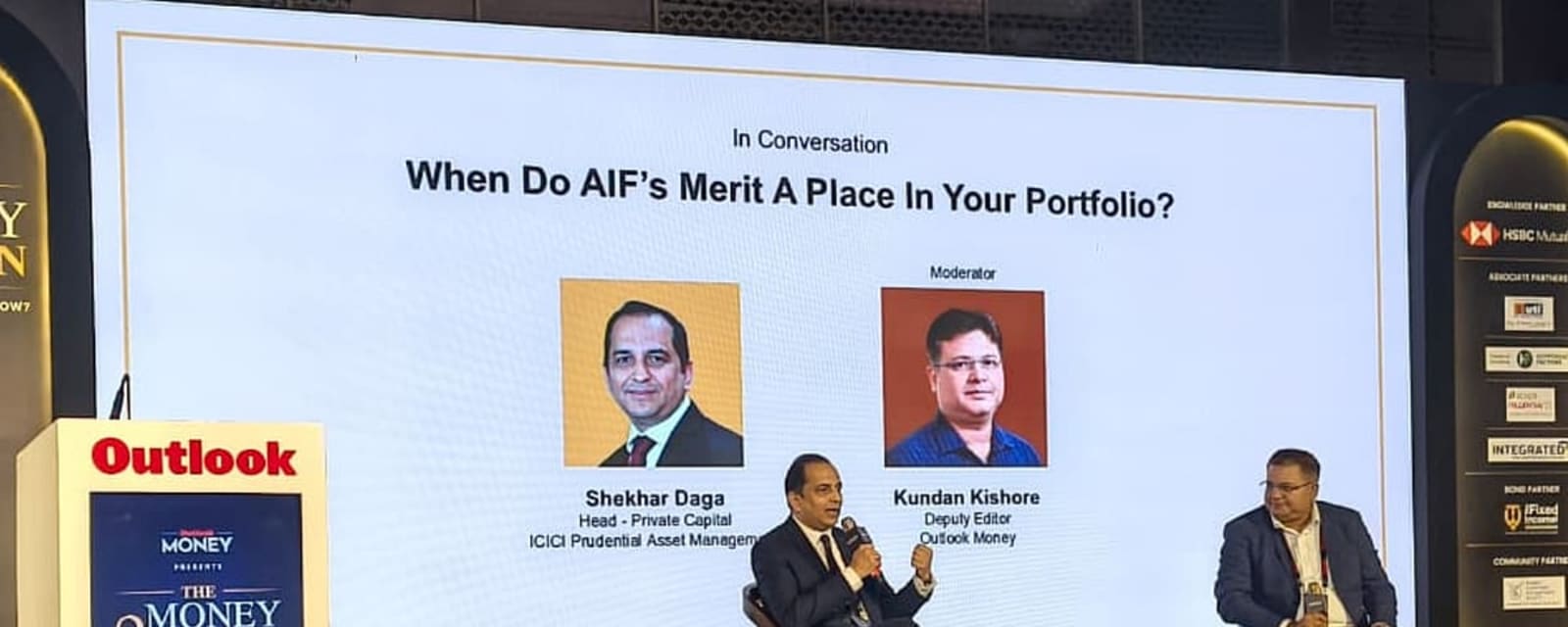
Alternative Investment Funds (AIFs) are increasingly finding a place in the portfolios of high-net-worth individuals and family offices, according to Outlook Money. In an interview with Deputy Editor Kundan Kishore at The Money Question event, Shekhar Daga, Head of Private Capital at ICICI Prudential Asset Management, argued that the central question for a first-time AIF investor is not how much return a fund can generate but whether the product fits the investor's risk appetite, financial goals and liquidity needs.
Daga suggested that investors could consider allocating around 10% to 15% of their overall portfolio to alternative investments, while keeping the majority in conventional products such as mutual funds and fixed-income instruments. He cautioned that this range is not a universal formula and that the appropriate figure depends on each investor's circumstances, risk tolerance, investment horizon and liquidity requirements.
On whether AIFs can combine equity-like returns, debt-like safety, mutual fund liquidity and crypto-style upside, Daga was direct: investors cannot expect everything in one package. He said AIFs offer multiple products across risk buckets, each with its own risk-reward profile. Investors seeking a return target of around 20% are likely taking significantly higher risk, while those wanting relative safety may consider overnight or liquid funds, or bank and corporate debt instruments. He drew an analogy to equity investing, where large-caps offer stability and mid- and small-caps offer higher growth potential with correspondingly higher risk.
Daga's core advice was not to chase returns. He said investors across India often first ask about a scheme's headline return, and stressed that understanding how the product works, what its risks are and whether it fits one's objectives matters more. He compared AIF due diligence to stock research, noting that investors should choose a strategy suited to their objectives and risk comfort and confirm the fund has a sound risk-management framework. Daga added that no asset class's future can be underwrittenwith certainty, and that focusing on what can be understood and assessed today gives an investment a better chance of delivering over the long term.
Go deeper than the headline
Research every firm in this story, track the ones that matter and get the daily briefing — free for 7 days.