
Key Takeaways
- • State Street Global Advisors (SSGA) positions liquid alternative ETFs as "the next evolution of portfolio construction for European investors," democratizing access to hedge fund-like strategies through transparent, liquid, and cost-effective vehicles that were historically exclusive to institutional clients.
- • European hedge fund-like ETFs remain a niche market segment, holding only $980.7 million in assets under management as of end-2024—a fraction of the $134.0 billion housed by US equivalents—despite recent strategic filings by SSGA for private credit and risk parity ETF products.
- • SSGA has filed for an exchange-traded risk parity fund modeled on Bridgewater Associates' flagship strategy, betting that macroeconomic uncertainty in Europe will drive investor demand for solutions that perform across market cycles; however, market headwinds persist, with existing hedge fund-like European ETFs experiencing mixed flows and a Bridgewater-run mutual fund hemorrhaging assets in 2024.
- • The timing of liquid alternative ETF expansion raises strategic questions, as the European alternatives space remains underpenetrated relative to the US market and faces near-term asset outflows in competing products.
Summary
Liquid alternative strategies packaged as ETFs represent a nascent but potentially significant evolution in European portfolio construction, according to State Street Global Advisors leadership. Matteo Andreetto, SSGA's senior managing director and head of intermediary client coverage for Europe, argues that these instruments "democratize access to sophisticated investment tools that were once exclusive to institutions" by combining hedge fund-like strategies with the transparency, liquidity, and cost efficiency inherent to exchange-traded products.
SSGA has positioned itself at the forefront of this trend under CEO Yie-Hsin Hung's direction, with recent regulatory filings underscoring the firm's commitment to alternatives expansion. In September 2024, SSGA submitted paperwork for a private credit ETF and subsequently filed for an exchange-traded risk parity fund—the signature investment approach of Bridgewater Associates, the world's largest hedge fund. Andreetto identified particular opportunity in Europe, where "macroeconomic uncertainty is prompting investors to seek solutions that perform across market cycles," suggesting that risk parity's portfolio-balancing characteristics could resonate with European allocators navigating volatile macro conditions.
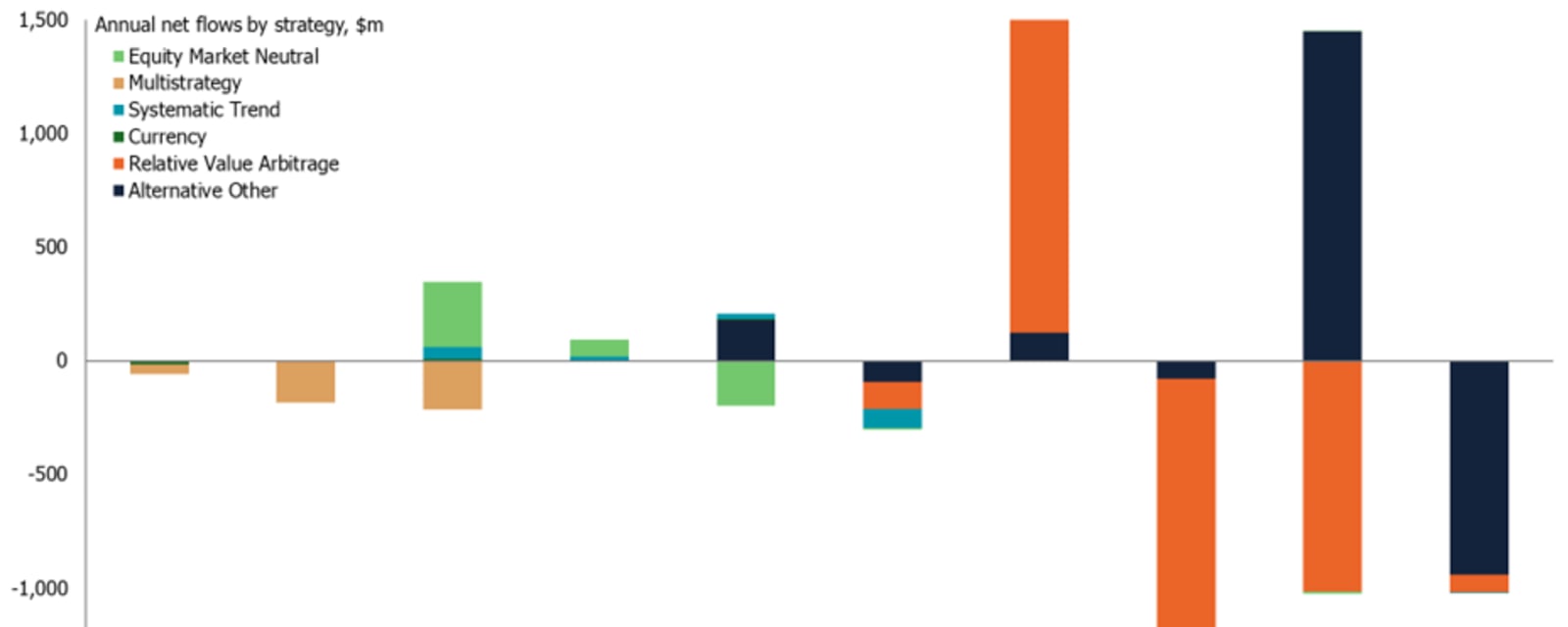
However, the strategic timing warrants scrutiny. European ETFs offering hedge fund-like exposure held only $980.7 million in assets under management at the close of 2024, according to Morningstar Direct data—a minimal sum relative to the $134.0 billion deployed in US-domiciled alternatives ETFs. More critically, existing European hedge fund-like ETFs have experienced mixed flow dynamics in recent years, and a Bridgewater-run mutual fund hemorrhaged assets throughout 2024. These headwinds suggest that investor appetite for alternatives packaging—even in liquid, accessible formats—remains constrained in the European market relative to North America, presenting both opportunity and execution risk for new entrants.
The liquid alternatives ETF market in Europe therefore occupies an interesting inflection point: structural demand for democratized alternatives appears genuine, yet the nascency and asset base of the European segment underscore the development stage of this evolution.
Go deeper than the headline
Research every firm in this story, track the ones that matter and get the daily briefing — free for 7 days.