
Key Takeaways
- • Bain & Company identifies $8 trillion to $12 trillion in household funds available for private alternative assets, representing substantial untapped demand from wealthy individual investors seeking to increase exposure beyond traditional public markets.
- • Current private asset infrastructure relies on bespoke, manual processes that create structural barriers: high administrative costs, illiquidity constraints, difficult collateral processes for lending, and elevated minimum investment thresholds that exclude retail and smaller institutional participation.
- • Five emerging business archetypes are positioned to overcome infrastructure constraints and serve individual investors at scale through digitized systems, shifting the market from its current institutional-dominated model.
- • Largest wealth and asset managers possess first-mover advantage in catalyzing infrastructure development, while smaller firms can capture value as challengers or fast followers in the evolving ecosystem.
- • Historical precedent—from the 1792 Buttonwood Agreement establishing NYSE rules—demonstrates that robust payment structures and multi-stakeholder ecosystems are prerequisites for sustainable financial market expansion and trust.
Summary
The private assets market stands at an inflection point requiring fundamental infrastructure modernization to unlock substantial household capital. Bain & Company's analysis reveals between $8 trillion and $12 trillion in household funds remain available for private alternative assets, yet current market structure prevents efficient capital deployment to individual investors. Private equity firms, wealth managers, and asset managers recognize this bottleneck as both a constraint and opportunity, driving urgency around digital infrastructure development.
Today's private assets market operates through bespoke, relationship-driven processes designed primarily for large institutional investors—pension funds, endowments, and family offices. This model creates four critical friction points: administrative costs remain prohibitively high at scale, illiquidity limits investor exit optionality, collateral processes for leverage transactions lack standardization, and minimum investment sizes exclude most individual participants. These structural inefficiencies prevent the market from absorbing the substantial household demand identified by Bain.
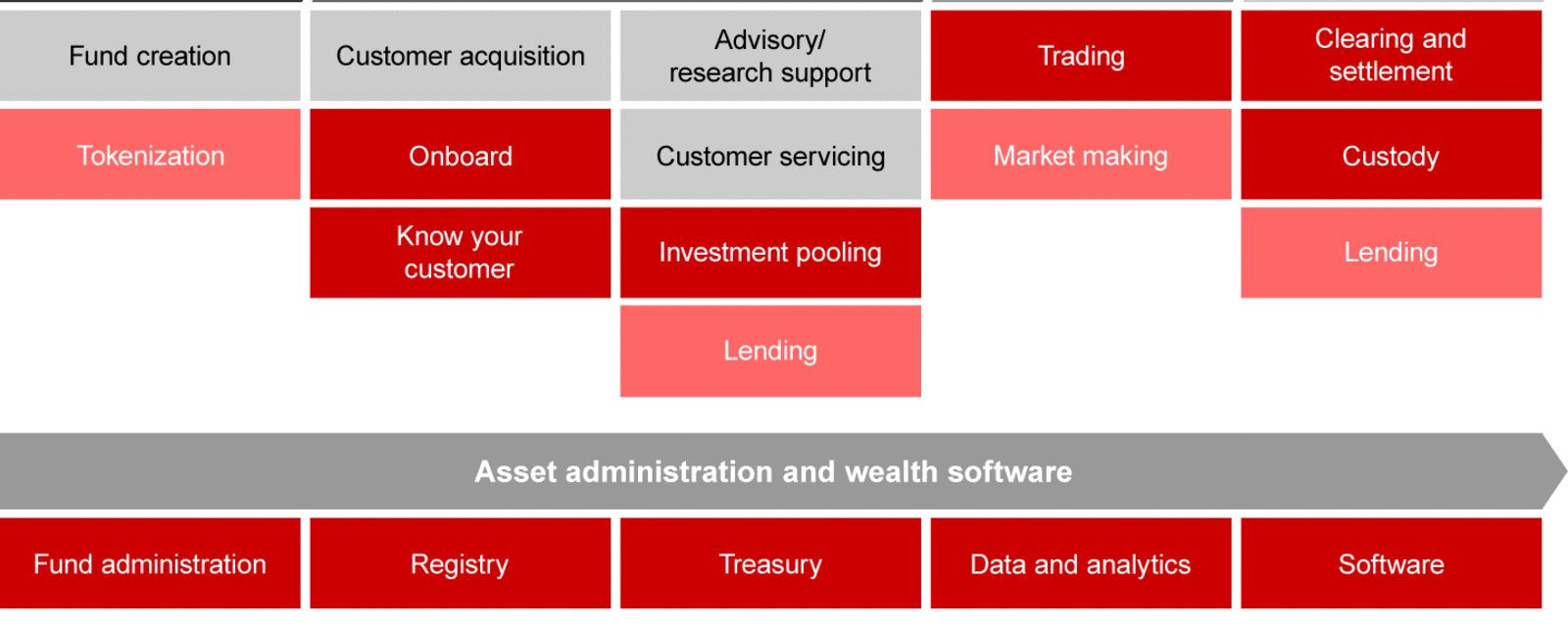
Bain identifies five emerging business archetypes as potential solutions to infrastructure gaps, though the analysis stops short of detailed specification. These models represent divergent approaches to digitization, standardization, and service delivery that could enable private assets to function more like public markets—with transparent pricing, rapid settlement, and accessible entry points—while preserving the return profile and risk management characteristics that institutional investors demand.
The concentration of assets under management among large wealth and asset managers positions these firms to drive infrastructure standards and capture first-mover advantages. Bain's framework suggests a bifurcated outcome: category leaders will shape ecosystem development and establish proprietary platforms, while smaller competitors can succeed as challengers through specialized offerings or by adopting emerging standards quickly. This dynamic mirrors historical financial market evolution, where foundational agreements and standardized rules—exemplified by the 1792 Buttonwood Agreement that established NYSE principles—enabled exponential growth in participation and capital flows.
The broader implication extends beyond private equity to encompassing infrastructure assets, private credit, and alternative investments broadly. As private markets approach $30 trillion in global assets under management, service complexity scales accordingly, making digital infrastructure investment not optional but existential for providers seeking to capture wealth management market share.
Go deeper than the headline
Research every firm in this story, track the ones that matter and get the daily briefing — free for 7 days.