
Key Takeaways
- • Between $8 trillion and $12 trillion in household wealth is available for private alternative asset allocation, but current market infrastructure cannot efficiently serve individual investors at scale, creating a structural bottleneck for asset managers and private equity firms seeking retail expansion.
- • The private assets market is heavily concentrated among institutional investors (pension funds, endowments) rather than individuals, who hold approximately half of global wealth (~$150 trillion) but control only ~16% of private assets—representing a significant addressable market opportunity.
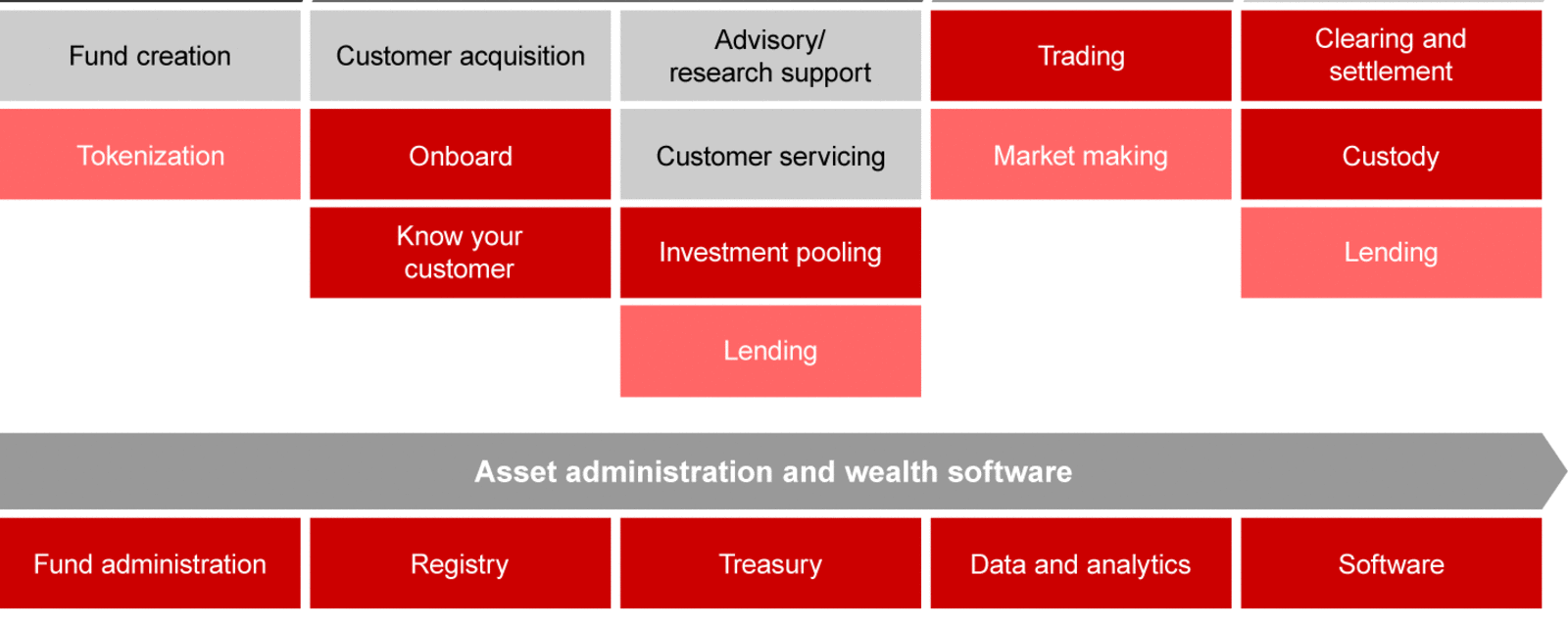
- • Five distinct business archetypes are emerging to address existing barriers: high administrative costs, illiquidity, complex collateral processes for lending, and elevated minimum investment thresholds that exclude retail capital.
- • Robust digital infrastructure modeled on historical financial market precedents (drawing parallel to the 1792 Buttonwood Agreement's establishment of trust and operational standards) is essential to facilitate efficient transaction flows and regulatory compliance at scale.
- • Largest wealth and asset managers are positioned to catalyze infrastructure development and capture first-mover advantages, while competitors can gain traction as challengers or fast followers once foundational systems mature.
Summary
The private alternative assets market faces a critical inflection point as demand from individual investors vastly outpaces the institutional infrastructure designed to serve them. According to Bain & Company analysis, wealthy households represent between $8 trillion and $12 trillion in available capital for private asset deployment, yet existing market mechanics remain fundamentally constrained by a bespoke, analog-era operating model that cannot scale efficiently.
The disparity between wealth concentration and private asset accessibility is stark. Individuals hold approximately half of global wealth ($150 trillion), yet control only 16% of private assets under management. Private equity firms, asset managers, and wealth managers recognize this gap as a critical growth opportunity, but current administrative structures impose prohibitive costs, enforce high minimum investment sizes, and create extended illiquidity windows that deter retail participation.
The Bain analysis frames the required solution through historical precedent, drawing parallels to the 1792 Buttonwood Agreement—the foundational document establishing the New York Stock Exchange. Similar to how formal rules and ecosystem participation restored market trust and enabled systematic trading, private assets require a robust digital infrastructure that standardizes payment mechanisms, establishes clear participant roles, and aligns regulatory oversight. This structural foundation must enable wealth managers, private equity providers, institutional investors, and custodians to interact seamlessly at scale.
Five emerging business archetypes are competing to address these infrastructure gaps by reducing administrative friction, enabling fractional ownership, simplifying collateral management for credit facilities, and lowering investment minimums. The largest global wealth and asset managers are well-positioned to lead this transition and capture early competitive advantages. Smaller firms capable of rapid adaptation can achieve success as challengers or fast followers, but the fundamental transformation from bespoke models to standardized digital platforms is now essential to capturing the $8-12 trillion retail opportunity in private alternatives.
The disparity between wealth concentration and private asset accessibility is stark. Individuals hold approximately half of global wealth ($150 trillion), yet control only 16% of private assets under management. Private equity firms, asset managers, and wealth managers recognize this gap as a critical growth opportunity, but current administrative structures impose prohibitive costs, enforce high minimum investment sizes, and create extended illiquidity windows that deter retail participation.
The Bain analysis frames the required solution through historical precedent, drawing parallels to the 1792 Buttonwood Agreement—the foundational document establishing the New York Stock Exchange. Similar to how formal rules and ecosystem participation restored market trust and enabled systematic trading, private assets require a robust digital infrastructure that standardizes payment mechanisms, establishes clear participant roles, and aligns regulatory oversight. This structural foundation must enable wealth managers, private equity providers, institutional investors, and custodians to interact seamlessly at scale.
Five emerging business archetypes are competing to address these infrastructure gaps by reducing administrative friction, enabling fractional ownership, simplifying collateral management for credit facilities, and lowering investment minimums. The largest global wealth and asset managers are well-positioned to lead this transition and capture early competitive advantages. Smaller firms capable of rapid adaptation can achieve success as challengers or fast followers, but the fundamental transformation from bespoke models to standardized digital platforms is now essential to capturing the $8-12 trillion retail opportunity in private alternatives.
Go deeper than the headline
Research every firm in this story, track the ones that matter and get the daily briefing — free for 7 days.