
Key Takeaways
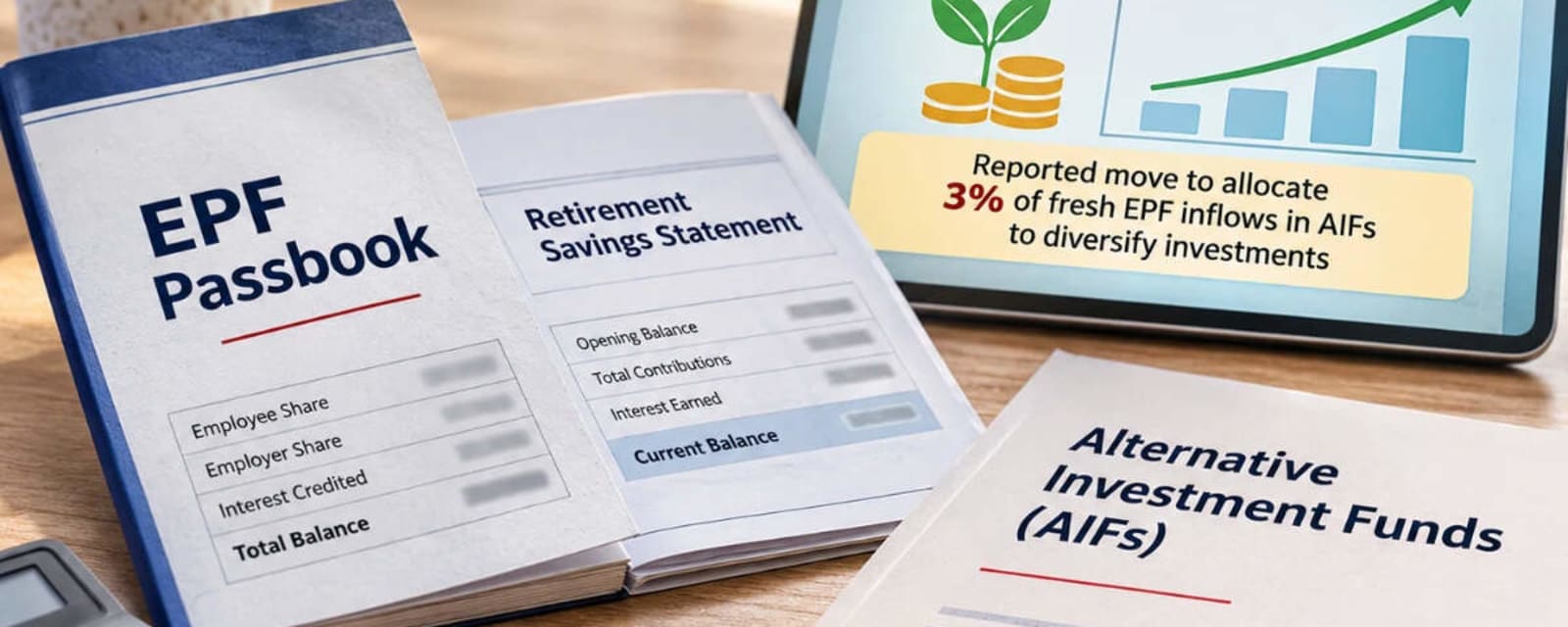
- • The EPFO Central Board of Trustees gave in-principle approval on November 19, 2026, to invest up to 3% of fresh accretion in eligible Alternative Investment Funds (AIFs).
- • The allocation applies only to new contributions, not to EPFO's entire accumulated corpus, and sits within the existing overall investment ceiling.
- • Initial investments will be routed through government-backed entities, with prescribed safeguards and oversight, according to the Ministry of Labour and Employment.
- • The approval does not shift existing PF balances into AIFs or change individual subscriber investment choices, and actual deployment depends on a yet-to-be-finalized implementation framework.
Summary
The Employees' Provident Fund Organisation (EPFO) is moving to diversify its retirement fund portfolio into alternative assets. At its meeting on November 19, 2026, the Central Board of Trustees (CBT) gave in-principle approval for EPFO to invest up to 3% of fresh accretion in eligible Alternative Investment Funds (AIFs). According to the Ministry of Labour and Employment, the allocation will sit within EPFO's existing overall investment ceiling and will initially be routed through government-backed entities, a structure intended to preserve safeguards and oversight.
AIFs are privately pooled investment vehicles that invest in assets such as start-ups, private companies, and infrastructure, offering exposure beyond conventional stocks and bonds. Shrikant Goyal, Managing Director of Getfive Funds, described the decision as a measured and welcome step that diversifies EPFO's portfolio without compromising prudence. He noted that long-term capital pools such as endowment funds have similarly expanded into private equity, venture capital and other alternatives, and that the move signals growing institutional confidence in AIFs as an asset class.
For PF subscribers, the key distinction is scope. The 3% allocation applies to fresh accretion, not to EPFO's entire accumulated corpus, and the decision does not mean existing PF balances will be directly moved into AIFs or that individual investment choices will change. The publisher's coverage notes that AIF investments, unlike government securities, may not offer assured returns or easy access to liquidity, and that valuations can be volatile; any potential return benefit is not guaranteed.
Because the decision is in-principle, actual investments will depend on the implementation framework and the safeguards prescribed for eligible funds. Earlier reporting on the proposal, including coverage of an investment committee discussion in October 2026, described the plan as covering SEBI-regulated Category I and Category II AIFs.
Go deeper than the headline
Research every firm in this story, track the ones that matter and get the daily briefing — free for 7 days.