
Key Takeaways
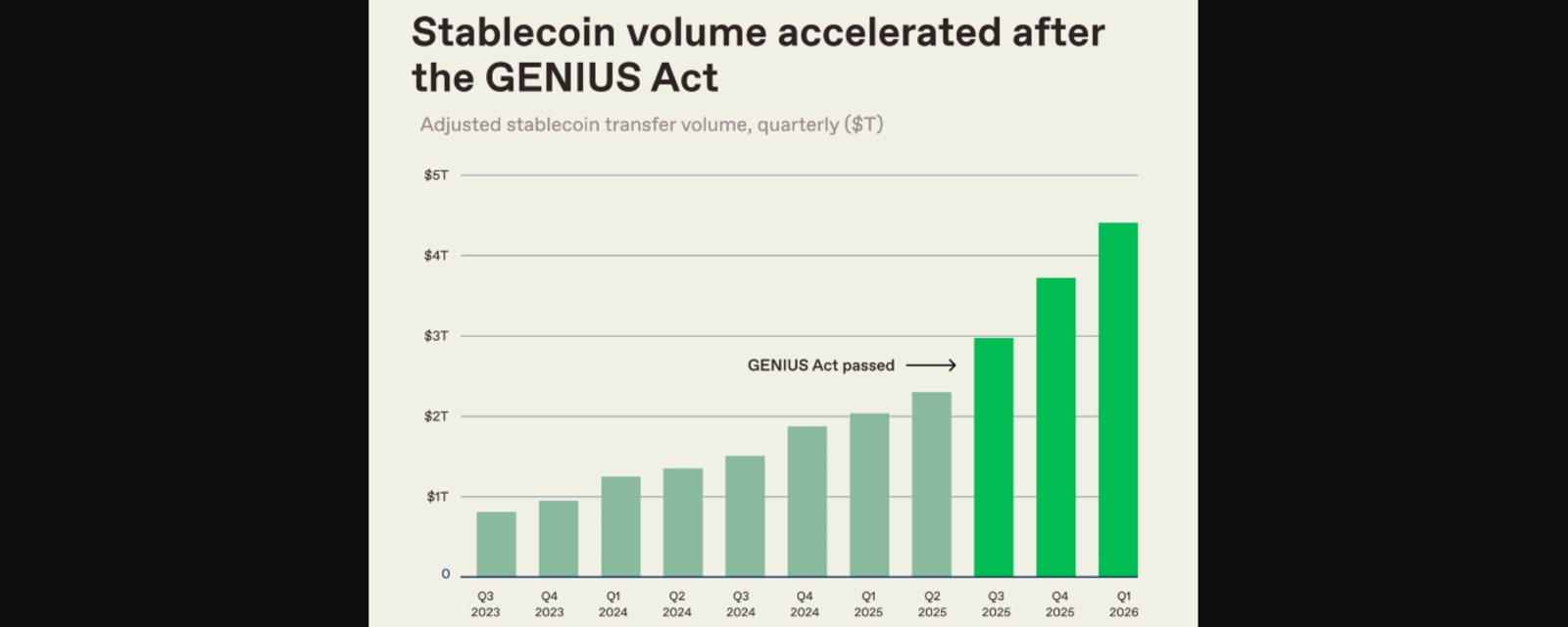
- • Stablecoin transaction volume reached $4.5 trillion in Q1 2026, with regulatory clarity from the U.S. GENIUS Act accelerating institutional and commercial adoption beyond cryptocurrency trading use cases.
- • Consumer-to-business (C2B) stablecoin transactions surged 128% year-over-year to 284.6 million in 2025, signaling a structural shift toward payments infrastructure with monthly collateral deposits for stablecoin card programs exceeding $300 million by early 2026.
- • Stablecoin velocity increased from 2.6x in early 2024 to 6x currently, demonstrating a transition from asset-holding behavior to frequent transactional use across global markets.
- • Strategic focus is shifting from cross-border payments to local payment infrastructure, with Asia leading payment flows followed by North America, and emerging adoption particularly evident in Brazil and other regional markets.
- • Total stablecoin market capitalization reached $315 billion, with Tether representing approximately two-thirds of the market, while regulatory frameworks like Europe's MiCA created persistent demand for non-USD stablecoins.
Summary
The stablecoin market has undergone a fundamental transformation from speculative trading instruments to core financial infrastructure, according to research from a16z crypto. Q1 2026 stablecoin transaction volumes reached $4.5 trillion, reflecting accelerated adoption driven largely by regulatory clarity. The passage of the U.S. GENIUS Act, which established the first federal framework for stablecoin issuance, amplified growth that had already been building. While adjusted volumes were rising for several quarters prior to the legislation, the regulatory framework catalyzed institutional participation and transaction velocity expansion.
The most significant behavioral shift appears in real-world payment adoption. Consumer-to-business transactions grew 128% year-over-year to 284.6 million in 2025, compared to 124.9 million in 2024, substantially outpacing consumer-to-consumer transaction growth of 789.5 million. Stablecoin card infrastructure expansion demonstrates this trend concretely: monthly collateral deposits across Rain-powered stablecoin card programs—including platforms such as Etherfi Cash, Kast, and Wallbit—grew from near zero in November 2024 to over $300 million by early 2026. Stablecoin velocity surged from 2.6x at the start of 2024 to 6x currently, indicating a decisive shift from holding behavior to frequent transactional deployment.
Geographic distribution reveals Asia as the largest stablecoin payment flow region, followed by North America, with emerging strength in markets like Brazil. a16z's research indicates the strategic focus of stablecoin applications is shifting from cross-border payment corridors toward local payment infrastructure deployment. This localization represents a maturation of the asset class from international arbitrage to domestic financial system integration.
Regulatory frameworks have shaped market composition. While the U.S. GENIUS Act accelerated volumes, Europe's Markets in Crypto-Assets (MiCA) framework, which took full effect in late 2024, produced market restructuring: several major exchanges delisted USDT for compliance, generating a temporary spike in non-USD stablecoin activity exceeding $40 billion. Monthly volumes subsequently stabilized at $15–25 billion, establishing a persistent market for non-USD stablecoins that barely existed before regulation. The total stablecoin market capitalization stands at $315 billion, with Tether commanding approximately two-thirds of the market, underscoring significant concentration despite growing diversification and localization trends.
Go deeper than the headline
Research every firm in this story, track the ones that matter and get the daily briefing — free for 7 days.