
Key Takeaways
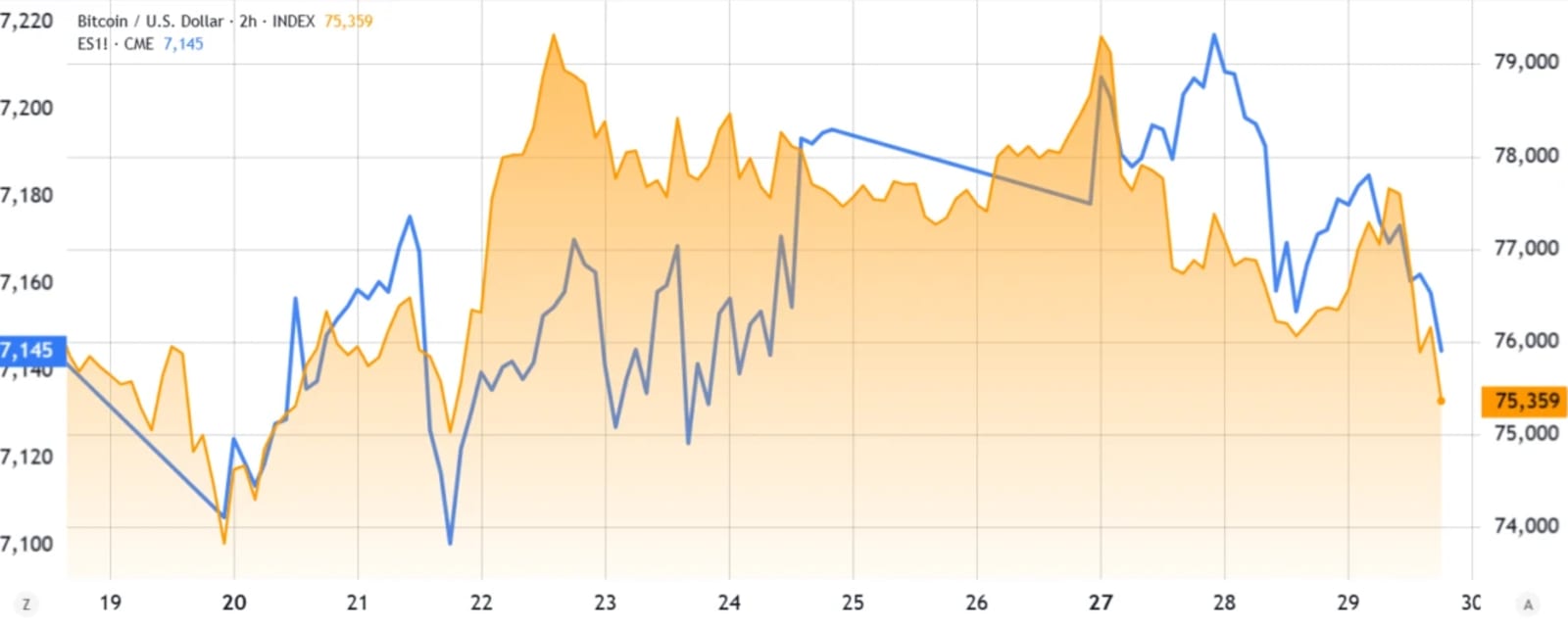
- • Bitcoin rejected resistance at $77,800 and retested $76,000 on April 30, 2026, mirroring weakness in the S&P 500 Index near the 7,200 level amid geopolitical tensions and energy price pressures.
- • Bitcoin perpetual futures funding rates turned negative, signaling increased demand for leveraged short positions and a shift toward sellers, though rates have remained mostly negative over the past two weeks.
- • Whale positioning on major exchanges shows long-to-short ratios near neutral levels (Binance at 0.80 on April 30), indicating professional traders are not aggressively committing to either direction despite negative funding signals.
- • Inflationary concerns driven by crude oil prices near $118 and geopolitical escalation in Iran—at the 60-day mark of conflict—are depressing both cryptocurrency and equity market sentiment by reducing consumer spending and corporate earnings.
- • Technology sector profitability concerns, particularly around AI investment returns, are weighing on Bitcoin trader confidence alongside macro uncertainty.
Summary
Bitcoin faced significant technical headwinds on April 30, 2026, as the cryptocurrency rejected resistance at $77,800 and retested the $76,000 support level. This weakness occurred amid a broader market correction in equities, with the S&P 500 Index struggling near 7,200. The selloff was catalyzed by escalating geopolitical tensions as the Iran conflict reached its 60-day mark, driving crude oil prices toward $118 per barrel—a level that carries inflationary implications across logistics and energy costs.
The divergence between on-chain sentiment indicators and whale positioning reveals a complex market backdrop. Bitcoin perpetual futures funding rates turned negative on April 30, following a brief neutral-to-bullish period the prior day. Negative funding rates typically indicate increased demand for leveraged short positions, as sellers outweigh buyers in the derivatives market. Over the preceding two weeks, these rates remained predominantly negative, suggesting sustained bearish positioning among leveraged traders. In healthy market conditions, funding rates typically range between 6% and 12% annually to cover capital costs, with buyers paying fees to maintain long exposure.
However, whale positioning data provides a more nuanced picture. The long-to-short ratio for professional traders on Binance stood at 0.80 on April 30, showing only marginal improvement from the 0.75 level recorded on Tuesday. This near-parity positioning among institutional traders suggests caution rather than conviction in either direction, even as retail leveraged shorts accumulated. The disconnect between negative funding rates and steady whale positioning indicates that larger market participants are neither capitulating nor aggressively accumulating at current price levels.
Sentiment pressures stem from two primary macroeconomic concerns. First, elevated crude oil prices driven by geopolitical instability are expected to increase transportation and production costs, thereby dampening consumer spending and corporate profitability. Second, market participants are reassessing the return on investment for technology sector AI spending, raising questions about earnings sustainability for major technology companies. These factors, combined with Bitcoin's failure to sustain momentum above $78,000, reflect broader institutional risk-off positioning that extends across both equity and cryptocurrency markets.
The current environment suggests market participants are positioned defensively without establishing aggressive directional bets, as evidenced by the gap between negative funding signals and neutral whale ratios. This positioning implies potential for volatile price swings if either macroeconomic conditions deteriorate further or geopolitical tensions resolve unexpectedly.
Go deeper than the headline
Research every firm in this story, track the ones that matter and get the daily briefing — free for 7 days.