
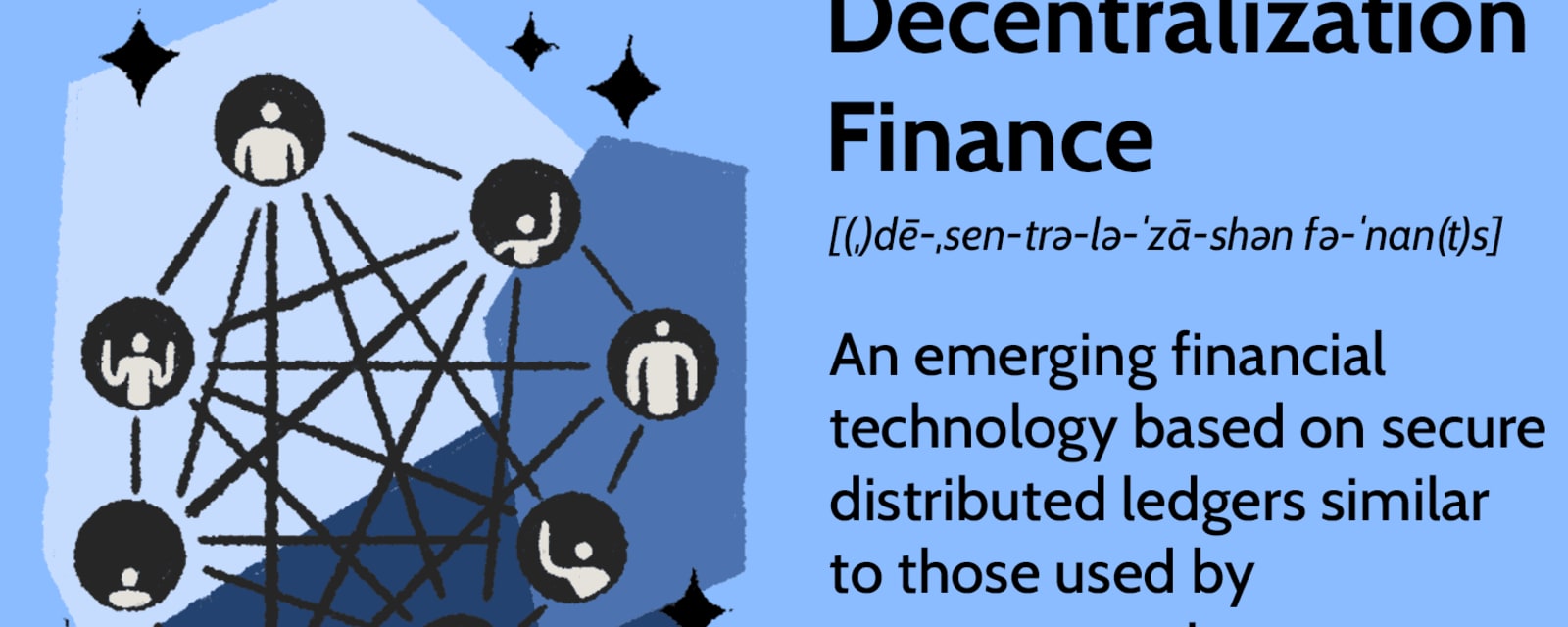
Key Takeaways
- • DeFi enables lending, borrowing, trading, and fund transfers via blockchain technology without intermediaries, processing over $50 billion in monthly transactions as of April 2026.
- • Decentralized exchanges (DEXs) facilitate peer-to-peer cryptocurrency trading without central authority, contrasting with traditional centralized exchange models.
- • DeFi operates on blockchain networks—primarily Ethereum—providing 24/7 global financial services with faster, cheaper, and more secure transactions than traditional financial intermediaries.
- • Key DeFi applications include yield generation, decentralized lending protocols, and tokenized financial products built on smart contracts rather than institutional infrastructure.
- • The sector presents both opportunity for financial inclusion and accessibility alongside material concerns regarding security, regulatory uncertainty, and systemic risks requiring institutional due diligence.
Summary
Decentralized Finance (DeFi) represents a fundamental shift in financial service delivery by leveraging blockchain technology to eliminate traditional intermediaries. According to Investopedia's comprehensive guide updated April 15, 2026, DeFi enables individuals and institutions to perform core financial functions—lending, borrowing, trading, and transferring value—directly through peer-to-peer mechanisms built on distributed ledger networks. The scale of this ecosystem has become material: DeFi platforms are processing over $50 billion in monthly transactions without the involvement of traditional banking infrastructure.
The operational architecture of DeFi centers on blockchain networks, with Ethereum serving as the primary deployment platform for decentralized financial products and services. Unlike centralized exchanges that require institutional custodians and market makers, DeFi's decentralized exchanges (DEXs) enable direct peer-to-peer trading of cryptocurrencies through smart contracts and automated market makers. This structural difference eliminates counterparty risk associated with institutional intermediaries while enabling 24/7 global market access—a material advantage over traditional markets with fixed trading hours and geographic limitations.
For institutional investors and alternative investment professionals, DeFi's value proposition centers on three core attributes: enhanced transaction speed and cost efficiency relative to traditional banking rails, potential yield generation through lending and liquidity provision mechanisms, and financial accessibility in markets where traditional banking infrastructure remains limited. However, Investopedia's analysis—reviewed by Amilcar Chavarria, who brings 10 years of FinTech and blockchain startup experience advising financial institutions and regulators—emphasizes that participation requires sophisticated risk management. The guide explicitly addresses concerns surrounding DeFi, including smart contract vulnerabilities, regulatory ambiguity, and the nascent security frameworks protecting institutional capital deployed in decentralized protocols.
The article positions DeFi within the broader "Primer on Investing in Transformative Technology" series, acknowledging its role alongside artificial intelligence, blockchain fundamentals, and digital payments as a technology reshaping financial infrastructure. For institutional allocators evaluating alternative investment exposure to blockchain-based financial systems, the April 2026 update provides current baseline understanding of DeFi mechanics, use cases, and the critical risk considerations necessary for informed capital deployment decisions.
Go deeper than the headline
Research every firm in this story, track the ones that matter and get the daily briefing — free for 7 days.