
Key Takeaways
- • Vanguard S&P 500 ETF (VOO) offers ultra-low-cost broad exposure to 500 large-cap U.S. companies with an expense ratio of just 0.03%, making it one of the cheapest vehicles for U.S. equity index investing.
- • VOO declined 3.54% year-to-date in Q1 2026 following a strong 2025 gain of 29%, with tech stocks now representing approximately 50% of the index composition, creating significant concentration risk.
- • Wall Street analysts project 9-12% potential gains with S&P 500 targets ranging from 7,500 to 7,900 in 2026, though the index is already approaching 7,000 levels as of late April 2026.
- • International ETFs significantly outperformed VOO in early 2026, prompting debate among investors about geographic diversification versus concentrated U.S. large-cap exposure.
- • The fund's structural advantages—diversification across sectors (tech, healthcare, energy, consumer goods), minimal fees, and long-term compounding potential—position it as a core holding for buy-and-hold investors with multi-year or multi-decade time horizons, despite near-term volatility concerns.
Summary
The Vanguard S&P 500 ETF (VOO) remains a foundational investment vehicle for institutional and individual investors seeking broad exposure to the U.S. large-cap equity market. The fund tracks the S&P 500 Index and maintains one of the industry's lowest expense ratios at 0.03%, offering efficient capital-weighted access to 500 of the largest and most economically durable U.S. companies across multiple sectors including technology, healthcare, energy, and consumer goods.
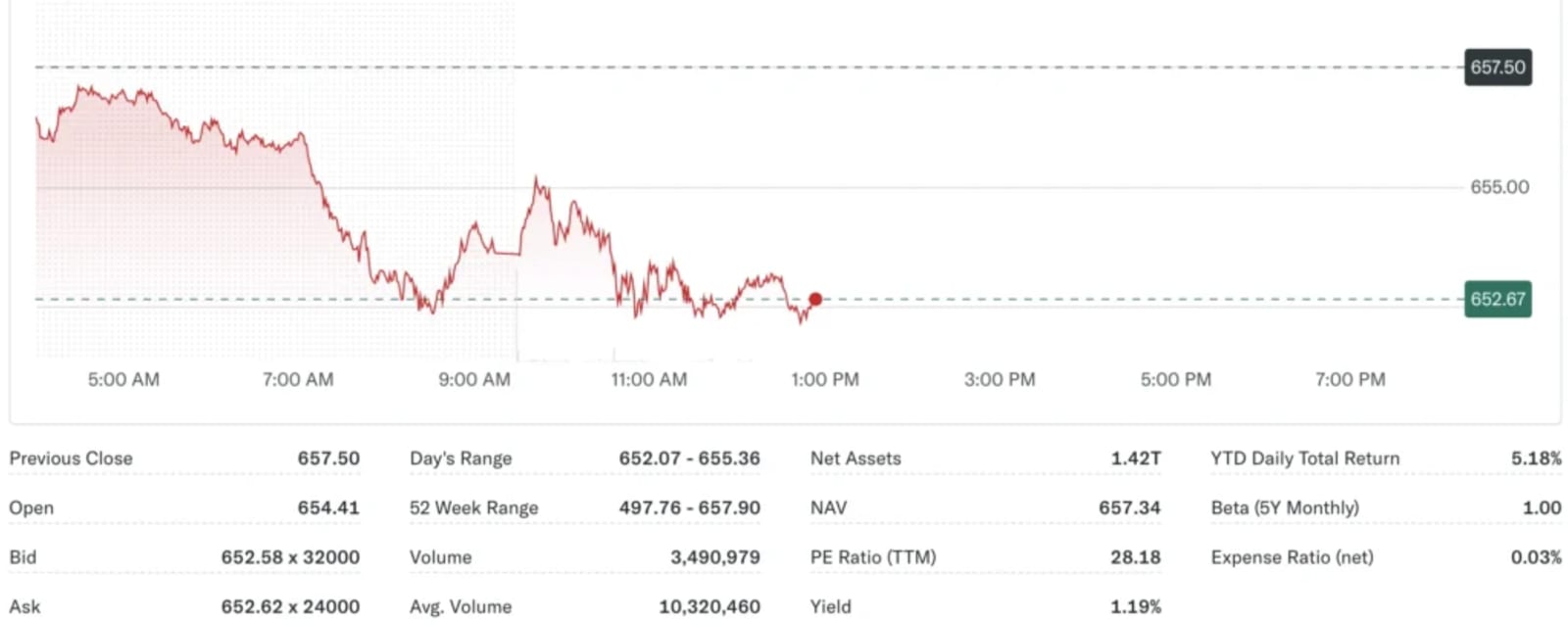
Performance dynamics have shifted considerably in 2026 relative to 2025's exceptional gains. After delivering 29% returns in 2025, VOO experienced a 3.54% year-to-date decline through Q1 2026, with pricing at $657.50 as of April 27, 2026. This pullback reflects broader market dynamics and has renewed debate among investors regarding optimal asset allocation, particularly as international equity ETFs have outperformed VOO during the same period. Current index composition presents both opportunity and risk: approximately 50% of VOO's holdings are now concentrated in technology stocks, effectively positioning the fund as partially correlated to artificial intelligence and mega-cap tech sector exposure rather than traditional broad market diversification.
Analyst outlooks for 2026 remain constructively biased, with Wall Street forecasts projecting 9-12% annualized gains and S&P 500 target levels between 7,500 and 7,900. However, these forecasts arrive at a time when the index is already approaching the 7,000 level, leaving limited upside buffer between current valuations and consensus targets. The fund's structural advantages center on its diversification benefits across economic cycles, minimal fee drag compared to actively managed alternatives, and the demonstrated wealth-creation potential of long-term buy-and-hold strategies. Historical analysis shows that consistent monthly contributions with disciplined rebalancing have produced multimillion-dollar portfolios over 20-30 year periods, despite periodic bear market drawdowns exceeding 30%.
VOO's viability as a 2026 investment depends critically on investor time horizon and opportunity cost. For investors with 5+ year investment horizons pursuing broad U.S. equity exposure, the fund's low cost structure and sectoral diversification remain compelling. Conversely, tactical investors or those concerned about near-term valuation expansion and international equity outperformance may evaluate alternatives such as broader total market exposure (via VTSAX) or geographic diversification strategies. The fund's recent underperformance against international peers suggests that 2026 market conditions may be favoring non-U.S. equity exposure, a material consideration for portfolio construction.
Go deeper than the headline
Research every firm in this story, track the ones that matter and get the daily briefing — free for 7 days.