
Key Takeaways
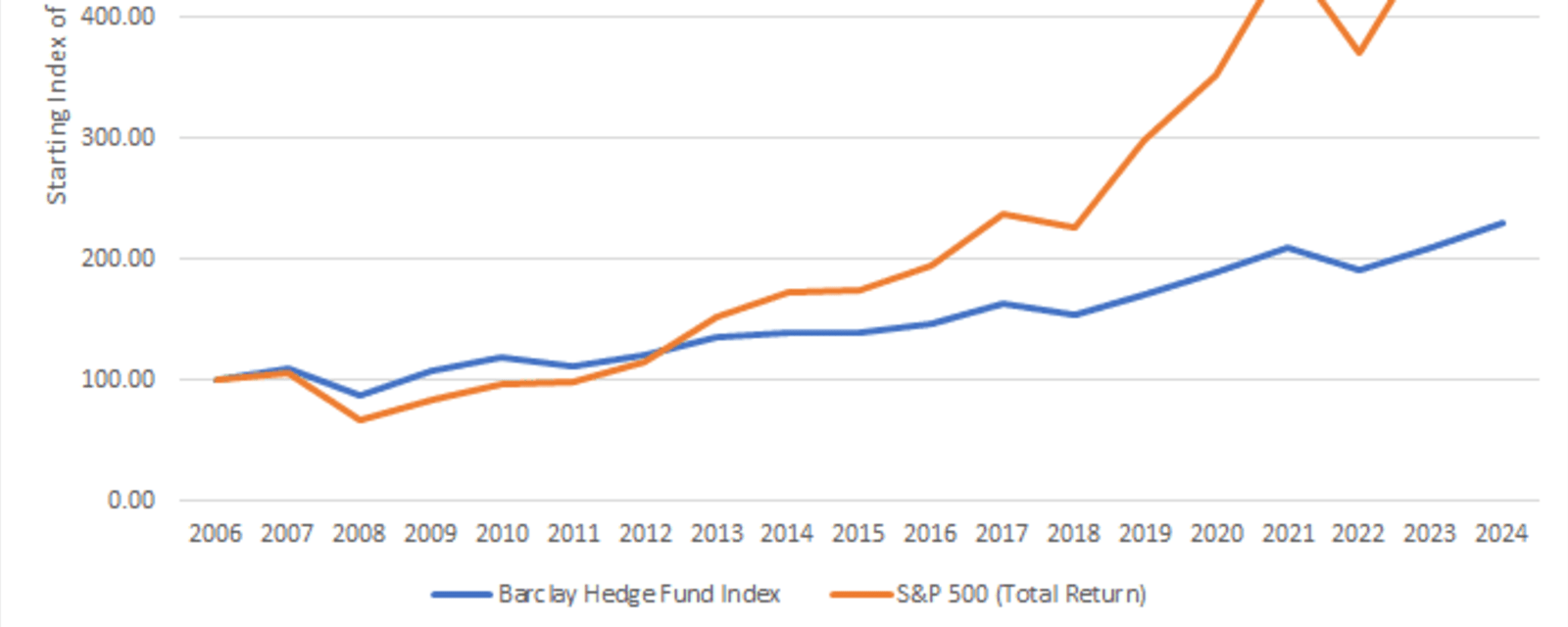
- • 401(k) plans have outperformed hedge funds over a five-year period ending December 2023, with average annual returns of 9.7% compared to 6.6% for the Barclay Hedge Fund Index, according to Vanguard data cited by Investopedia.
- • Hedge fund performance lagged significantly in 2024, with the Hedge Fund Index gaining 9.6% and Hedge Fund Research reporting an average of 8.3%, substantially below the S&P 500's 24.9% return for the year.
- • Fee structures heavily favor 401(k) investors: hedge funds charge high management and performance fees that capture nearly half of client profits, while 401(k)s offer low-cost, transparent fee structures tied to passive and active index funds.
- • 401(k) performance demonstrates the effectiveness of disciplined, long-term investing through market cycles, including recovery from the 2022 downturn, contradicting the perception that only sophisticated hedge fund strategies generate wealth.
Summary
The conventional wisdom that hedge funds outperform workplace retirement plans has been challenged by recent performance data. According to Investopedia's analysis, 401(k) accounts have consistently beaten an index of over 1,300 hedge funds, delivering returns that would surprise investors who assume sophisticated alternative strategies are necessary for competitive wealth building.
Over the five-year period ending December 2023, participants in 401(k) plans earned average annual returns of approximately 9.7%, according to Vanguard data. This performance is particularly significant given that the period included both favorable market conditions and the substantial 2022 downturn, demonstrating the resilience of diversified retirement portfolios. In contrast, the Barclay Hedge Fund Index returned only 6.6% over the same timeframe. The performance gap widened in 2024, when the Hedge Fund Index gained 9.6% and Hedge Fund Research calculated an even lower average of 8.3% for hedge funds broadly—a stark underperformance relative to the S&P 500's 24.9% gain.
The fee disparity between these investment vehicles plays a central role in the return differential. Hedge funds typically employ high management fees (commonly 1-2% of assets annually) combined with performance fees capturing 20% of profits, effectively allowing managers to pocket nearly half of client gains. 401(k) plans, by contrast, offer low-cost index and actively managed mutual funds with transparent, minimal fee structures. This structural cost advantage compounds significantly over time, particularly for investors in low-risk, diversified portfolios comprising stock and bond funds. The data suggests that for most investors, the disciplined, long-term approach inherent to 401(k) investing—particularly through market cycles—has delivered superior wealth accumulation compared to the complex strategies marketed by hedge fund managers.
Go deeper than the headline
Research every firm in this story, track the ones that matter and get the daily briefing — free for 7 days.