
Key Takeaways
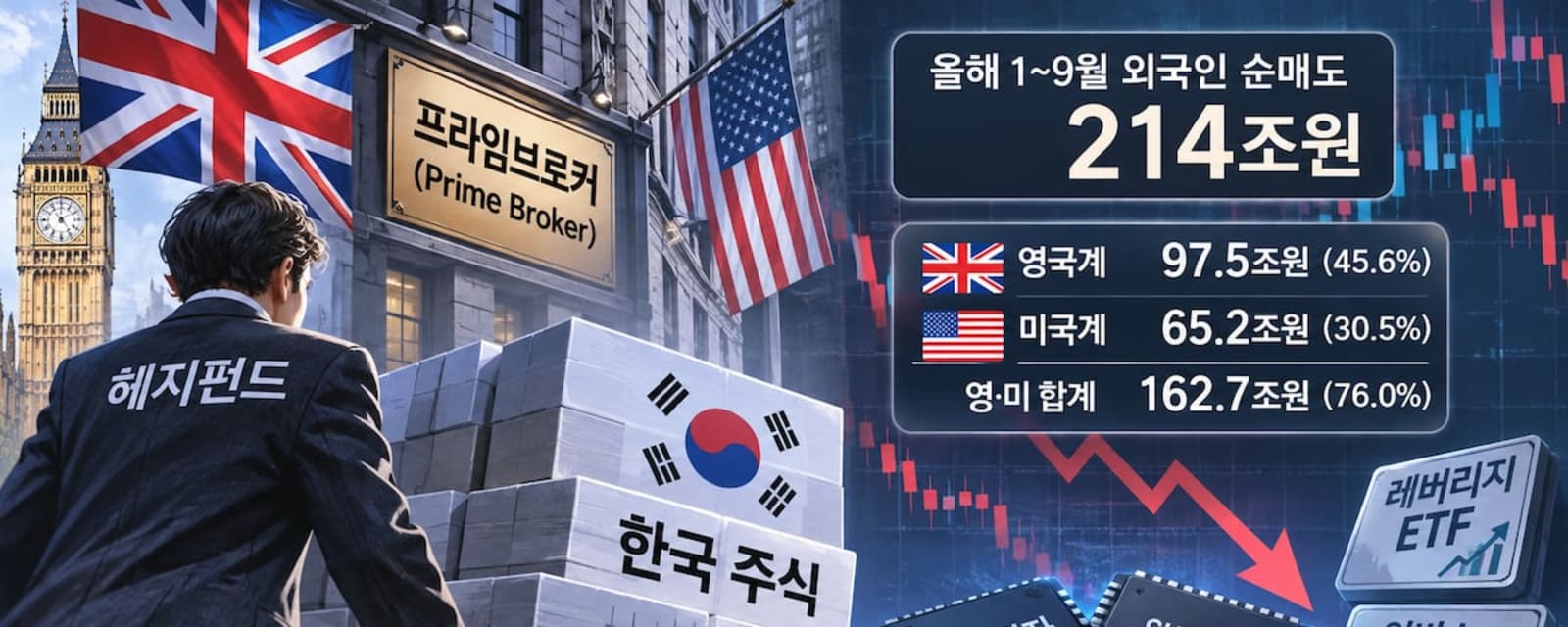
- • Foreign investors sold a net 213.999 trillion won in Korean-listed stocks from January through September, according to Financial Supervisory Service (FSS) data released on the 30th of the prior month.
- • British accounts accounted for 97.488 trillion won (45.6%) of net selling, and U.S. accounts for 65.177 trillion won (30.5%), together 76.0% of the total.
- • Daishin Securities found stocks outside the semiconductor sector accounted for just 1.3% of net selling across the 10 largest selling days from June 22 to Nov. 6, versus a 46% share of market capitalization.
- • Because FSS classifies flows by settlement account location, hedge fund trades routed through British prime brokerage are counted as British, and Daishin estimates about half of British-account holdings may be nonresident funds.
- • Analysts attribute the selling to hedge fund deleveraging, mechanical leveraged ETF rebalancing and profit-taking by global allocation funds, and say foreign inflows may not return until earnings improve and liquidity eases.
Summary
Foreign investors sold a net 213.999 trillion won in Korean-listed stocks from January through September, according to September data released by the Financial Supervisory Service (FSS). British accounts accounted for 97.488 trillion won, or 45.6% of the total, while U.S. accounts accounted for 65.177 trillion won (30.5%). British accounts were net sellers every month from February except May, selling 69.332 trillion won over June through August, and continued selling in August even as foreign investors overall turned net buyers. U.S. accounts sold more than 52 trillion won in May and June but bought a net 16.9 trillion won in July and August.
Market analysts attribute much of the British-account selling to hedge funds reducing leveraged positions, which increased volatility and prompted long-term investors to cut holdings. Lee Hyo-seop, head of the financial industry department at the Korea Capital Market Institute, said British accounts have a larger hedge fund presence than U.S. accounts, though European pension money invested through Britain likely means a mix of long-only and hedge fund capital. A deputy minister characterized U.S. accounts as dominated by large long-only funds such as BlackRock. The U.S. share of foreign holdings rose from 41.2% at end-2025 to 43.9% at end-September, while the British share fell from 10.9% to 7.5%.
The FSS classifies flows by the location of settlement accounts rather than investor nationality. Daishin Securities compared IMF data with FSS figures and found British-resident holdings of about 76.4 trillion won at end-last year, just 0.53 times the 144.1 trillion won recorded in British accounts, suggesting roughly half may be nonresident funds. Daishin also calculated that fund flows relative to holdings were 3.8 times greater for British accounts than for U.S. accounts. Kwon Soon-ho, a Daishin analyst, said accounts with large flows relative to holdings likely hold a greater share of short-term trading money.
Selling was heavily concentrated in semiconductors. Daishin found non-semiconductor stocks accounted for just 1.3% of net selling across the 10 largest selling days from June 22 to Nov. 6, against a 46% share of market capitalization. Kwon said hedge funds' Korean positions were concentrated in major chip stocks, and that derivative-based positions such as total return swaps must be mechanically reduced as volatility raises margin requirements. Net assets in leveraged and inverse Korean-stock ETFs grew from 9.95 trillion won at end-last year to 41.3 trillion won on June 22, and ETF rebalancing trades equaled 7.8% of KOSPI and KOSDAQ trading value in July.
Some argue much of the selling reflects profit-taking rather than bearish bets. After the sharp rise in the KOSPI and semiconductor stocks this year, global asset allocation funds found their Korean exposure well above target weights. Lee said long-term funds likely sold to rebalance, describing the activity as "more like profit-taking than betting on a short." Foreign investors may nonetheless take considerable time to return: the won has strengthened from the 1,500-won range to about 1,330 per dollar, reducing the exchange-rate advantage, while a sharp rise in U.S. Treasury yields is tightening global liquidity. Lee said foreign investors will return when earnings improve and liquidity eases, and noted that asset managers typically close their books in December, making large new inflows unlikely.
Market analysts attribute much of the British-account selling to hedge funds reducing leveraged positions, which increased volatility and prompted long-term investors to cut holdings. Lee Hyo-seop, head of the financial industry department at the Korea Capital Market Institute, said British accounts have a larger hedge fund presence than U.S. accounts, though European pension money invested through Britain likely means a mix of long-only and hedge fund capital. A deputy minister characterized U.S. accounts as dominated by large long-only funds such as BlackRock. The U.S. share of foreign holdings rose from 41.2% at end-2025 to 43.9% at end-September, while the British share fell from 10.9% to 7.5%.
The FSS classifies flows by the location of settlement accounts rather than investor nationality. Daishin Securities compared IMF data with FSS figures and found British-resident holdings of about 76.4 trillion won at end-last year, just 0.53 times the 144.1 trillion won recorded in British accounts, suggesting roughly half may be nonresident funds. Daishin also calculated that fund flows relative to holdings were 3.8 times greater for British accounts than for U.S. accounts. Kwon Soon-ho, a Daishin analyst, said accounts with large flows relative to holdings likely hold a greater share of short-term trading money.
Selling was heavily concentrated in semiconductors. Daishin found non-semiconductor stocks accounted for just 1.3% of net selling across the 10 largest selling days from June 22 to Nov. 6, against a 46% share of market capitalization. Kwon said hedge funds' Korean positions were concentrated in major chip stocks, and that derivative-based positions such as total return swaps must be mechanically reduced as volatility raises margin requirements. Net assets in leveraged and inverse Korean-stock ETFs grew from 9.95 trillion won at end-last year to 41.3 trillion won on June 22, and ETF rebalancing trades equaled 7.8% of KOSPI and KOSDAQ trading value in July.
Some argue much of the selling reflects profit-taking rather than bearish bets. After the sharp rise in the KOSPI and semiconductor stocks this year, global asset allocation funds found their Korean exposure well above target weights. Lee said long-term funds likely sold to rebalance, describing the activity as "more like profit-taking than betting on a short." Foreign investors may nonetheless take considerable time to return: the won has strengthened from the 1,500-won range to about 1,330 per dollar, reducing the exchange-rate advantage, while a sharp rise in U.S. Treasury yields is tightening global liquidity. Lee said foreign investors will return when earnings improve and liquidity eases, and noted that asset managers typically close their books in December, making large new inflows unlikely.
Go deeper than the headline
Research every firm in this story, track the ones that matter and get the daily briefing — free for 7 days.