
Key Takeaways
- • Warren Buffett attributes his wealth creation to three forces: living in America, "lucky genes," and the compounding of investment returns over decades—not exceptional genius alone.
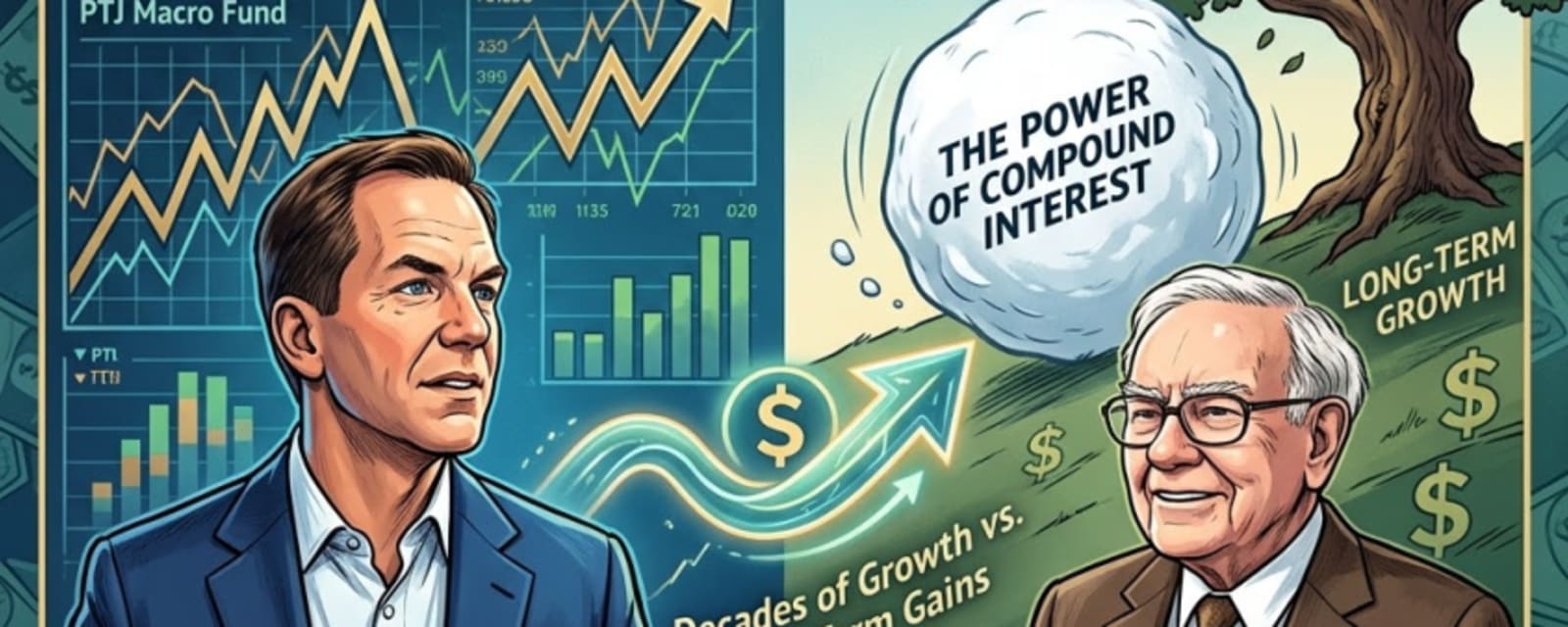
- • Paul Tudor Jones has compounded his fund's capital at approximately 20% annually since the early 1980s, exemplifying the practical application of compound interest principles in professional asset management.
- • Buffett describes compound interest as the "eighth wonder of the world," employing the metaphor of a snowball rolling downhill and accumulating mass to illustrate exponential wealth growth over time.
- • The power of compounding is maximized by starting investments early and allowing returns to reinvest uninterrupted for extended periods, enabling principal to grow at accelerating rates.
- • Compound interest works synergistically with Buffett's core investing philosophy of long-term capital preservation and reinvestment, making it the foundational mechanism of his wealth-building strategy at Berkshire Hathaway.
Summary
Warren Buffett, who officially transitioned from his chief executive role at Berkshire Hathaway on January 1, 2026, has consistently credited compound interest as a primary driver of his wealth accumulation rather than pure investment acumen. In explaining his financial success, Buffett points to three foundational forces: the opportunity of living in America with its functional capital markets, inherent personal advantages he describes as "lucky genes," and decades of uninterrupted compounding on invested capital. This framing reflects the Oracle of Omaha's characteristic humility and his emphasis on systemic advantage over individual brilliance.
Buffett's characterization of compound interest as the "eighth wonder of the world" draws from a famous attribution to Albert Einstein, though Buffett has made the concept central to his public philosophy. He explains compounding through an intuitive metaphor: a snowball rolling down a long hill, accumulating more snow with each rotation until it reaches massive proportions. This illustration captures the exponential nature of returns reinvested on themselves—a process the Consumer Financial Protection Bureau defines as earning interest on both saved capital and previously earned interest. The mathematical reality is that principal grows faster as compounding frequency increases, and growth accelerates dramatically when time horizons extend across decades.
The institutional parallels to Buffett's approach are evident in practitioners like Paul Tudor Jones, who has compounded his fund's capital at approximately 20% annually since the early 1980s. This sustained performance exemplifies how disciplined application of long-term compounding principles translates into substantial wealth creation within professional asset management frameworks. Buffett's strategy has always rewarded early entry into the compounding process; he began his investment activities as a young investor, allowing seven decades of reinvested returns to accumulate. The timing advantage of starting early is mathematically decisive—each additional year of compounding dramatically magnifies terminal wealth.
For institutional investors and family offices, Buffett's emphasis on compounding underscores a critical distinction: wealth creation at scale depends less on identifying exceptional annual returns than on maintaining consistent mid-to-high single-digit or low double-digit returns uninterrupted across multiple decades. This principle has structured Berkshire Hathaway's investment approach and serves as an instructive model for alternative investment professionals evaluating long-term portfolio construction and capital allocation discipline.
Go deeper than the headline
Research every firm in this story, track the ones that matter and get the daily briefing — free for 7 days.