
Key Takeaways
- • Broadly syndicated loan (BSL) lenders financed $24.25 billion of new-issue LBO debt in the three months ended Oct. 31, versus $9.34 billion for direct lenders, the lowest direct-lending three-month total since 2020, according to PitchBook/LCD data.
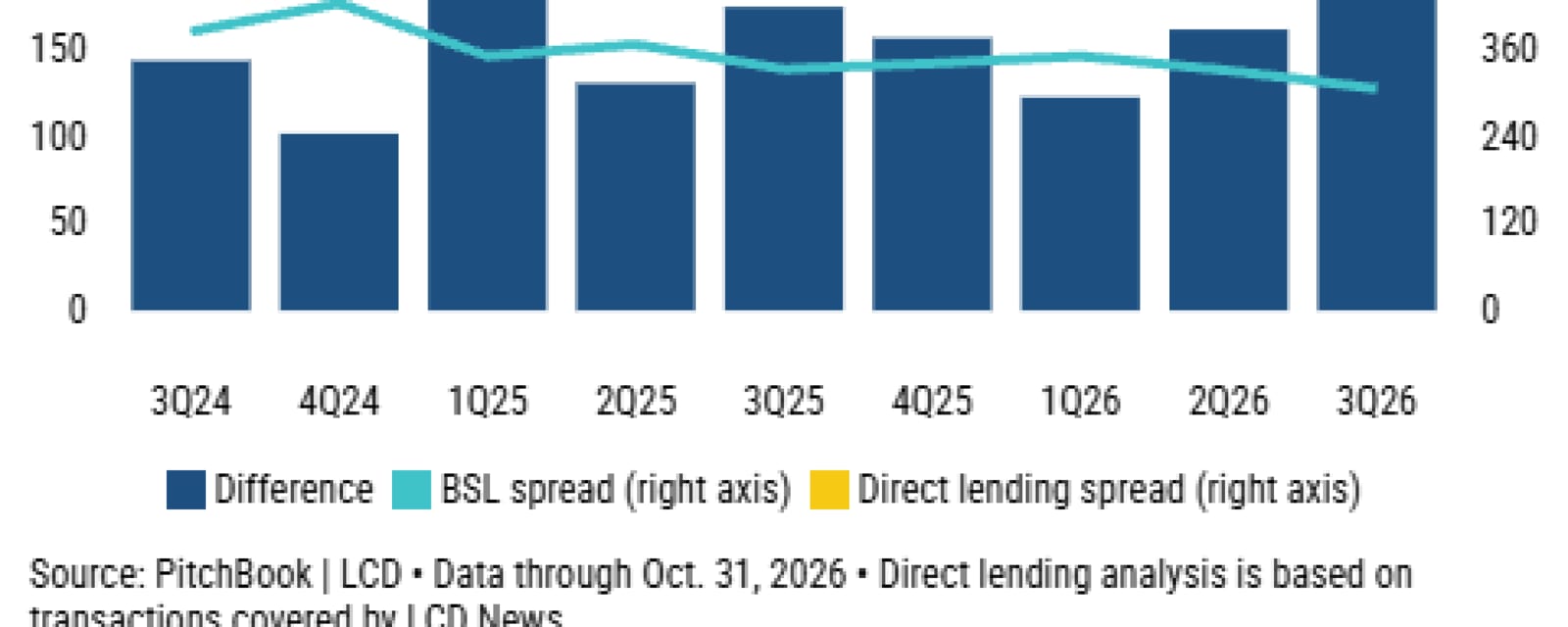
- • The average direct lending spread on new-issue LBOs widened to 520 bps in Q3 from 494 bps in Q2, while BSL spreads on new LBOs tightened to 307 bps from 332 bps, the lowest level since 2007.
- • BSL lenders poached a record $12 billion of existing direct lending deals in Q3, including a $4.1 billion Catalent refinancing that cut pricing from S+500 to S+300.
- • More than two-thirds of private credit LBOs in Q3 priced at or above 500 bps, versus a low-water mark of S+450 in Q1, underscoring the widening pricing gap between the two markets.
- • Direct lenders still lead by deal count, though that lead has narrowed since the start of the year.
Summary
The gap between direct lending and broadly syndicated loan spreads has reached its widest point since 2023, and banks now hold a clear lead by volume in winning new-issue leveraged buyout financings, according to PitchBook. Direct lending spreads have widened since the start of the year, following a wave of software sector pessimism and redemption pressures that led lenders to make fewer new investments. Per LCD data cited in the report, the average direct lending spread on new-issue LBOs rose to 520 bps in Q3 from 494 bps in Q2.
Strong demand from BSL investors for LBO paper has pushed spreads lower. The average credit quality of borrowers has also improved, with issuers generally carrying less debt and healthier interest coverage. BSL spreads on new LBOs fell to 307 bps in Q3 from 332 bps in Q2, meaning broadly syndicated lenders are being paid less for risk on LBO loans than at any point since 2007. Goldman Sachs Asset Management's Vivek Bantwal, global co-head of private credit, said at an October conference that there had been a lot of activity in the public market, citing recent LBOs where first-lien term loans launched at S+300 or S+325 and cleared at S+250. LCD Research data show 41% of LBO-related term loans tightened pricing during syndication in Q3. In January, a $7.25 billion term loan for Hologic priced at S+225, the tightest spread for a B+/B1 buyout borrower since the global financial crisis.
In private credit, more than two-thirds of Q3 LBOs featured spreads at or above 500 bps, according to LCD. Borrowers were able to secure spreads as low as S+450 in Q1, the low-water mark for the period. Market participants say that deals in more desirable sectors or with stronger credit stories still draw healthy competition among private credit lenders, and some A+ credits have achieved pricing of S+475 even as average spreads have widened.
Reflecting this pricing gap, BSL lenders financed $24.25 billion of new-issue LBO debt in the three months ended Oct. 31, while direct lenders financed $9.34 billion, the lowest three-month total since 2020. Direct lenders continue to lead by number of deals, though that gap has narrowed. The BSL market is also refinancing existing private credit debt, with lenders poaching a record $12 billion of direct lending deals in Q3. One example was the $4.1 billion refinancing for contract development and manufacturing organization Catalent, completed in August, in which the dollar portion of the cross-border term loan, led by JPMorgan, priced at S+300, replacing a private credit loan priced at S+500. LCD's US Private Credit Monitor provides further detail on competition between the two markets.
Strong demand from BSL investors for LBO paper has pushed spreads lower. The average credit quality of borrowers has also improved, with issuers generally carrying less debt and healthier interest coverage. BSL spreads on new LBOs fell to 307 bps in Q3 from 332 bps in Q2, meaning broadly syndicated lenders are being paid less for risk on LBO loans than at any point since 2007. Goldman Sachs Asset Management's Vivek Bantwal, global co-head of private credit, said at an October conference that there had been a lot of activity in the public market, citing recent LBOs where first-lien term loans launched at S+300 or S+325 and cleared at S+250. LCD Research data show 41% of LBO-related term loans tightened pricing during syndication in Q3. In January, a $7.25 billion term loan for Hologic priced at S+225, the tightest spread for a B+/B1 buyout borrower since the global financial crisis.
In private credit, more than two-thirds of Q3 LBOs featured spreads at or above 500 bps, according to LCD. Borrowers were able to secure spreads as low as S+450 in Q1, the low-water mark for the period. Market participants say that deals in more desirable sectors or with stronger credit stories still draw healthy competition among private credit lenders, and some A+ credits have achieved pricing of S+475 even as average spreads have widened.
Reflecting this pricing gap, BSL lenders financed $24.25 billion of new-issue LBO debt in the three months ended Oct. 31, while direct lenders financed $9.34 billion, the lowest three-month total since 2020. Direct lenders continue to lead by number of deals, though that gap has narrowed. The BSL market is also refinancing existing private credit debt, with lenders poaching a record $12 billion of direct lending deals in Q3. One example was the $4.1 billion refinancing for contract development and manufacturing organization Catalent, completed in August, in which the dollar portion of the cross-border term loan, led by JPMorgan, priced at S+300, replacing a private credit loan priced at S+500. LCD's US Private Credit Monitor provides further detail on competition between the two markets.
Go deeper than the headline
Research every firm in this story, track the ones that matter and get the daily briefing — free for 7 days.