
Key Takeaways
- • Private equity firms face intensifying pressure from regulators, consumers, B2B customers, and investors to decarbonize portfolios, with 2022 marking a significant escalation in accountability demands.
- • The energy transition represents a generational capital deployment opportunity requiring trillions in new investment across technology, products, and services to support the global shift away from carbon-based fuels.
- • Successful PE fund managers are adopting a dual-imperative strategy combining defensive portfolio management (decarbonization/risk mitigation) with offensive positioning (capitalizing on transition-driven growth opportunities).
- • The energy transition sprawls across every sector of the global economy, presenting both technological and industrial challenges that require sector-agnostic investment frameworks rather than siloed approaches.
- • PE firms that move decisively despite regulatory ambiguity, uneven policy implementation, and regional political variation are positioning themselves ahead of competitors in capturing transition-driven value creation.
Summary
The energy transition has emerged as a defining investment landscape for private equity, combining material portfolio management imperatives with substantial capital deployment opportunities. According to Bain & Company's 2023 Global Private Equity Report, the pressure on PE firms to decarbonize their holdings intensified significantly in 2022, driven by coordinated escalation from multiple stakeholder groups: regulators implementing stricter environmental standards, consumers exercising purchasing preferences for sustainable businesses, B2B customers demanding supply chain decarbonization, and institutional investors incorporating ESG metrics into capital allocation decisions.
Rather than viewing decarbonization purely as a compliance burden, leading PE firms recognize the energy transition as a dual-mandate framework. General partners managing through this transition must simultaneously execute defensive strategies—reducing carbon exposure and managing climate-related portfolio risks—while positioning for offense through aggressive capital deployment into low-carbon solution providers. This approach acknowledges that transition risks and opportunities are not static; they shift dynamically across portfolio companies and sectors.
The capital requirements underpinning the energy transition are staggering. Companies developing and deploying alternative energy sources and low-carbon solutions across the global economy will require trillions in new capital as societies work to mitigate climate change. This represents a historic opportunity for private equity's core competency: supplying growth capital and operational expertise to accelerate scaling of transformative businesses. However, capitalizing on these opportunities requires fund managers to navigate significant ambiguity around regulatory frameworks, the pace of technological adoption, regional political variation, and macroeconomic headwinds.
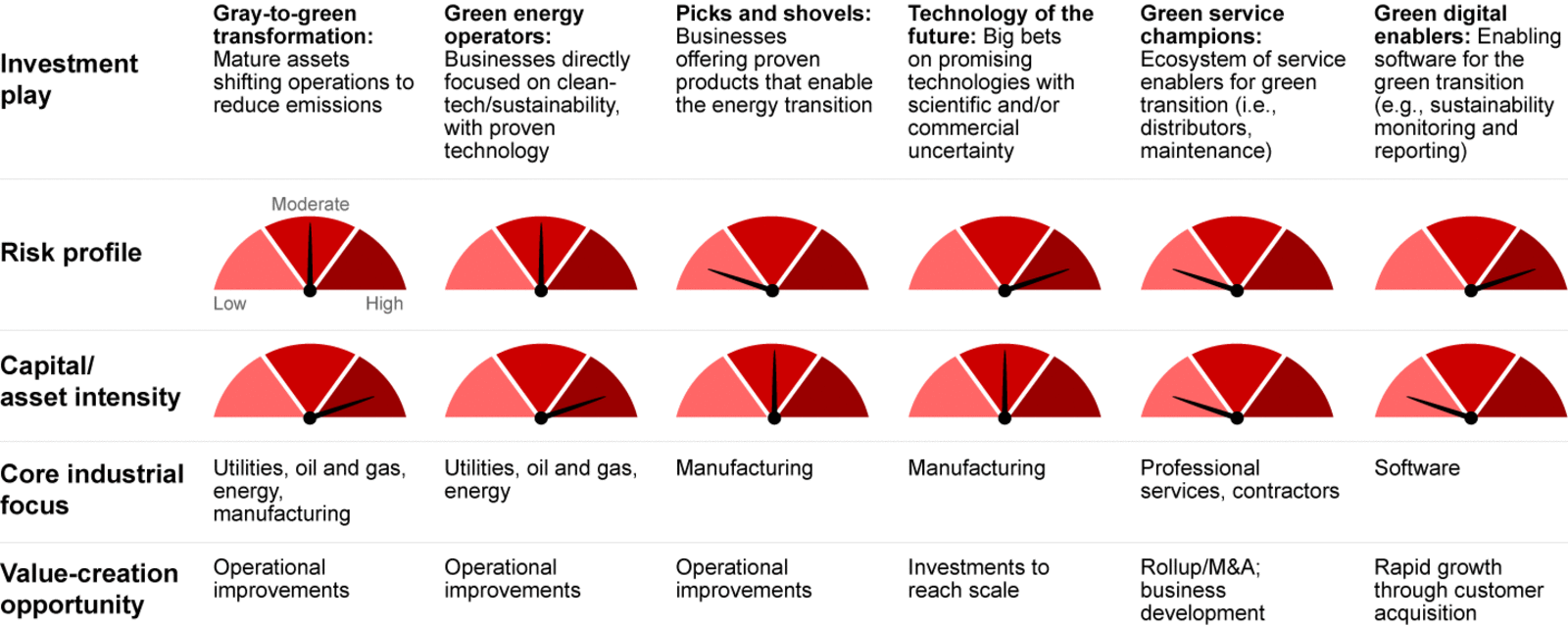
Critically, the energy transition does not fit neatly into traditional sector silos. It spans every industry vertically and presents challenges that are simultaneously industrial and technological in nature. Funds that develop sophisticated, cross-sector frameworks for identifying transition winners—rather than betting on isolated subsectors—are better positioned to capture alpha while managing portfolio-level climate transition risk. For PE investors, the strategic imperative is clear: inaction amid uncertainty is a strategic liability, while disciplined action across both defensive and offensive positioning is emerging as the competitive differentiator.
Go deeper than the headline
Research every firm in this story, track the ones that matter and get the daily briefing — free for 7 days.