
Key Takeaways
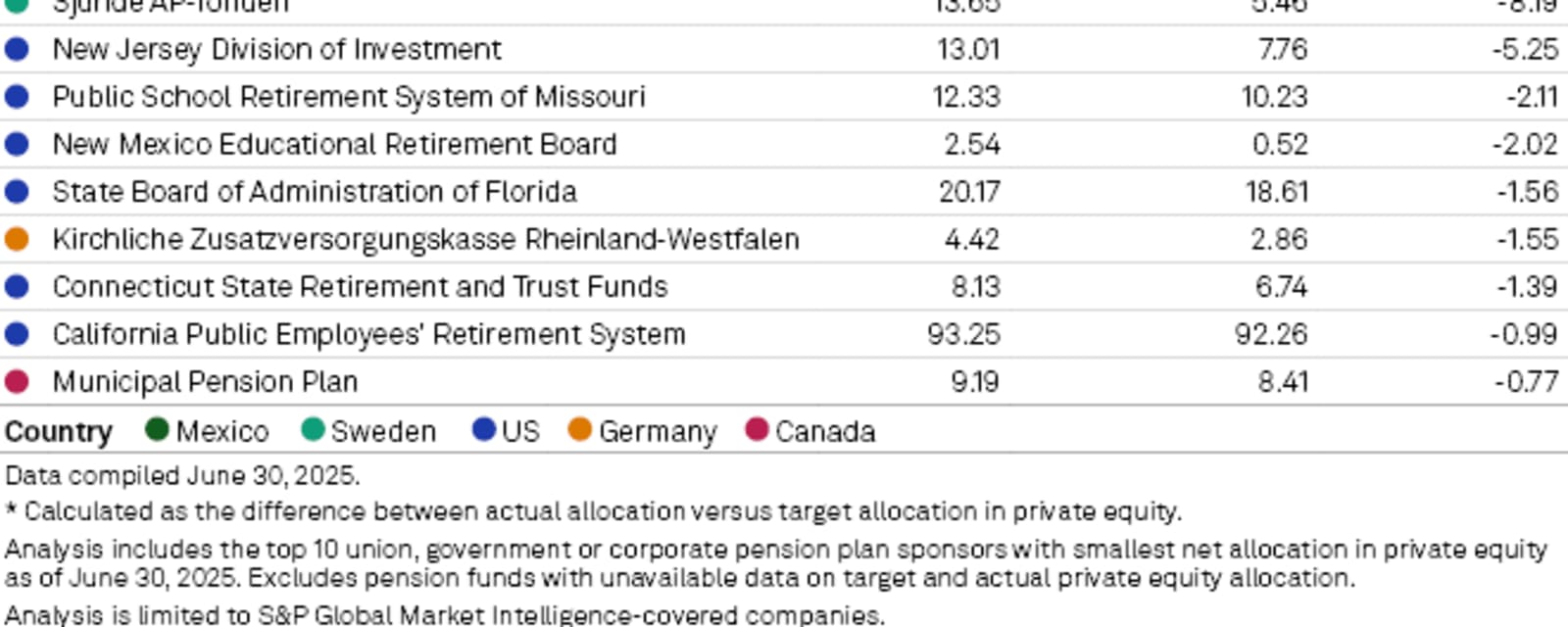
- • 62% of global pension funds exceeded private equity allocation targets as of June 30, 2025, with median actual allocations of $339.8 million versus target allocations of $312.0 million, according to S&P Global Market Intelligence data covering 294 pension funds.
- • California State Teachers' Retirement System leads overallocation by magnitude, with actual PE exposure of $55.10 billion exceeding its target by $8.70 billion; the Teacher Retirement System of Texas follows with $32.65 billion in actual allocation versus a $26.57 billion target.
- • Depressed private equity exits are a primary driver of overallocation, with exit volumes and values falling to two-year lows in Q1 2025, reducing the cash distributions available to pension funds and extending portfolio monetization timelines.
- • The denominator effect amplifies overallocation as declining public market valuations mechanically inflate the relative weight of private assets in pension portfolios, independent of new capital deployment.
- • Pension funds face strategic pressure to rebalance, including potential reductions in future PE commitment budgets and increased reliance on secondary markets to reduce exposures, according to Cambridge Associates partner Sheila Ryan.
Summary
A structural imbalance has emerged across global pension fund portfolios, with nearly two-thirds of institutional investors now holding larger private equity positions than their target allocations dictate. S&P Global Market Intelligence's analysis of 294 pension funds reveals that the median actual allocation to PE stood at $339.8 million at quarter-end June 2025, exceeding the median target allocation of $312.0 million. This 8.9% aggregate overshoot reflects a persistent liquidity constraint across the alternative assets space and signals mounting pressure on pension fund managers to recalibrate their portfolios.
The overallocation is most acute at the largest public pension systems. The California State Teachers' Retirement System, the nation's second-largest pension fund, carries a $55.10 billion private equity allocation against a target of $46.40 billion—an overage of $8.70 billion. The Teacher Retirement System of Texas reports similar pressure, with actual PE exposure of $32.65 billion exceeding its target by $6.08 billion. These overshoots are material in absolute terms and reflect the operational challenges facing mega-cap institutional investors.
The primary culprit is a collapse in private equity exit activity. Exit volumes and valuations hit two-year lows in Q1 2025, starving pension funds of the cash distributions that would normally allow for rebalancing and redemption management. Despite $2.5 trillion in undeployed capital raised by private equity firms, existing portfolio companies are being held longer, creating a structural mismatch between LP cash needs and GP liquidity generation. "The anemic distribution environment has contributed to the overallocation of some pensions," noted Sheila Ryan, partner in the pension practice at Cambridge Associates, adding that funds will likely respond by reducing future PE commitment budgets and accessing secondary markets to trim exposures.
A secondary mechanism amplifying overallocation is the denominator effect, wherein declining public equity valuations mechanically increase the relative weight of private assets within diversified pension portfolios, even without fresh PE capital being deployed. As equity markets weaken, the denominator shrinks, making fixed-dollar private holdings represent a larger percentage of total assets.
Pension funds now face a difficult strategic choice: maintain commitments and accept higher PE exposure, or aggressively reduce future allocations and tap secondary markets to meet rebalancing targets. The magnitude of overshoot—particularly at large CalSTRS and TRS Texas—suggests that patience and market recovery in exit activity may be the near-term path of least resistance, though structural constraints on PE distribution may force tactical adjustments in 2025 and beyond.
Go deeper than the headline
Research every firm in this story, track the ones that matter and get the daily briefing — free for 7 days.