
Key Takeaways
- • Private real estate lending funds collect capital from investors and deploy it across diversified pools of real estate-backed loans, offering high yields comparable to stock returns but with substantially lower volatility than publicly traded real estate securities.
- • The author allocates 5% of total portfolio to private lending funds (25% of a 20% real estate allocation), demonstrating a measured approach to this alternative asset class among high-net-worth investors seeking passive income with real estate backing.
- • Private lending funds exhibit superior tax efficiency and lower market correlation compared to public REITs and real estate ETFs, which in 2022 experienced losses exceeding 27% despite offering yields near 10%—highlighting the structural advantage of mark-to-market-free private vehicles.
- • Primary risk exposure centers on manager selection and conversion risk, where operators may default on debt obligations during severe real estate downturns, effectively converting the debt position into an equity stake in distressed assets.
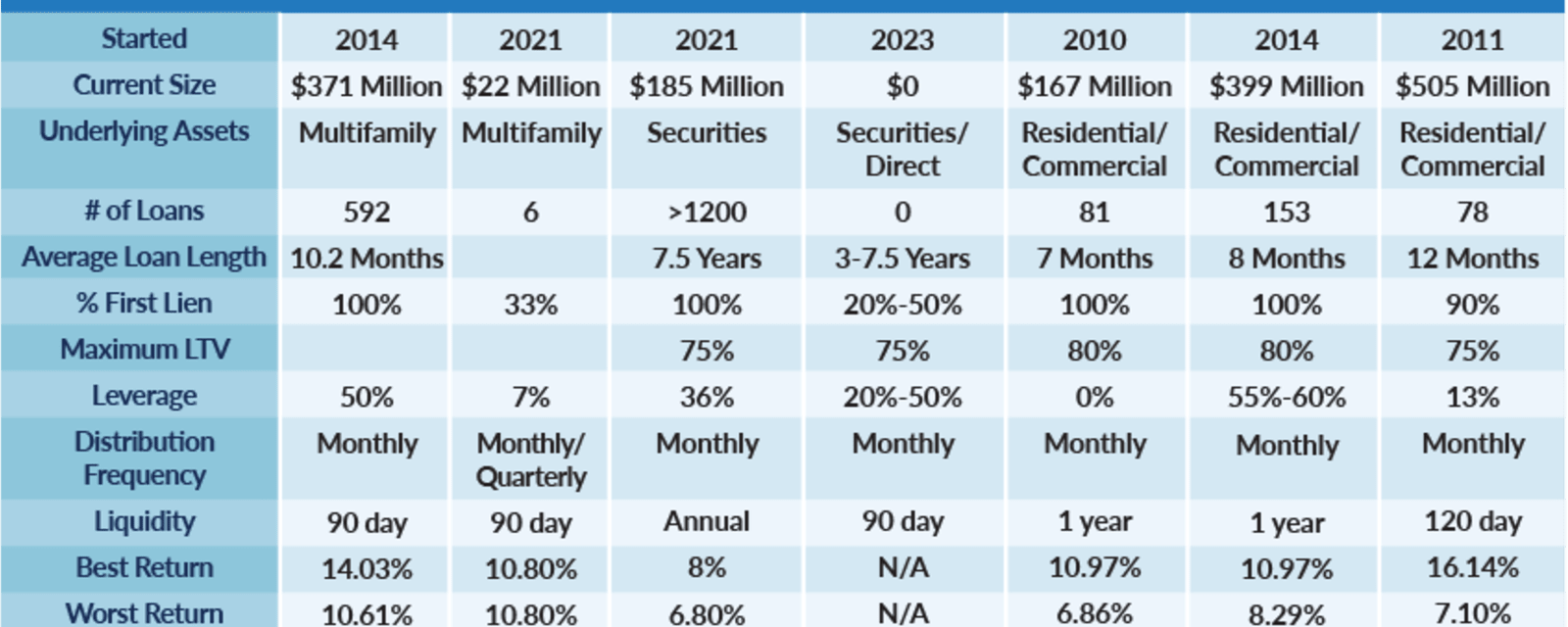
- • The article compares seven private real estate lending funds across four different fund managers, positioning this as a due diligence framework for institutional and high-net-worth investors evaluating this alternative investment category.
Summary
Private real estate lending funds represent a distinct alternative investment vehicle that pools capital from investors to finance real estate operators across diversified loan portfolios. According to The White Coat Investor, these funds collect investor capital, cover operator expenses, deduct management fees, and distribute remaining profits to shareholders. The structure provides investors with passive exposure to dozens of underlying real estate-backed loans without direct property ownership or operational involvement.
The performance profile of private lending funds differs meaningfully from their public market equivalents. While both private funds and publicly traded REITs derive returns from real estate lending operations, private funds insulate investors from daily mark-to-market volatility. Public real estate lending ETFs, by contrast, exhibited significant drawdowns—declining more than 27% in 2022—despite offering yields near 10% at the time of writing. This volatility reflects the speculative component introduced by daily stock market pricing rather than fundamental changes in underlying loan performance. Investors seeking steadier, less correlated returns gravitate toward private structures to escape short-term market noise.
For portfolio construction, the author implements a measured allocation to this asset class, dedicating 5% of total portfolio capital to private lending funds. This represents 25% of a broader 20% real estate allocation, illustrating how institutional and high-net-worth investors size exposure to alternative real estate vehicles within diversified portfolios. The yields generated tend to approximate stock market returns while displaying considerably lower volatility, though the author notes these returns carry material tax inefficiency—a structural disadvantage relative to other passive investments.
Risk management in private lending funds centers on two primary dimensions: manager selection and conversion risk. Manager risk reflects the operational competence and integrity of fund sponsors overseeing loan origination, underwriting, and portfolio management. Conversion risk emerges during severe real estate downturns when operators facing distress may default on debt obligations, forcing lenders to absorb equity-like losses rather than receive scheduled payments. This tail risk distinguishes private lending from senior secured lending in stable market environments.
The White Coat Investor's comparative analysis spans seven private real estate lending funds from four fund managers, providing a structured due diligence framework for investors evaluating this alternative asset class. This comparative approach addresses a key institutional need: systematic evaluation of fund sponsors, fee structures, return targets, and risk management protocols before capital deployment.
Go deeper than the headline
Research every firm in this story, track the ones that matter and get the daily briefing — free for 7 days.