
Key Takeaways
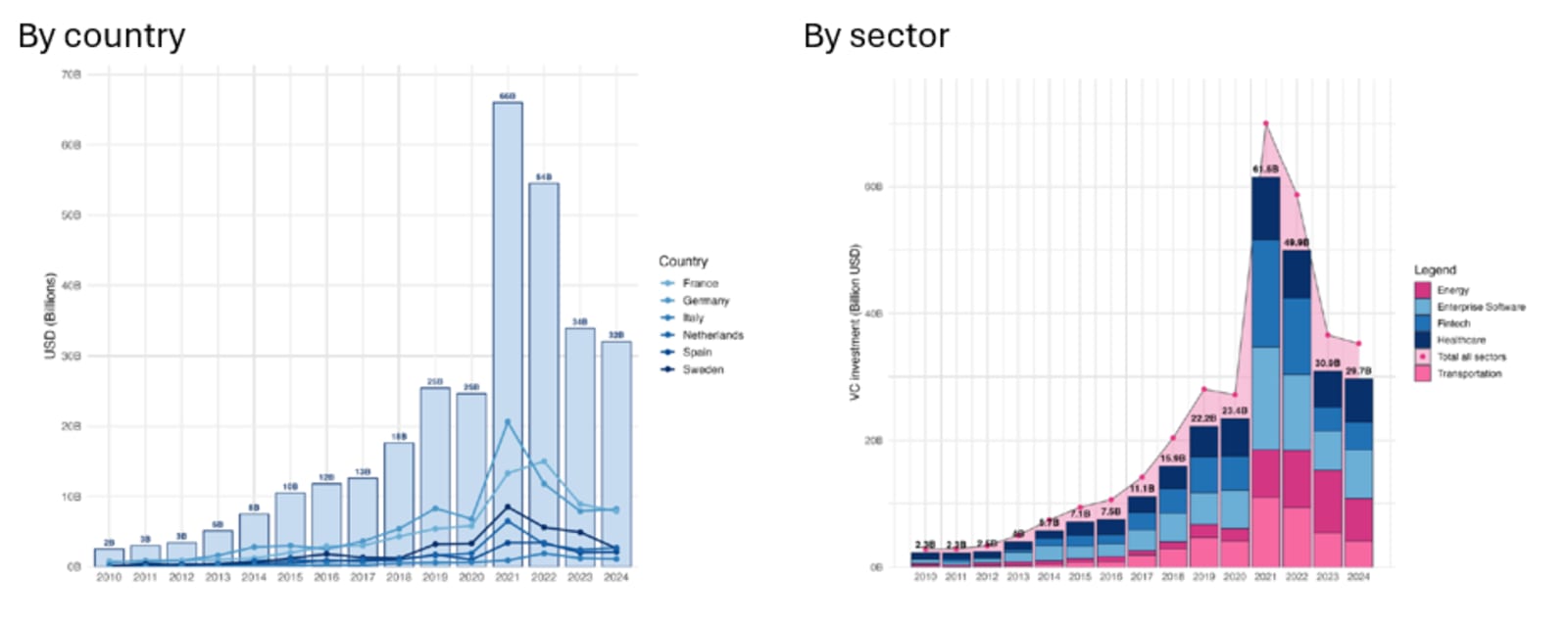
- • European venture and growth-stage funding lags the US by a substantial margin, particularly at later stages of firm growth, compelling innovative companies to seek capital abroad rather than scaling domestically.
- • The EU's alternative investment fund (AIF) market holds EUR 8.2 trillion in assets under management, but regulatory fragmentation and cross-border restrictions prevent effective capital mobilization for scaling startups.
- • CFA Institute has recommended targeted regulatory reforms including widening light-touch VC fund formats, raising fund size thresholds, reducing cross-border marketing barriers, and opening market access to high-quality non-EU investors.
- • Europe excels at startup formation and maintains world-leading science and innovation capabilities, yet systematically fails to develop technology champions—companies that drive productivity growth and economic competitiveness.
- • Pension funds, traditionally the primary source of innovation financing, require time to strengthen, but policymakers can achieve immediate impact by reforming the EU's alternative investment regulatory framework.
Summary
Europe's paradox is well-defined: the continent generates substantial startup activity and maintains global leadership in scientific innovation, yet consistently fails to scale young firms into category-defining technology companies. Venture and growth-stage funding in the European Union remains significantly below US levels, according to analysis by CFA Institute, with the disparity most acute in later-stage financing rounds. This funding shortfall forces many European startups to migrate capital-raising efforts to North America and other markets as they mature, effectively relocating innovation and economic value creation outside EU borders.
The root cause is not entrepreneurial talent or scientific capability, but rather structural impediments within Europe's fragmented capital markets and regulatory framework. The EU's alternative investment fund ecosystem—comprising EUR 8.2 trillion in assets under management—remains largely inaccessible to growth-stage startups due to regulatory barriers, fund size constraints, and cross-border restrictions that discourage scaling. Pension funds, which traditionally serve as primary sources of innovation financing, require extended periods to build institutional capacity.
To address this dynamic, CFA Institute outlined specific regulatory reforms in its response to the European Commission consultation. These include broadening the scope and raising size thresholds for the EU's light-touch venture capital fund format, reforming mainstream alternative investment fund regulations to mobilize growth capital for later-stage firms, reducing regulatory hurdles that discourage fund manager scaling, eliminating cross-border marketing barriers within the EU, and establishing predictable market access criteria for high-quality non-EU investors and fund managers. The recommendations target regulatory harmonization across fragmented national markets rather than capital infusion, positioning policy intervention as the immediate lever for unlocking Europe's existing savings pools.
The strategic imperative centers on preventing continued brain drain and capital flight. Europe's failure to nurture technology champions—firms that drive productivity growth in modern economies—represents not merely a competitive disadvantage but a structural productivity headwind. Regulatory modernization offers policymakers a pathway to mobilize dormant capital and retain innovative companies within EU jurisdiction without requiring new funding mechanisms or extended institutional development timelines.
Go deeper than the headline
Research every firm in this story, track the ones that matter and get the daily briefing — free for 7 days.