
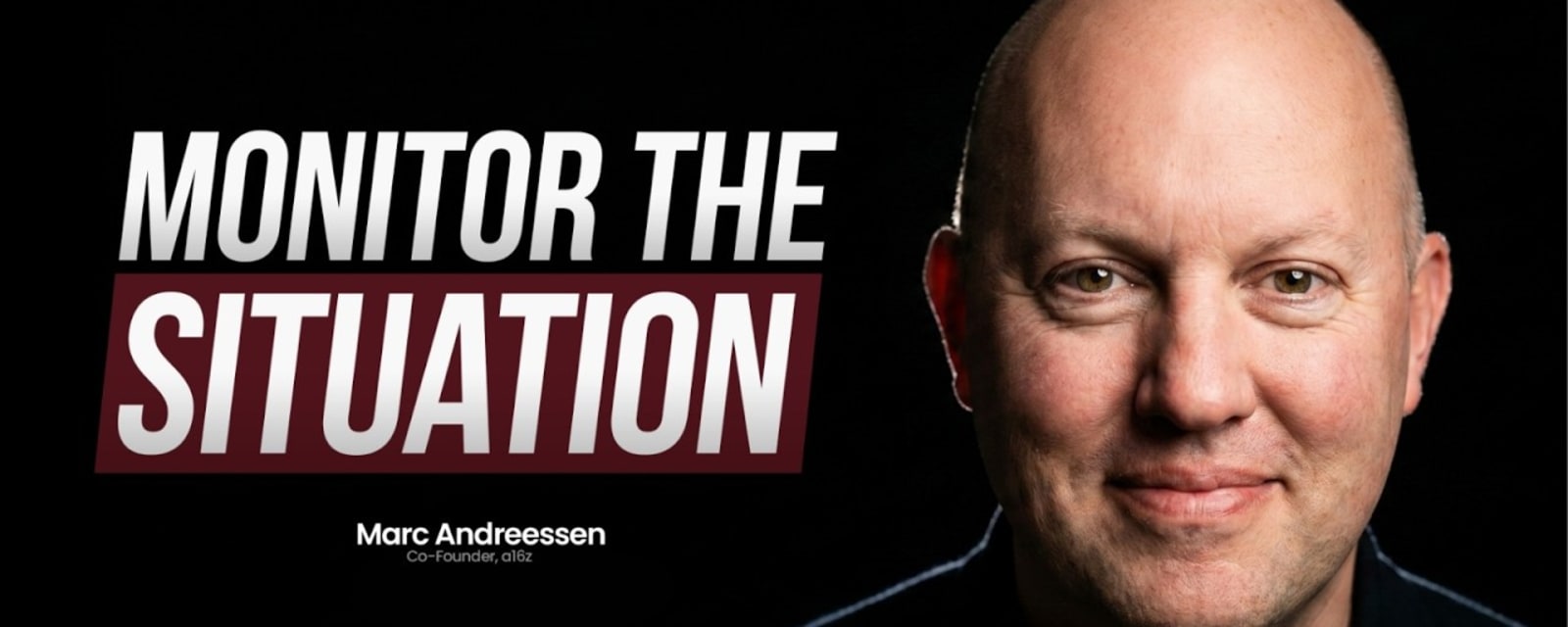
Key Takeaways
- • Marc Andreessen argues that AI has the potential to "cut through the noise" by providing context, verifying information, and presenting more balanced perspectives, addressing distortions created by historical media narratives and modern social media amplification.
- • Andreessen draws parallels between media's role in shaping public perception across different historical periods—specifically the Spanish Civil War and Vietnam War—to illustrate how information dissemination fundamentally influences public understanding and sentiment around conflicts.
- • The venture capitalist positions AI as a corrective mechanism to current media environment problems, including 24/7 news cycles and polarizing social media dynamics that have amplified certain tendencies in how information reaches the public.
- • Andreessen characterizes AI as transformative technology ("the philosopher's stone") with potential to profoundly augment human intelligence across multiple dimensions of human activity and economic outcomes.
Summary
In a recent appearance on The A16Z Show, Marc Andreessen, co-founder of Andreessen Horowitz and a seminal figure in the internet revolution, articulated a perspective on how artificial intelligence might address structural problems in contemporary media and information ecosystems. Andreessen's remarks centered on the thesis that AI could serve as a counterbalance to historical media distortions and the polarizing effects of modern digital information channels.
Andreessen's framework draws on historical precedent to establish the stakes. He referenced how propaganda and biased reporting shaped public opinion during the Spanish Civil War, and how television coverage of the Vietnam War brought conflict realities directly into American homes, materially impacting public sentiment and fueling anti-war movements. By invoking these historical examples, Andreessen positioned media coverage as a fundamental determinant of public perception and political mobilization, not merely as a passive recorder of events.
The venture capitalist argues that the contemporary media environment has intensified these historical dynamics through social media proliferation and continuous news cycles, creating an ecosystem prone to misinformation and polarization. Within this context, Andreessen contends that AI offers a substantive solution: the capacity to aggregate information sources, provide contextual verification, and present more balanced narratives that circumvent the noise and bias inherent in current media structures.
Andreessen's characterization of AI as "the philosopher's stone"—invoking the legendary substance purported to transmute base metals into gold—suggests he views the technology as capable of profound transformation across multiple domains of human intelligence and economic activity. This positioning reflects a broader thesis that AI, when properly developed and deployed, can augment rather than replace human capability across sectors ranging from media to commerce to knowledge work.
Go deeper than the headline
Research every firm in this story, track the ones that matter and get the daily briefing — free for 7 days.