
Key Takeaways
- • China expanded rare earth export controls in October 2025 to cover five additional rare earth elements and, critically, applied the foreign direct product rule (FDPR) to magnets and materials containing even trace amounts (0.1%) of Chinese-origin content, mirroring U.S. semiconductor restrictions and extending extraterritorial jurisdiction to foreign-produced goods using Chinese technology.
- • China dominates 70% of global rare earth mining, 90% of separation and processing, and 93% of permanent magnet manufacturing, giving Beijing substantial leverage over defense, semiconductor, battery, and electric vehicle supply chains globally.
- • The controls initially escalated U.S.-China trade tensions, with President Trump announcing 100% tariffs on Chinese imports effective November 1, 2025, but the announcement was walked back within days as markets reacted sharply to the prospect of trade escalation.
- • A one-year suspension of the October 2025 controls was negotiated and agreed in November 2025 following the Xi-Trump meeting, suspending implementation until November 10, 2026, though prior April 2025 export controls on rare earth materials remain in place pending Chinese confirmation of general-purpose licensing.
- • Export restrictions on critical minerals risk constraining emerging projects' ability to refine raw materials and manufacture strategic components, potentially undermining global efforts to diversify rare earth supply chains and reduce dependence on Chinese processing capacity.
Summary
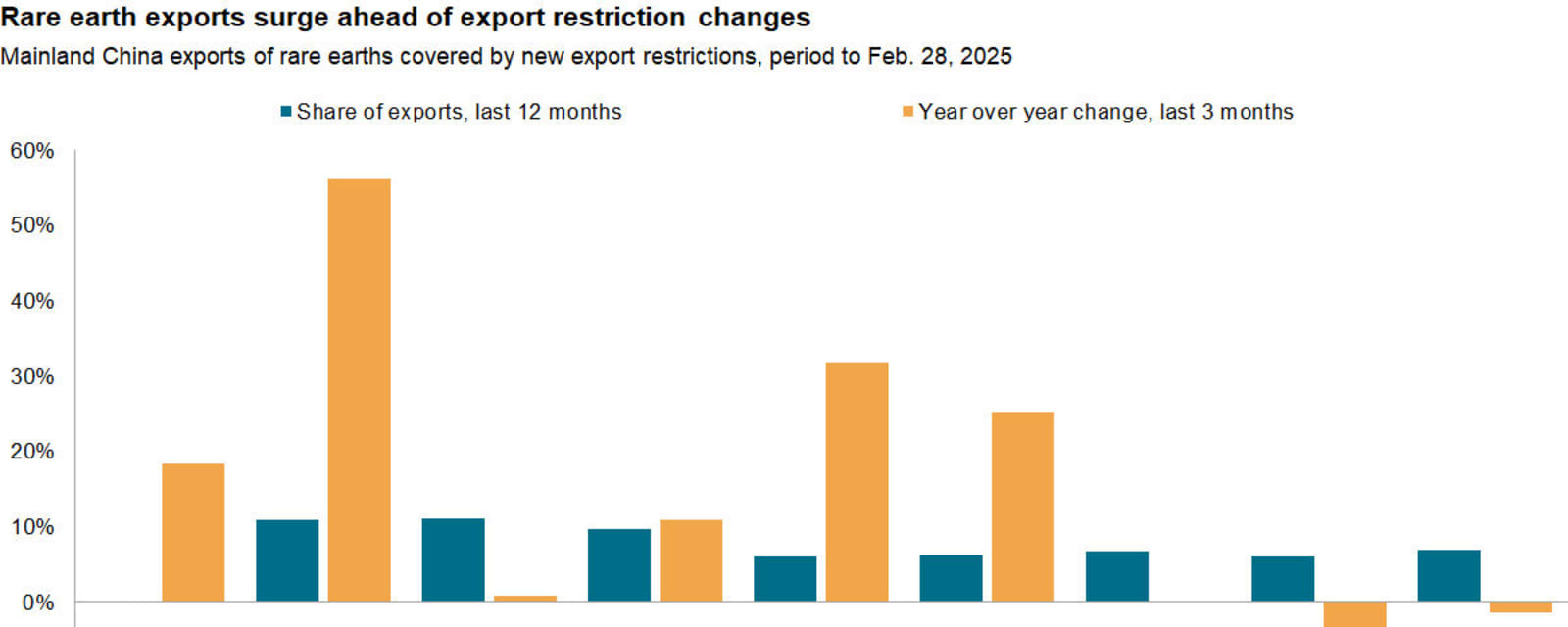
China announced its most stringent rare earth and permanent magnet export controls on October 9, 2025, representing a significant escalation in Beijing's use of critical mineral trade as a geopolitical lever. The announcement included restrictions on five additional rare earth elements essential for medical, telecommunications, and military applications, alongside controls on magnets, recycling equipment, and battery-related materials including cathode and anode materials and manufacturing equipment. The most consequential innovation in the measures is China's application of the foreign direct product rule (FDPR)—a jurisdictional mechanism historically used by the United States to restrict semiconductor exports—to require Chinese government approval for foreign firms exporting magnets containing even trace amounts (0.1%) of Chinese-origin rare earth materials or produced using Chinese mining, processing, or magnet-making technologies.
China's dominance across the rare earth supply chain amplifies the strategic impact of these controls. Beijing accounts for approximately 70% of global rare earth mining, 90% of separation and processing capacity, and 93% of permanent magnet manufacturing. This concentration gives China extraordinary leverage over industries critical to U.S. and allied defense capabilities, semiconductor manufacturing, renewable energy infrastructure, and the electric vehicle supply chain. The extraterritorial application of the FDPR to foreign-produced goods signals Beijing's intent to extend control beyond its borders, following a strategic vision articulated decades earlier when Chinese leader Deng Xiaoping stated in 1992 that rare earths held strategic significance comparable to oil in the Middle East.
The announcement prompted an immediate trade policy response. President Trump announced 100% tariffs on all Chinese imports effective November 1, 2025, but reversed course within 48 hours, stating via social media that "the USA wants to help China, not hurt it." This abrupt shift stabilized financial markets, which had fallen sharply on concerns of trade escalation. The volatile market reaction underscored investor concern regarding supply chain disruption and retaliatory tariff impacts.
In November 2025, following the Xi-Trump meeting, the U.S. and China reached a trade agreement that suspended implementation of the October export controls for one year until November 10, 2026. The suspension covers both the five newly restricted rare earth elements and broader restrictions on rare earth materials and technologies, including items produced overseas using Chinese source materials. However, prior export controls implemented in April 2025 remain in effect pending Chinese confirmation of general-purpose export licenses. Experts warn that even suspended controls risk constraining emerging refining and processing projects globally, potentially undermining Western efforts to diversify rare earth supply chains and reduce strategic dependence on Chinese processing infrastructure.
China's dominance across the rare earth supply chain amplifies the strategic impact of these controls. Beijing accounts for approximately 70% of global rare earth mining, 90% of separation and processing capacity, and 93% of permanent magnet manufacturing. This concentration gives China extraordinary leverage over industries critical to U.S. and allied defense capabilities, semiconductor manufacturing, renewable energy infrastructure, and the electric vehicle supply chain. The extraterritorial application of the FDPR to foreign-produced goods signals Beijing's intent to extend control beyond its borders, following a strategic vision articulated decades earlier when Chinese leader Deng Xiaoping stated in 1992 that rare earths held strategic significance comparable to oil in the Middle East.
The announcement prompted an immediate trade policy response. President Trump announced 100% tariffs on all Chinese imports effective November 1, 2025, but reversed course within 48 hours, stating via social media that "the USA wants to help China, not hurt it." This abrupt shift stabilized financial markets, which had fallen sharply on concerns of trade escalation. The volatile market reaction underscored investor concern regarding supply chain disruption and retaliatory tariff impacts.
In November 2025, following the Xi-Trump meeting, the U.S. and China reached a trade agreement that suspended implementation of the October export controls for one year until November 10, 2026. The suspension covers both the five newly restricted rare earth elements and broader restrictions on rare earth materials and technologies, including items produced overseas using Chinese source materials. However, prior export controls implemented in April 2025 remain in effect pending Chinese confirmation of general-purpose export licenses. Experts warn that even suspended controls risk constraining emerging refining and processing projects globally, potentially undermining Western efforts to diversify rare earth supply chains and reduce strategic dependence on Chinese processing infrastructure.
Go deeper than the headline
Research every firm in this story, track the ones that matter and get the daily briefing — free for 7 days.