
Key Takeaways
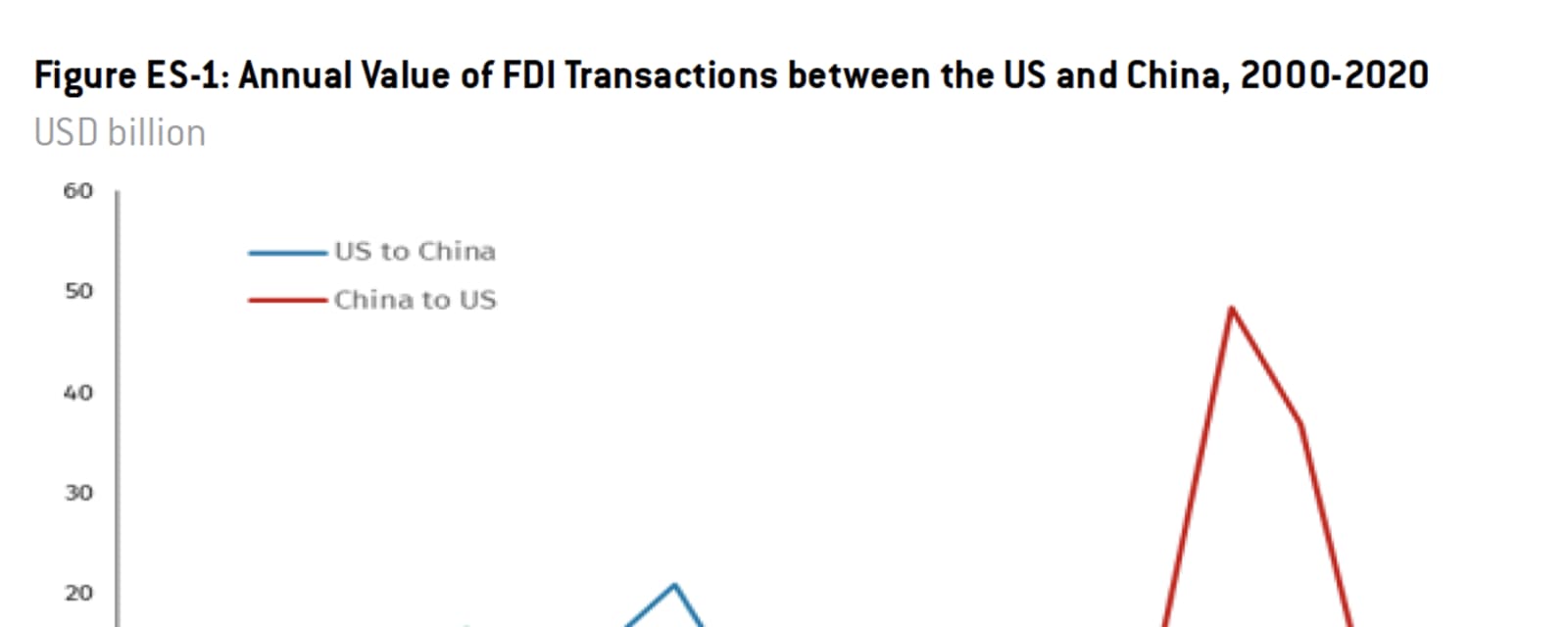
- • Two-way US-China FDI collapsed to $15.9 billion in 2020, the lowest level in over a decade, driven by pandemic disruptions and escalating bilateral tensions amid political transition in Washington.
- • Chinese FDI into the US increased marginally to $7.2 billion (from $6.3 billion in 2019) despite low M&A volumes, buoyed by high-value acquisitions including Tencent's stake in Universal Music Group and Harbin Pharmaceutical's purchase of GNC Holdings.
- • US direct investment in China fell sharply by one-third to $8.7 billion—the lowest since 2004—with greenfield projects significantly reduced and M&A activity concentrated in consumer products and financial services.
- • Venture capital flows between the US and China declined in both value and transaction volume, with Chinese VC into the US marginally exceeding reverse flows for the first time, signaling a structural shift in technology investment patterns.
- • Investment trends reflect a broader structural decline in bilateral capital flows since peaking in 2016, with 2020 marking an inflection point shaped by both cyclical pandemic factors and secular geopolitical deterioration.
Summary
The US-China Investment Project's 2021 update, published by Rhodium Group, reveals a pronounced contraction in bilateral direct investment flows driven by converging cyclical and structural headwinds. Two-way FDI between the world's two largest economies declined to $15.9 billion in 2020, marking the lowest annual level since 2009 and continuing a downward trajectory that began following the 2016 peak. The decline reflects both immediate disruptions from COVID-19 economic lockdowns and the deepening geopolitical friction that has characterized US-China relations over the past four years.
Chinese investment into the United States reached $7.2 billion in 2020, a modest increase from $6.3 billion in 2019, though this aggregate masks significant operational challenges. The growth was driven almost entirely by a narrow set of large-cap acquisitions, most notably Tencent's investment in Universal Music Group and Harbin Pharmaceutical Group's acquisition of GNC Holdings. However, M&A transaction volumes remained suppressed, with deal activity confined primarily to consumer-oriented sectors and minimal greenfield investment activity. The data suggests Chinese capital is increasingly selective, targeting established market positions rather than building new operational footprints in the US.
Conversely, US direct investment in China deteriorated more sharply, falling approximately one-third to $8.7 billion—the lowest annual figure since 2004. Pandemic-related restrictions initially disrupted greenfield projects in the first half of 2020, but activity rebounded strongly in the second half as China's economy stabilized and COVID containment measures eased. Despite this recovery, American investors launched significantly fewer major greenfield initiatives compared to historical norms. M&A activity contracted even more severely, with only a handful of medium-sized takeovers completed in consumer products and financial services.
Cross-border venture capital flows declined in both aggregate value and transaction frequency, reflecting broader technology sector caution amid regulatory uncertainty. Chinese VC into the United States increased marginally and exceeded inbound US VC flows for the first time, albeit by a slim margin, signaling a potential inflection in technology investment patterns and venture capital market dynamics.
These 2020 figures represent the culmination of a multi-year secular decline in bilateral capital flows interrupted only temporarily by the pandemic's cyclical disruptions. The structural headwinds—including tightened US foreign investment screening, Chinese capital controls, and deteriorating bilateral political relations—suggest that near-term normalization to pre-2016 volumes remains unlikely absent material shifts in US-China policy alignment.
Go deeper than the headline
Research every firm in this story, track the ones that matter and get the daily briefing — free for 7 days.