
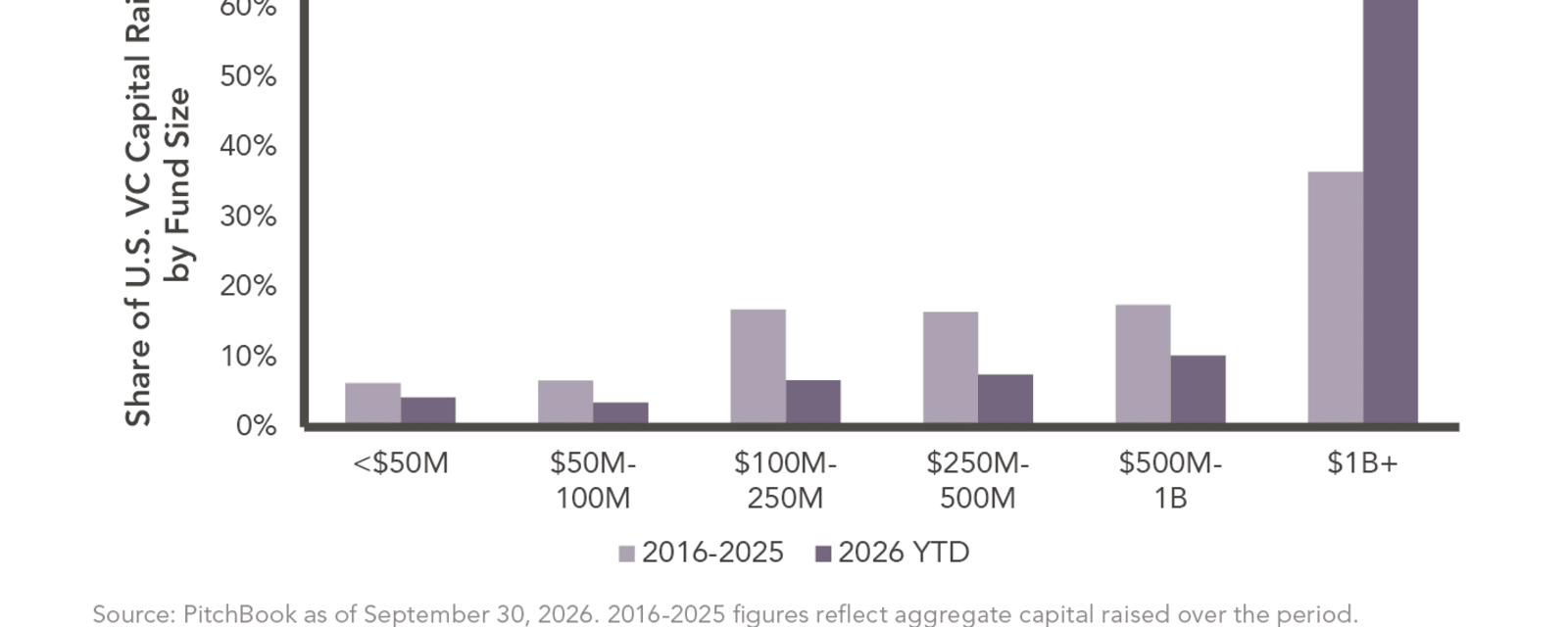
Venture capital fundraising in the U.S. has picked up in 2026, with funds in the space raising more than $108 billion through the end of September. That said, commitments are not being spread out as evenly across funds as they had been in previous years. Middle-market funds, or those raising $50 million to $500 million, have captured less than 18% of capital commitments this year, compared to nearly 40% of total capital raised from 2016 through 2025. On the other hand, the share of total commitments that have gone to funds raising $1 billion or more has increased significantly from roughly 37% from 2016 through 2025 to almost 68% in 2026. This meaningful shift toward larger funds reflects the continued rise of multi-stage platforms (i.e., firms that raise capital across multiple stages of a company’s development, from seed and early-stage financing through growth-stage investing), which have captured nearly 60% (a record) of all venture capital fundraising in 2026. Andreessen Horowitz (a16z) alone accounts for roughly 25% of total venture commitments this year.
The fact that companies are staying private for longer is certainly a tailwind for multi-stage managers that can maintain or increase ownership across successive financing rounds, and the artificial intelligence boom has reinforced this advantage. Indeed, companies tied to AI have accounted for almost 83% of U.S. venture capital deal value in 2026 and often require support that smaller venture capital firms were not built to provide. Investor preferences are also trending towards favoring scale as distributions as a share of fund value have remained below historical averages for nearly five years. With less cash coming back, many investors are currently directing new commitments to established managers offering strong brands, deep resources, institutional infrastructure, and demonstrated access to highly sought after companies. Recent performance has reinforced this preference. According to MSCI Private Capital, funds above $500 million have generated a trailing five-year net IRR of more than 7% as of June 30, compared to less than 5% for funds between $50 million and $500 million. Against this backdrop, mid-size managers are being squeezed on both sides. Series A (i.e., the first institutional financing round following a company’s seed stage, typically used to fund product development, early commercialization, and initial market expansion) has traditionally been the sweet spot for investors accessing the venture capital space, and it is exactly where multistage firms have focused most aggressively in recent time. According to PitchBook, multi-stage firms have participated in more than 17% (another record) of Series A deals so far in 2026, representing nearly 38% of Series A deal value. At the same time, 2026 is on pace for the lowest level of first-time fund formation in at least a decade.
While it is too early to definitively state that 2026 capital flows constitute a permanent shift in investor preferences, the multi-year decline in mid-size venture capital fundraising suggests that fundraising pressures may indeed be structural as opposed to cyclical. These pressures, however, do not mean that mid-size funds do not offer compelling opportunities for investors. Figures from MSCI Private Capital indicate that mid-size venture capital funds have modestly outperformed funds above $500 million over longer-term horizons (12.7% vs. 11.7% and 11.7% vs. 11.0% over the trailing 10- and 15-year periods ending June 30, 2026, respectively). So, while capital is becoming more concentrated across large, multi-stage platforms, long-term performance figures do not clearly demonstrate that bigger funds have been superior places to allocate. If the last decade proved that mid-size venture firms can generate attractive returns, then the next decade will test whether they can sustain that success in a market increasingly tilted toward scale and multi-stage venture funds.
The post The Missing Middle appeared first on Marquette Associates.
Go deeper than the headline
Research every firm in this story, track the ones that matter and get the daily briefing — free for 7 days.