
Key Takeaways
- • Family offices in India are expanding their allocation to alternative assets, signaling a strategic shift toward diversified investment portfolios beyond traditional holdings.
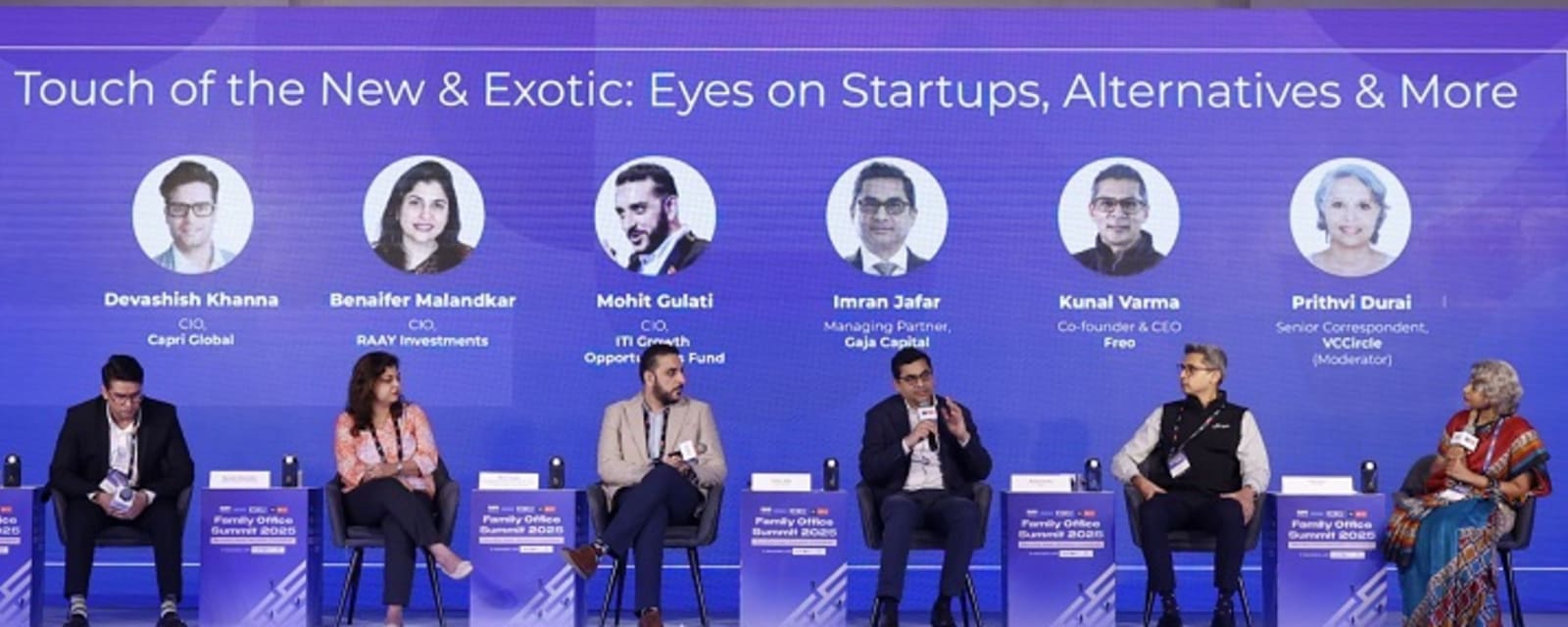
- • Family office participants at the VCCircle summit, including panelists Devashish Khanna, Benaifer Malandkar, Mohit Gulati, Imran Jafar, and Kunal Varma, expressed caution regarding exotic alternative assets, indicating preference for established, transparent investment vehicles.
- • Goldman Sachs 2023 Family Office Investment Insights data referenced at the summit shows institutional family offices allocate an average of 44% of total capital across alternative asset classes, with 35% in specific segments, establishing a benchmark for industry allocation patterns.
- • Indian family offices are increasingly professionalizing their investment operations and seeking to institutionalize capital allocation frameworks, though risk management frameworks remain underdeveloped across the sector.
- • The divergence between rising alternatives allocation and wariness of exotic assets reflects a maturing but selective approach to alternative investments among high-net-worth family offices in India.
Summary
Family offices operating in India are meaningfully increasing their capital allocation toward alternative assets, according to panelists convened at the VCCircle summit on July 25, 2025. The panel discussion, featuring executives including Devashish Khanna, Benaifer Malandkar, Mohit Gulati, Imran Jafar, and Kunal Varma, underscored a strategic reorientation within the family office sector toward diversified investment categories beyond traditional equities and fixed income.
However, this expanded appetite for alternatives comes with notable constraints. Despite lifting allocation levels, family office participants expressed considerable wariness toward exotic or complex alternative assets, indicating a preference for more established and transparent investment mechanisms. This selective approach reflects growing sophistication in portfolio construction tempered by risk aversion and limited expertise in specialized asset classes.
Industry benchmarks provide context for this shift. Goldman Sachs' 2023 Family Office Investment Insights report, referenced during the summit discussions, indicates that family offices on average allocate 44% of total capital across alternative asset classes broadly, with 35% deployed to specific alternative segments. These figures establish a baseline against which Indian family office allocation strategies can be measured.
Beyond asset allocation, the summit revealed a broader trend of professionalization within Indian family offices. Participants emphasized the sector's movement toward institutionalizing capital allocation processes and governance structures. However, this professionalization remains incomplete; family offices continue to operate with underdeveloped risk management frameworks, creating potential vulnerabilities in portfolio oversight and decision-making processes.
The convergence of increased alternatives allocation with caution toward exotic assets suggests Indian family offices are navigating a maturation phase—seeking higher returns and diversification through alternatives while maintaining prudent risk controls and demanding transparency in investment structures.
Go deeper than the headline
Research every firm in this story, track the ones that matter and get the daily briefing — free for 7 days.