
Key Takeaways
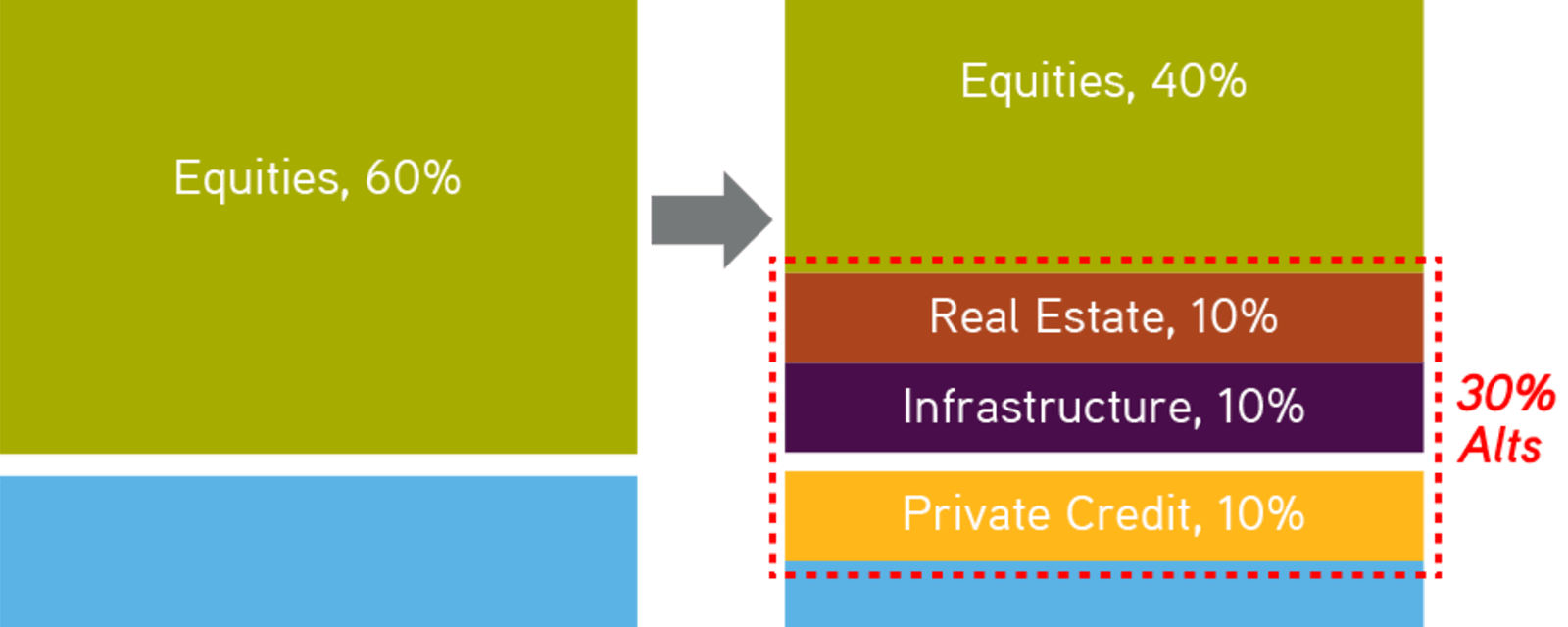
- • KKR advocates replacing the traditional 60/40 stock-bond portfolio with a 40/30/30 framework (40% stocks, 30% bonds, 30% alternatives) to address structural changes in macroeconomic conditions and the breakdown of historical stock-bond correlation.
- • Private Credit allocation of 10% within the alternatives sleeve is positioned as a key solution to enhance portfolio diversification and risk-adjusted returns, particularly through floating-rate structures that provide income generation in higher inflation environments.
- • KKR identifies three primary macro drivers reshaping investment regimes: labor supply constraints, rising geopolitical tensions, and the global energy transition, each requiring portfolio construction reassessment.
- • Private Equity, Private Credit, and Real Assets are presented as additive to traditional portfolios for investors concerned about inflation protection and those without near-term liquidity constraints.
- • The thesis rests on the premise that quantitative easing artificially inflated bonds' role as both income producers and portfolio shock absorbers, and quantitative tightening has fundamentally altered this dynamic.
Summary
KKR has released a portfolio construction framework arguing that investors must fundamentally rethink traditional asset allocation in light of changed macroeconomic conditions. The firm contends that the structural relationship between stocks and bonds has shifted, rendering the canonical 60/40 portfolio suboptimal for contemporary market environments. According to KKR's analysis, positive correlation between stocks and bonds—a phenomenon attributed to decades of quantitative easing—will likely persist as a long-term headwind to traditional fixed income allocations.
To address these challenges, KKR proposes a 40/30/30 portfolio architecture: 40% equities, 30% traditional fixed income, and 30% alternatives. Within this alternatives allocation, Private Credit represents a pivotal component, with KKR recommending a 10% weight. The firm emphasizes that Private Credit's floating-rate characteristics offer meaningful advantages in an inflationary environment by providing dynamic income generation that traditional bonds cannot match. Daniel Pietrzak, Global Head of Private Credit at KKR, oversees the firm's private credit strategy across negotiated direct deals that bypass traditional banking intermediaries.
KKR's macro thesis centers on three structural supply-side shocks: labor shortages, geopolitical realignments, and energy transition costs. These factors underpin KKR's house view of a persistently elevated "resting heart rate" for inflation across the cycle. The firm argues this environment demands two concurrent portfolio objectives: first, increasing inflation protection through Real Assets allocation; and second, enhancing portfolio robustness via private alternatives with floating-rate exposure. The recommendations are specifically targeted at institutional investors with moderate-to-long-term horizons and flexibility around liquidity constraints.
The analysis explicitly challenges decades of quantitative easing assumptions that overstated bonds' utility as both income sources and shock absorbers. As quantitative tightening accelerates, KKR contends that existing portfolios require substantive re-underwriting. Private Credit's direct-negotiated structure—operating outside public markets and traditional banking channels—offers enhanced return profiles and diversification benefits relative to public fixed income, particularly in regimes characterized by rising rates and inflation volatility.
To address these challenges, KKR proposes a 40/30/30 portfolio architecture: 40% equities, 30% traditional fixed income, and 30% alternatives. Within this alternatives allocation, Private Credit represents a pivotal component, with KKR recommending a 10% weight. The firm emphasizes that Private Credit's floating-rate characteristics offer meaningful advantages in an inflationary environment by providing dynamic income generation that traditional bonds cannot match. Daniel Pietrzak, Global Head of Private Credit at KKR, oversees the firm's private credit strategy across negotiated direct deals that bypass traditional banking intermediaries.
KKR's macro thesis centers on three structural supply-side shocks: labor shortages, geopolitical realignments, and energy transition costs. These factors underpin KKR's house view of a persistently elevated "resting heart rate" for inflation across the cycle. The firm argues this environment demands two concurrent portfolio objectives: first, increasing inflation protection through Real Assets allocation; and second, enhancing portfolio robustness via private alternatives with floating-rate exposure. The recommendations are specifically targeted at institutional investors with moderate-to-long-term horizons and flexibility around liquidity constraints.
The analysis explicitly challenges decades of quantitative easing assumptions that overstated bonds' utility as both income sources and shock absorbers. As quantitative tightening accelerates, KKR contends that existing portfolios require substantive re-underwriting. Private Credit's direct-negotiated structure—operating outside public markets and traditional banking channels—offers enhanced return profiles and diversification benefits relative to public fixed income, particularly in regimes characterized by rising rates and inflation volatility.
Go deeper than the headline
Research every firm in this story, track the ones that matter and get the daily briefing — free for 7 days.