
Key Takeaways
- • KKR's Chief Investment Officer Henry McVey and Head of Portfolio Construction Racim Allouani released a macro research report asserting that the traditional 60/40 equity-bond portfolio faces structural challenges in the current macroeconomic regime due to positive correlation between stocks and bonds.
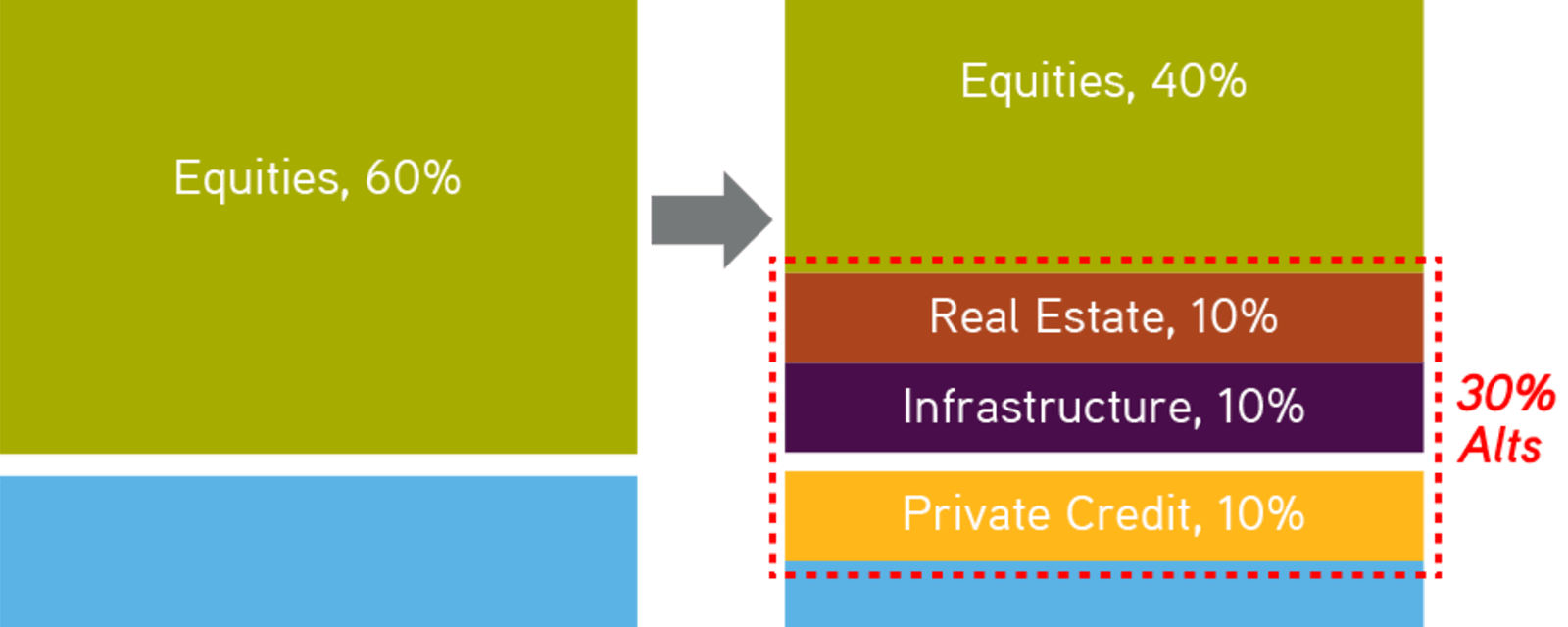
- • The report contends that allocating 10% of portfolio assets to Private Credit—alongside Infrastructure and Real Estate—can enhance risk-adjusted returns and improve diversification over the long term.
- • KKR argues the investment case for Private Credit has strengthened since earlier in 2023, particularly given recent pullbacks by traditional lending institutions that have created opportunity gaps in credit markets.
- • The analysis follows KKR's earlier "Regime Change" report that challenged investors to fundamentally rethink traditional portfolio construction models to protect pricing power in a new investing environment.
- • McVey and Allouani acknowledge that while the 60/40 portfolio may experience short-term rebounds, the longer-term breakdown in equity-bond correlation signals a structural shift requiring portfolio rebalancing toward inflation-resilient alternative assets.
Summary
KKR released a research report on October 12, 2023, arguing that Private Credit deserves expanded allocation within institutional investor portfolios as traditional asset allocation frameworks face structural obsolescence. The report, authored by Henry McVey (Chief Investment Officer of KKR's Balance Sheet and Head of Global Macro and Asset Allocation) and Racim Allouani (Head of Portfolio Construction, Investment Risk Management and Quantitative Analysis), builds on KKR's earlier "Regime Change: Enhancing the 'Traditional' Portfolio" thesis, which questioned the viability of the canonical 60/40 stock-bond portfolio in current macroeconomic conditions.
The core argument centers on a fundamental market regime shift. The authors contend that positive correlation between equities and bonds—a dynamic that diverges from historical patterns—threatens the risk-mitigation properties traditionally attributed to balanced portfolios. In environments where stocks and bonds move in tandem, the diversification benefits that justified the 60/40 construct erode substantially. McVey and Allouani state that "in the new macroeconomic regime we have entered, the positive correlation between stocks and bonds will likely be problematic over the long-term for the traditional 60/40 portfolio."
To address this structural challenge, KKR recommends a targeted allocation shift toward inflation-resilient assets, specifically recommending a 10% allocation to Private Credit alongside increased commitments to Infrastructure and Real Estate. The authors contend this rebalancing improves risk-adjusted returns and enhances portfolio diversification. Notably, they assert that the Private Credit case has become "even stronger now than it was earlier this year," citing recent pullbacks by traditional lending institutions that have created credit supply gaps. This supply-side constraint potentially benefits private credit funds that can fill market gaps left by banks and other institutional lenders operating under tighter constraints.
The report's timing reflects broader market conditions in October 2023, when traditional lenders were indeed reducing credit availability amid higher interest rates and economic uncertainty. By positioning Private Credit as a structural portfolio solution rather than a cyclical opportunity, KKR frames the allocation decision as a fundamental rebalancing toward a new macroeconomic paradigm rather than tactical opportunism.
The core argument centers on a fundamental market regime shift. The authors contend that positive correlation between equities and bonds—a dynamic that diverges from historical patterns—threatens the risk-mitigation properties traditionally attributed to balanced portfolios. In environments where stocks and bonds move in tandem, the diversification benefits that justified the 60/40 construct erode substantially. McVey and Allouani state that "in the new macroeconomic regime we have entered, the positive correlation between stocks and bonds will likely be problematic over the long-term for the traditional 60/40 portfolio."
To address this structural challenge, KKR recommends a targeted allocation shift toward inflation-resilient assets, specifically recommending a 10% allocation to Private Credit alongside increased commitments to Infrastructure and Real Estate. The authors contend this rebalancing improves risk-adjusted returns and enhances portfolio diversification. Notably, they assert that the Private Credit case has become "even stronger now than it was earlier this year," citing recent pullbacks by traditional lending institutions that have created credit supply gaps. This supply-side constraint potentially benefits private credit funds that can fill market gaps left by banks and other institutional lenders operating under tighter constraints.
The report's timing reflects broader market conditions in October 2023, when traditional lenders were indeed reducing credit availability amid higher interest rates and economic uncertainty. By positioning Private Credit as a structural portfolio solution rather than a cyclical opportunity, KKR frames the allocation decision as a fundamental rebalancing toward a new macroeconomic paradigm rather than tactical opportunism.
Go deeper than the headline
Research every firm in this story, track the ones that matter and get the daily briefing — free for 7 days.