
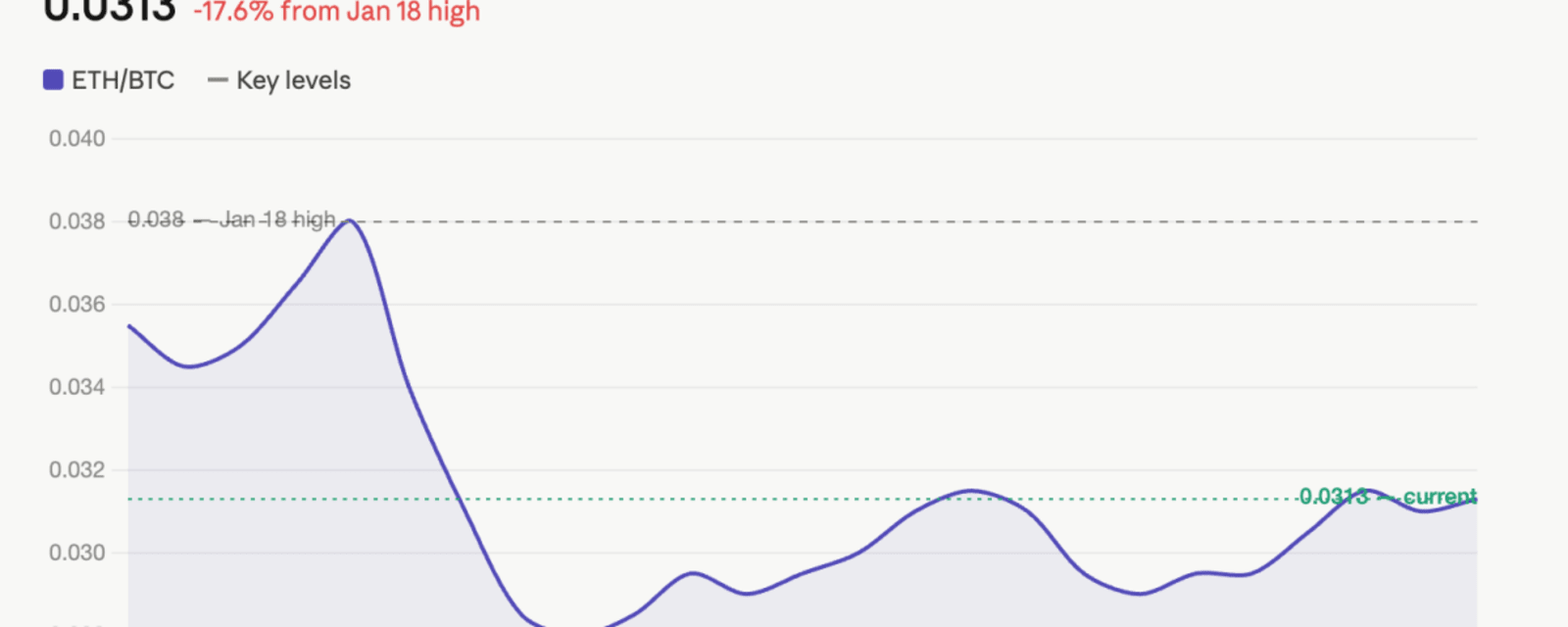
Key Takeaways
- • Ethereum traded at $2,141 on March 23, 2026, up 5% in 24 hours and 9.94% over one month, but remains 57% below its August 2025 peak of $5,000, signaling persistent structural underperformance relative to Bitcoin despite tactical bounces.
- • ETH/BTC ratio continues compressed throughout 2026, with Ethereum underperforming Bitcoin despite weekly gains of 3.51% (week of March 16), reflecting sustained relative weakness and systematic rejection of rallies above the $2,150 resistance level.
- • Ethereum holder retention has rebounded from 4-year lows, but network growth has slowed and the $1,800 support level remains critical; the Crypto Fear and Greed Index sits at extreme lows (8 out of 100), indicating deep defensive positioning rather than accumulation confidence.
- • Standard Chartered forecasts Ethereum will decline to $1,400 before recovering to $4,000 by end-2026, citing 43% drops in Ethereum ETF holdings from August 2025 peaks ($23 billion down to $13 billion), though long-term institutional involvement is expected to provide downside cushion.
- • Digital asset volatility has cooled materially across the sector, with Bitcoin volatility declining from 56.03 to 53.49 on the BVXS gauge (week ending March 13), while all major cryptocurrencies posted positive weekly returns despite year-to-date losses ranging from Ethereum's -29.77% to Bitcoin's -18.61%.
Summary
The Ethereum-Bitcoin ratio has staged a technical bounce from 2026 lows, but institutional investors face a paradox: while the asset has recovered tactically, structural underperformance persists and conviction remains absent. As of March 23, 2026, Ethereum traded at $2,141—up 5% in 24 hours and nearly 10% from one month prior—yet this headline recovery masks a market where every rally attempt above $2,150 has been systematically rejected by sellers using bounces as distribution points. The asset sits 57% below its August 2025 peak of $5,000, with a market capitalization of $233 billion that continues to compress relative to Bitcoin's relative strength.
The technical picture reflects genuine institutional engagement but equally genuine demand destruction. The Crypto Fear and Greed Index (Alternative.me) sits at 8 out of 100—Extreme Fear—signaling that while there are catalysts and institutional buyers entering the market, the dominant market emotion remains defensive positioning rather than accumulation confidence. A $270 million short liquidation spike in a single 60-minute window on March 23 underscores volatility, but this occurred around geopolitical catalysts (Trump's Iran announcement) rather than sustained fundamental recovery. The $1,800 support level has held through weeks of selling pressure, a technically significant floor, yet the inability to break $2,150 with conviction suggests distribution rather than capitulation bottoming.
Year-to-date performance through mid-March tells the broader story: Ethereum has declined 29.77% against Bitcoin's 18.61% loss, exemplifying the relative compression of the ETH/BTC pair throughout 2026. However, weekly relief rallies have emerged, with Ethereum rising 3.51% in the week ending March 16, 2026, alongside Bitcoin's 3.62% gain. This relief is broad-based—every major digital asset posted positive weekly returns across that period—yet remains insufficient to repair year-to-date losses, suggesting directional recovery without balance-sheet confidence.
Standard Chartered's medium-term outlook provides institutional context: the bank forecasts further near-term downside, with Ethereum potentially declining to $1,400 before recovering to $4,000 by year-end 2026. This projection follows significant deleveraging: Ethereum ETF holdings have fallen 43% from August 2025 peaks ($23 billion down to $13 billion), while Bitcoin ETF holdings dropped 41% from their October 2025 peak of $165 billion to $96 billion. Geoff Kendrick, Standard Chartered's head of digital asset research, characterized this as a sign of market maturation, noting that institutional involvement is expected to cushion downside compared to previous cycles. Ethereum holder retention has rebounded from 4-year lows, though network growth has slowed, creating mixed signals about conviction at current levels.
Volatility compression across digital assets also suggests a market searching for direction. The CME CF Bitcoin Volatility Settlement gauge (BVXS) declined from 56.03 to 53.49 in the week ending March 13, while realized volatility fell 9.16 points to 52.56, indicating calmer market structure. Yet this volatility relief has not translated into sustained directional momentum, leaving the ETH/BTC ratio in a precarious position where technical bounces lack the conviction necessary to signal a durable recovery.
Go deeper than the headline
Research every firm in this story, track the ones that matter and get the daily briefing — free for 7 days.