
Key Takeaways
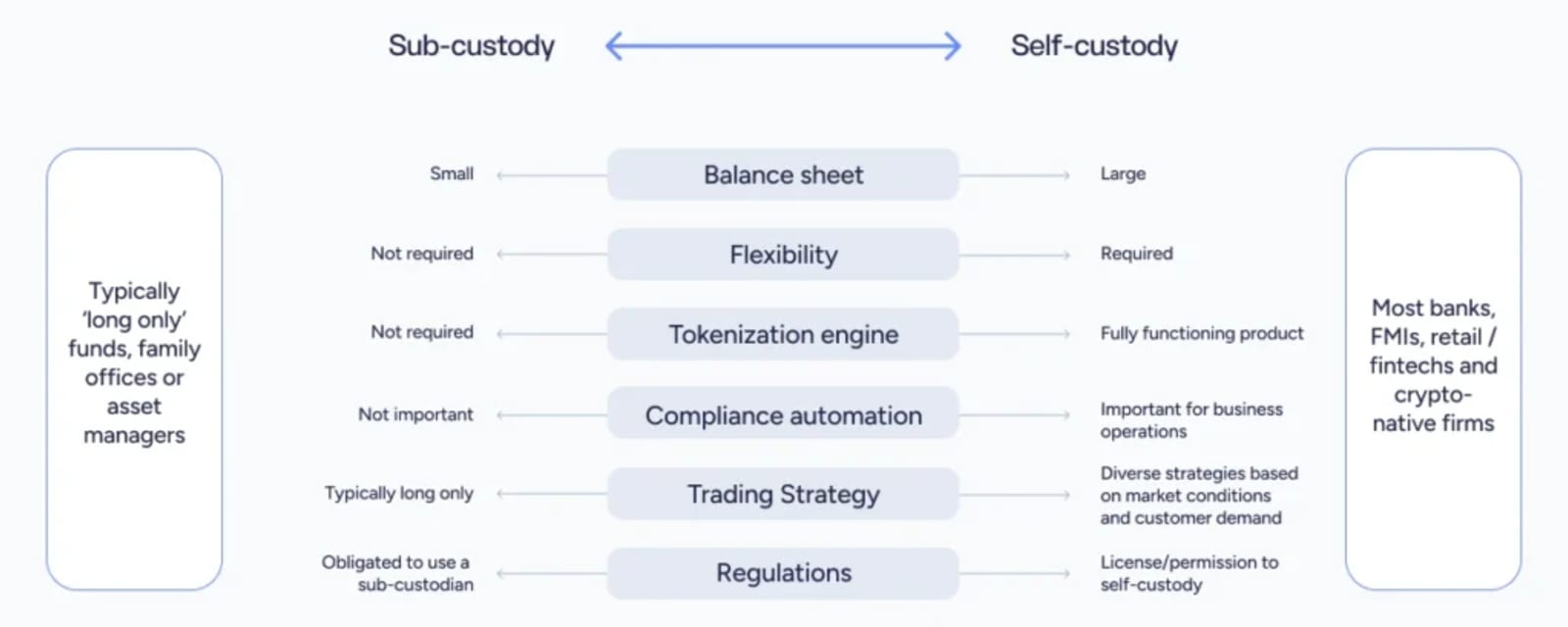
- • Custody model choice is strategic, not operational: Banks must decide between direct custody (controlling wallets and assets directly) and sub-custody (relying on third-party custodians), a decision that determines operational control, competitive positioning, and revenue potential across all digital asset services.
- • Control placement has shifted to the wallet layer: Unlike traditional custody housed in core banking systems, digital asset control now resides at the wallet layer, requiring institutions to rethink how approvals, security policies, and transaction enforcement are implemented across blockchain networks.
- • Two foundational questions define institutional positioning: Institutions must determine (1) how much control over assets themselves is required, and (2) what level of connectivity is needed to operate across onchain networks—these answers collectively shape wallet infrastructure and market participation boundaries.
- • Direct custody enables faster product launches and market scaling: Banks with direct custody capabilities gain meaningful advantages in speed, flexibility, and ability to scale services in continuous 24/7 digital asset markets, while also positioning themselves for stablecoin issuance and tokenized asset services.
- • Custody infrastructure unlocks downstream revenue opportunities: Once custody is established, banks are positioned to expand into stablecoins, tokenized asset issuance, and embedded DeFi solutions, with custody serving as the foundation for participation in emerging finance ecosystems blending traditional and blockchain-native models.
Summary
The architecture of digital asset custody fundamentally differs from traditional financial custody, requiring banks to abandon legacy assumptions and adopt wallet-layer control mechanisms. According to Fireblocks' strategic analysis, the shift reflects a structural reality: control that traditionally sat inside core banking systems must now be applied at the wallet layer, where transactions execute on distributed networks. This architectural distinction creates a strategic fork that banks must navigate early in their digital asset strategy. The two core questions institutions face—how much direct asset control is required, and what level of onchain network connectivity is needed—directly determine the wallet infrastructure they deploy and ultimately define their competitive positioning in digital markets.
The direct versus sub-custody decision carries material implications for operational control and revenue capture. Banks choosing direct custody retain control over asset movement, approval workflows, and policy enforcement, enabling faster product launches and tighter compliance management. This approach provides stronger governance over stablecoin activities, tokenized assets, and compliance risk. Conversely, sub-custody models delegate these functions to specialized third-party custodians, reducing operational complexity but ceding direct control and potentially limiting speed to market. Major institutional custodians including State Street, BNY Mellon, and others are now offering bank-grade digital asset custody services, but the strategic question remains whether institutions should build or outsource these capabilities.
Once custody infrastructure is established, banks unlock a pipeline of higher-value services. Institutions with direct custody are well-positioned to issue stablecoins, participate in tokenized asset markets, and integrate embedded decentralized finance (DeFi) solutions—revenue streams largely unavailable to banks without custody capabilities. The custody decision thus becomes the first strategic choice in digital asset strategy, with implications that ripple across product development, market participation, and long-term competitive advantage. As regulatory clarity improves and institutional adoption accelerates, banks that have established clear custody models and wallet infrastructure are positioned to scale digital asset services in markets that operate continuously, a competitive advantage that traditional banking's 9-to-5 operating model cannot replicate.
Go deeper than the headline
Research every firm in this story, track the ones that matter and get the daily briefing — free for 7 days.