
Key Takeaways
- • DRW CEO Don Wilson argues that crypto perpetual futures should be classified as futures, contending that the absence of an expiry date does not qualitatively distinguish perpetuals from other standard derivatives.
- • According to the article, the U.S. now offers perpetual-style Bitcoin and Ether futures with regulated clearing (2025) and is positioned to permit true perpetuals (2026), after perpetuals were largely unavailable to U.S. retail traders on a regulated basis.
- • The CFTC is studying how to bring perpetuals within existing futures law, while the SEC has taken a more cautious approach given its jurisdiction over securities and other assets.
- • Regulators' central concerns are excessive leverage (for example, 10x leverage magnifying losses), manipulation risk, price discovery, collateralization, liquidation, and funding-rate transparency.
- • Coinbase has begun offering perpetual-style Bitcoin and Ether futures in the U.S. and launched regulated institutional access to its derivatives, and Kraken has announced plans for U.S. perpetual products.
Summary
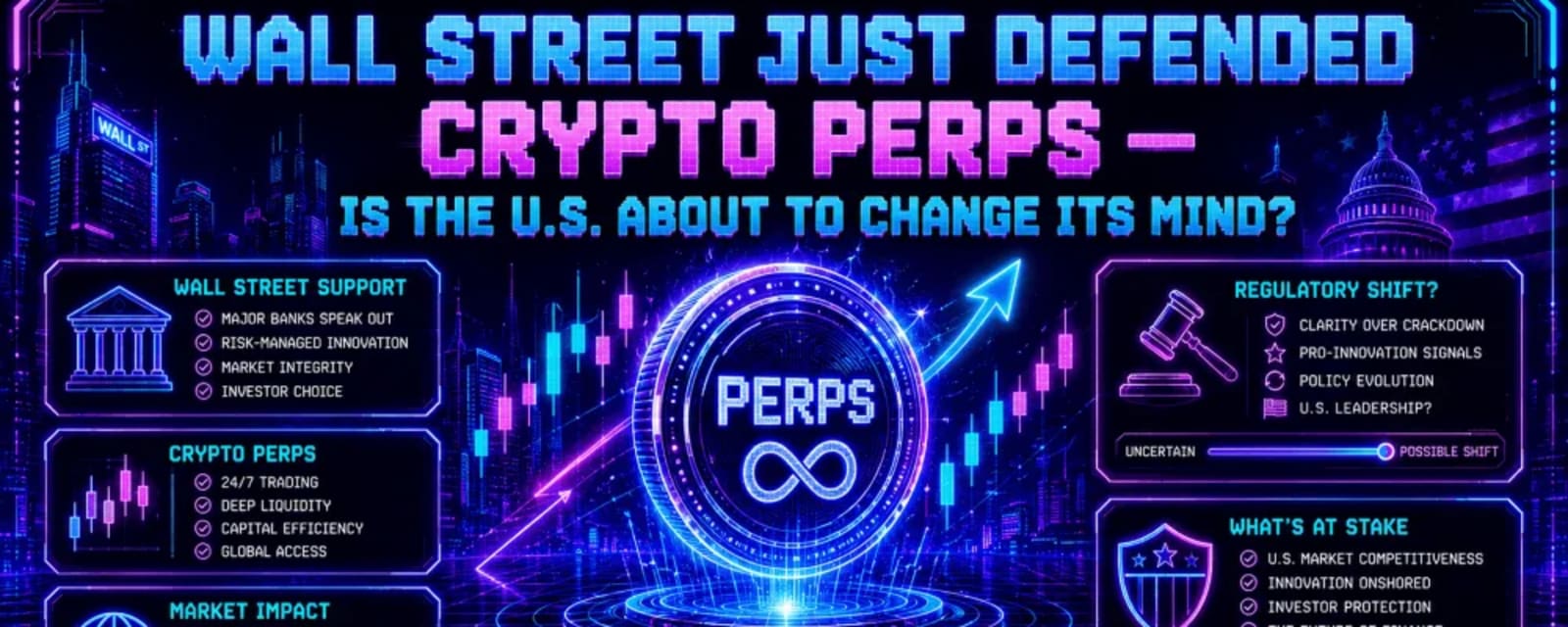
Crypto perpetual futures, derivatives with no expiration date that use funding payments to keep prices near reference rates, dominate leveraged crypto trading outside the United States. According to the article, that dynamic may be about to change as DRW CEO Don Wilson advocates classifying perpetuals as futures. Wilson argues that removing the expiry date does not qualitatively differentiate perpetuals from other derivatives, which likewise provide exposure to an underlying asset, use leverage, and rely on risk management systems. He contends that regulators fail to separate responsible product design from reckless trading practices, and that proper margin requirements, liquidation rules, and market surveillance should address leverage risk.
The article reports that crypto perps were previously unavailable to most U.S.-based traders on a regulated basis, though not due to a blanket ban. Instead, differences in derivatives regulation, particularly stricter rules on leverage and on listing new products on centralized exchanges, constrained availability. The CFTC, which oversees regulated futures markets, has been considering how to bring perpetuals within existing law, while the SEC, with jurisdiction over securities, has taken a more cautious stance. The article notes that a spot-only exchange cannot simply add leveraged derivatives without licenses and clearing, custody, risk management, and settlement arrangements.
Regulatory concerns center on excessive leverage. The article illustrates that at 10x leverage, a small adverse price move can produce significant losses or a total loss of capital, with liquidations triggered by even smaller moves in volatile crypto assets. Regulators also cite potential market manipulation and the need for sound price discovery, along with collateral, liquidation, funding-rate, and transparency standards.
The article characterizes the current federal approach as developing clearer guidelines for crypto, with the SEC and CFTC working with industry stakeholders on perpetuals. It points to the House's passage of the CLARITY Act in 2025 and Senate work in 2026 as steps toward clearer derivatives guidance. Coinbase and Kraken are identified as exchanges likely to benefit. The article argues that regulated perpetuals could expand institutional access for hedging, short selling, and basis trading, and could deepen liquidity, tighten market-maker spreads, and strengthen arbitrage convergence among perpetuals, spot assets, ETFs, and dated futures.
Go deeper than the headline
Research every firm in this story, track the ones that matter and get the daily briefing — free for 7 days.