
Key Takeaways
- • Sygnum co-founder and Asia-Pacific executive chairman Gerald Goh said keeping digital assets at zero is itself an active investment decision, with appropriate crypto allocation depending on investment horizon and loss-absorption capacity rather than a fixed percentage.
- • Goh said Sygnum's client base increasingly wants cash, cryptocurrencies and money market funds managed through a single institution, prompting its expansion from crypto trading and custody into portfolio advisory and discretionary asset management across traditional and digital assets.
- • Goh cited diversification as the most frequently given reason for client digital asset investment in Sygnum's client survey last year.
- • Goh highlighted custody risk, warning that even a diversified portfolio could suffer losses if a custodian is hacked or mishandles client assets.
- • Goh said many Korean financial institutions were exploring partnerships with overseas digital asset firms, with regulatory scope in Korea remaining the key constraint.
Summary
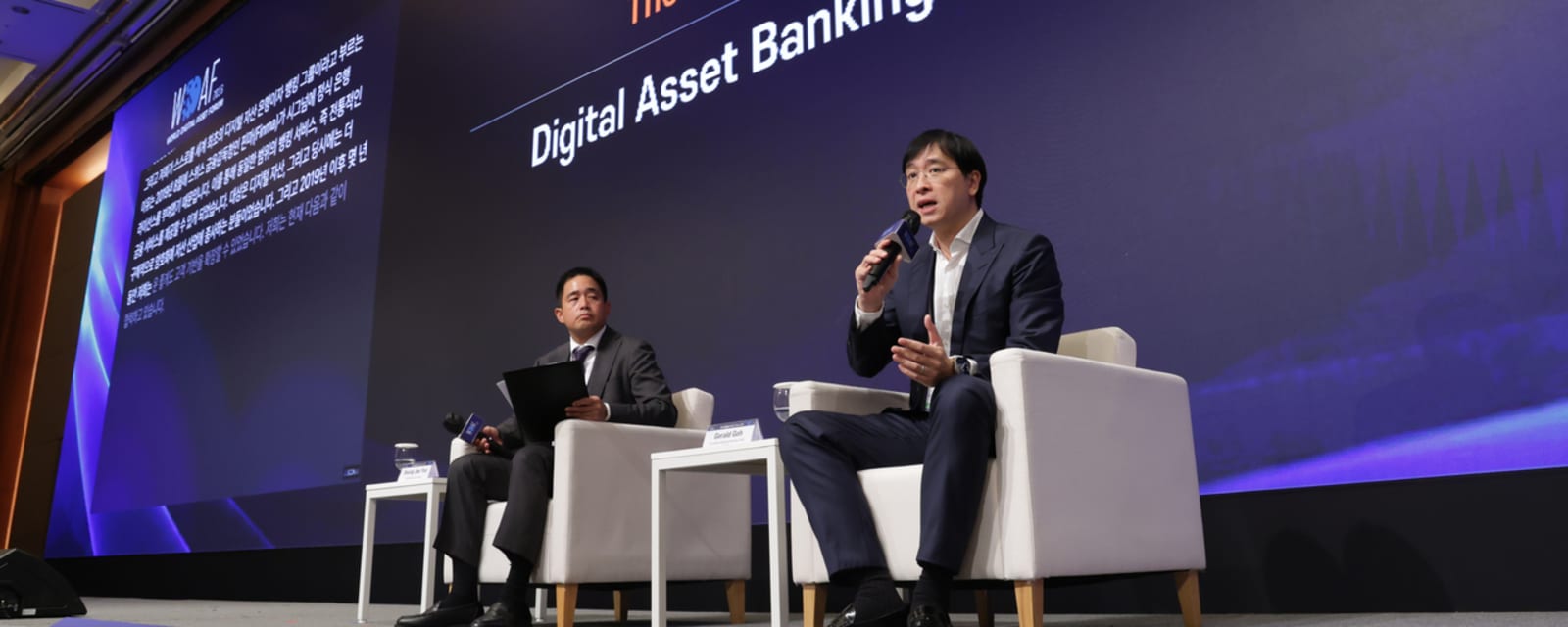
Sygnum co-founder and Asia-Pacific executive chairman Gerald Goh told the World Digital Assets Forum 2026 in Seoul on Monday that wealthy investors are increasingly weighing how much cryptocurrency exposure to hold, and that a zero allocation is not a passive default. "The decision not to include digital assets, so staying at zero, let's also be clear, that is an active decision," Goh said during a fireside chat moderated by Yoo Seung-jae, an attorney at Kim & Chang. He said the appropriate allocation depends on investors' investment horizons and their ability to absorb losses, rather than a fixed percentage suitable for all.
Goh described a broader shift in private wealth management from simply buying and holding cryptocurrencies toward integrating digital assets into overall portfolios. Sygnum initially helped clients hold, trade and convert cryptocurrencies into cash, while many investors kept digital assets with exchanges or specialized custodians and managed traditional holdings through banks and brokerages. Goh said this arrangement "introduces friction" as well as cost and risk. Clients increasingly sought to manage cash, cryptocurrencies and money market funds through one institution, leading Sygnum to expand into portfolio advisory and discretionary asset management covering both traditional and digital assets. Diversification was the most frequently cited reason for investing in digital assets in Sygnum's client survey last year, Goh said.
On generating returns during crypto market weakness, a topic Yoo described as "a challenging time" for the sector, Goh said some strategies do not depend solely on rising prices. These include earning staking rewards on eligible tokens, lending bitcoin and exploiting price differences across trading markets. He also emphasized custody arrangements, warning that even a diversified portfolio could suffer losses if a custodian is hacked or mishandles client assets.
For Korean banks, Goh said the convergence of traditional and digital asset management could open opportunities for new wealth management services. He said many Korean financial institutions he met this year were exploring partnerships with overseas digital asset firms for technology and strategic expertise while deciding which capabilities to build internally. "There's now a whole universe of service providers, many of whom, like us, are fully regulated in offshore locations," he said, adding that their experience could be applied in Korea "when domestic regulations allow these products and services to be offered here." The scope of such services will depend on Korea's evolving regulatory framework.
Go deeper than the headline
Research every firm in this story, track the ones that matter and get the daily briefing — free for 7 days.