
Key Takeaways
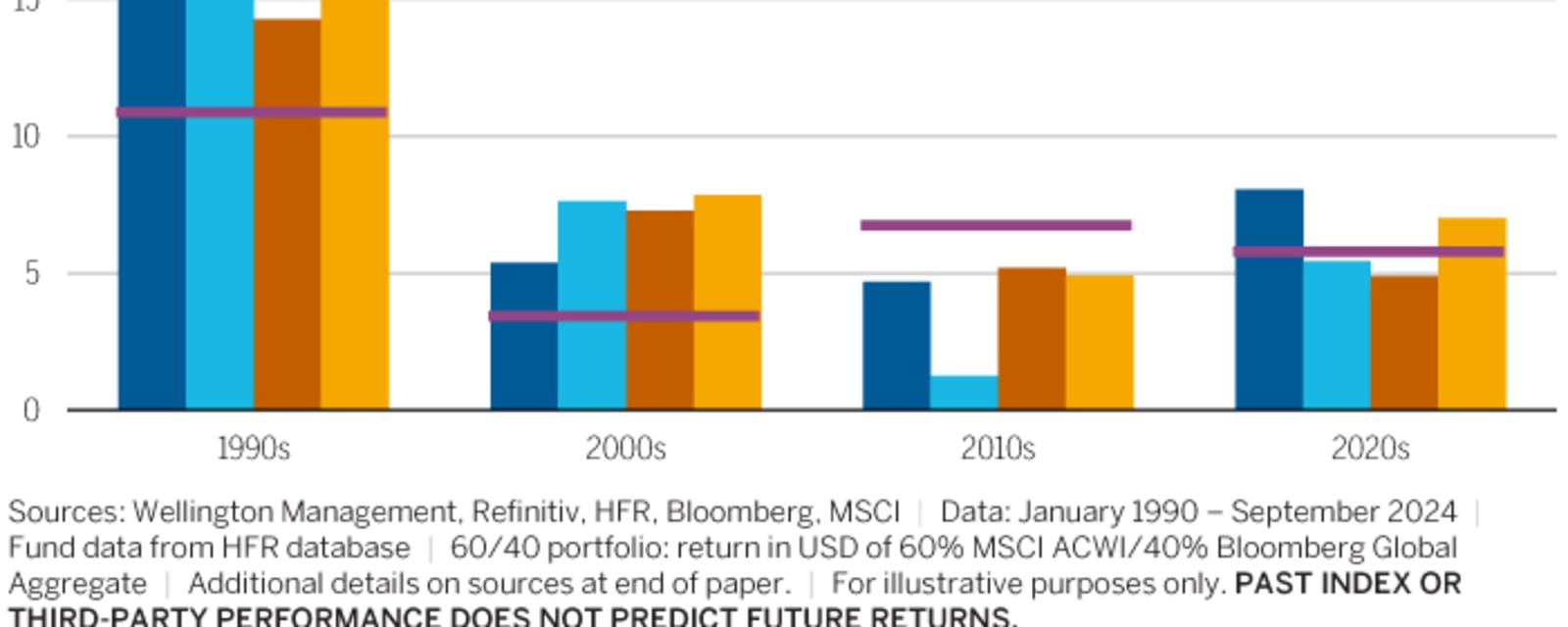
- • Hedge funds significantly outperformed a 60% equity/40% bond portfolio during the 1990s and 2000s, but delivered lackluster returns throughout the 2010s, with macro funds experiencing particular weakness during that period.
- • "Goldilocks" economic periods characterized by low stock dispersion and low macro volatility have historically posed headwinds for hedge fund returns, despite benefiting broader investor portfolios over the past decade.
- • Hedge fund performance has improved substantially in the 2020s, particularly for equity long/short strategies, driven by three key performance drivers: higher security-level dispersion, elevated macro volatility, and rising interest rates.
- • The hedge fund industry's maturation over 30+ years—marked by increased competition and regulation—has elevated manager selection as a critical determinant of investment success relative to the historical performance of the broader hedge fund asset class.
- • Current market conditions suggest hedge funds are entering an environment favorable for outperformance, characterized by elevated volatility and dispersion that contrasts sharply with the low-volatility regime that pressured returns during the 2010s.
Summary
Analysis of over 30 years of hedge fund performance data reveals a counterintuitive relationship between macroeconomic stability and hedge fund returns. While "Goldilocks" economic periods—defined by low stock dispersion, low macro volatility, and stable conditions—have generally supported overall portfolio performance, these same periods have historically constrained hedge fund returns. This paradox explains the divergent performance trajectories across recent decades.
The 1990s and 2000s proved exceptionally favorable for hedge funds, during which the asset class substantially outpaced both a conventional 60% equity/40% bond portfolio and the broader equity market. However, the subsequent decade marked a significant deterioration in hedge fund performance. The 2010s represented a challenging period for the industry, with macro-focused strategies underperforming particularly sharply. This underperformance coincided with an extended period of low volatility, compressed security-level dispersion, and stable macroeconomic conditions—the exact "Goldilocks" environment that, while supportive for traditional balanced portfolios, constrains hedge fund alpha generation.
The 2020s have demonstrated a marked reversal of this trend. Equity long/short hedge funds have delivered notably improved returns in the early years of this decade, suggesting a fundamental shift in the market regime. This performance improvement aligns with three identifiable drivers: elevated security-level dispersion, increased macro volatility, and higher interest rate environments. These conditions create the asymmetric opportunities that hedge fund strategies are structurally designed to exploit.
The maturation and competitive intensification of the hedge fund industry over three decades has simultaneously increased both the sophistication of the asset class and the difficulty of generating consistent outperformance. Enhanced regulatory oversight and increased capital flows have compressed the inefficiencies that historically provided return opportunities. Against this backdrop, the selection of skilled managers with demonstrated alpha-generation capabilities has become increasingly central to investment success. Returns will likely diverge more sharply between superior and average managers, making due diligence and manager research essential components of institutional hedge fund allocation decisions.
The 1990s and 2000s proved exceptionally favorable for hedge funds, during which the asset class substantially outpaced both a conventional 60% equity/40% bond portfolio and the broader equity market. However, the subsequent decade marked a significant deterioration in hedge fund performance. The 2010s represented a challenging period for the industry, with macro-focused strategies underperforming particularly sharply. This underperformance coincided with an extended period of low volatility, compressed security-level dispersion, and stable macroeconomic conditions—the exact "Goldilocks" environment that, while supportive for traditional balanced portfolios, constrains hedge fund alpha generation.
The 2020s have demonstrated a marked reversal of this trend. Equity long/short hedge funds have delivered notably improved returns in the early years of this decade, suggesting a fundamental shift in the market regime. This performance improvement aligns with three identifiable drivers: elevated security-level dispersion, increased macro volatility, and higher interest rate environments. These conditions create the asymmetric opportunities that hedge fund strategies are structurally designed to exploit.
The maturation and competitive intensification of the hedge fund industry over three decades has simultaneously increased both the sophistication of the asset class and the difficulty of generating consistent outperformance. Enhanced regulatory oversight and increased capital flows have compressed the inefficiencies that historically provided return opportunities. Against this backdrop, the selection of skilled managers with demonstrated alpha-generation capabilities has become increasingly central to investment success. Returns will likely diverge more sharply between superior and average managers, making due diligence and manager research essential components of institutional hedge fund allocation decisions.
Go deeper than the headline
Research every firm in this story, track the ones that matter and get the daily briefing — free for 7 days.