
Key Takeaways
- • Major policy reversal underway: Schools across multiple states (Kansas, North Carolina, Virginia, Maryland, Michigan) are actively dismantling one-to-one laptop programs after years of significant capital investment, signaling a fundamental shift in education technology spending.
- • Performance data contradicts tech adoption thesis: Long-term studies show negligible or negative correlation between classroom device deployment and academic outcomes—Maine's 15-year laptop initiative (launched 2002) yielded no measurable improvement in test scores, per NPR analysis.
- • Behavioral distraction concerns override educational benefits: McPherson Middle School (Kansas) found that unrestricted device access drove off-task behavior (YouTube, gaming, Gmail harassment) despite concurrent cell phone bans, forcing transition to on-demand laptop access rather than universal distribution.
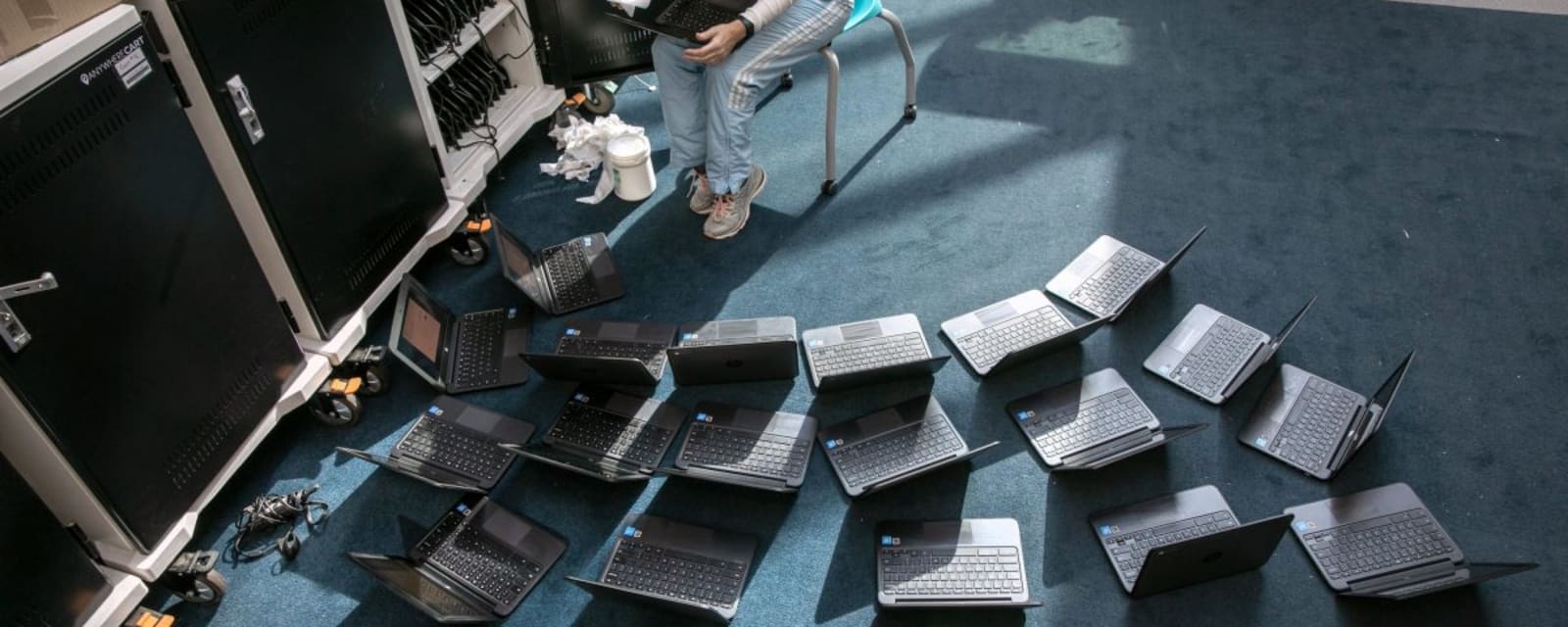
- • Estimated capital write-off potential: Millions of dollars in Chromebook and device investments now sit unused in classroom carts, representing sunk capital that generated no documented learning gains and may signal broader malinvestment in EdTech sector.
- • Operational model shift to instructor-controlled access: Schools transitioning to assignment-based laptop use and library checkout systems, fundamentally reducing per-device utilization rates and questioning the ROI thesis that underpinned mass deployment budgets.
Summary
A coordinated policy reversal is underway across American school districts, with administrators publicly acknowledging that large-scale classroom technology adoption—championed for over a decade—has failed to deliver promised educational outcomes and is now being systematically dismantled.
McPherson Middle School in central Kansas exemplifies this shift. After implementing a one-to-one Chromebook program, the school banned cell phones in 2020 but continued unrestricted laptop access, only to discover students were exploiting the devices for YouTube viewing, gaming, and harassment via school Gmail accounts. In December 2025, administrators directed all 480 students to surrender laptops, transitioning to pen-and-paper note-taking with selective teacher-assigned device access. Principal Inge Esping, named Kansas's Middle School Principal of the Year for 2025, articulated the emerging consensus: "This technology can be a tool. It is not the answer to education."
The pattern extends beyond Kansas. Schools in North Carolina, Virginia, Maryland, and Michigan are simultaneously reconsidering and reversing comparable programs that represented substantial capital expenditure. The driver is empirical: long-term academic data contradicts the technology-adoption hypothesis. Maine, among the first states to adopt universal laptop distribution (2002), saw no measurable improvement in test scores after 15 years of continuous program investment, according to NPR reporting cited by neuroscientist and former teacher Jared Cooney Horvath in formal testimony to Congress.
The operational model now shifting toward demand-based distribution—where students borrow devices from library systems for specific assignments rather than receiving personal machines—substantially reduces per-device utilization and raises fundamental questions about the capital efficiency of prior purchasing decisions. This represents a de facto admission by school administrators that technology adoption was driven by policy assumption rather than validated learning outcomes, leaving districts with deprecating inventories of Chromebooks in classroom storage carts and accumulated opportunity costs in diverted capital budgets.
Go deeper than the headline
Research every firm in this story, track the ones that matter and get the daily briefing — free for 7 days.