
Key Takeaways
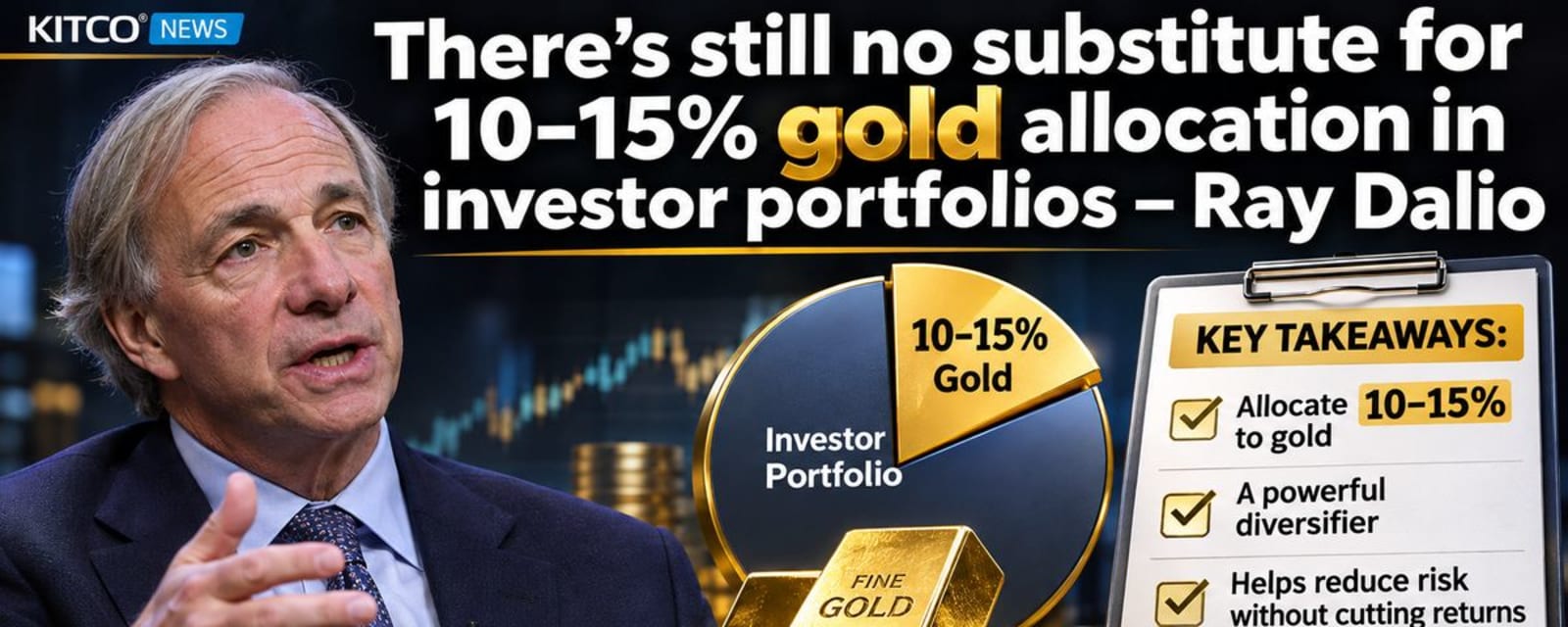
- • Ray Dalio, founder of Bridgewater Associates, told Kitco News that a 10% to 15% gold allocation is the right move regardless of where investors are in the investment cycle.
- • Dalio argued gold is an effective diversifier when the credit system is abnormal, citing excessive debt and large problems as the conditions where gold performs.
- • Dalio said cryptocurrencies cannot fulfill gold's role because they can be monitored and taken legally, while gold is held by central banks and is not dependent on a counterparty.
- • Dalio cited central banks and sovereign wealth funds shifting from Treasuries toward gold, and noted gold rose 67%.
- • Dalio's framework starts with knowing the amount needed for stable living, planning for roughly 3% annual inflation erosion and a 50% worst-case drawdown.
Summary
Ray Dalio, founder of Bridgewater Associates, said in a recent interview with Kitco News that gold is irreplaceable as an effective diversifier in investor portfolios and that a 10% to 15% allocation is appropriate regardless of where investors stand in the investment cycle. He framed the foundation of any portfolio as knowing how much capital is needed to maintain stability, then securing that amount through safe, diversified investing. Dalio recommended estimating that inflation will erode an average of about 3% of investment value annually and preparing for a worst-case scenario of a 50% drawdown.
On diversification, Dalio described what he called the "holy grail of investing": reducing risk without reducing returns. He said 10 to 15 good uncorrelated investments can reduce risk by almost five times, allowing the same return with one-fifth of the risk. On gold specifically, he said most financial markets perform well when the credit system is normal, but gold is an effective diversifier when there is too much debt and significant systemic problems. He said a traditional portfolio holding 10% to 15% in gold would be well diversified whether investors expect good or bad times.
Dalio also argued that cryptocurrencies cannot fill gold's role. While acknowledging crypto's privacy benefits during difficult periods, he said central banks hold gold because it is securely in their possession, whereas digital assets can be monitored and restricted legally. He said he finds crypto less appealing than gold.
Speaking at the World Economic Forum in Davos earlier this year, Dalio discussed the convergence of debt, capital flows, domestic politics and international conflict. He said central banks and sovereign wealth funds are pivoting from Treasuries toward gold, and warned that heavy sovereign debt creates supply pressure on bonds. He also pointed to geopolitical risk, including sanctions concerns for holders of U.S. dollar-denominated debt, and said central banks are "moving to gold," which he described as the second-largest currency. Dalio cited gold's 67% gain as evidence of this shift and urged investors to pay attention to buyer behavior and domestic conditions.
Go deeper than the headline
Research every firm in this story, track the ones that matter and get the daily briefing — free for 7 days.