
Key Takeaways
- • Cybersecurity is framed as a weakest-link public good: a breach at one bank can spread through shared payment systems, cloud services, and third-party technology providers, so one institution's defenses affect the wider financial system.
- • The paper (Anand, Duley and Gai, Review of Finance, 2026, as summarized by Alpha Architect) identifies free-riding as a reason banks may underinvest in cybersecurity, while the threat of a bank run pushes banks toward stronger defenses.
- • Prevention and operational resilience are distinct and compete for limited resources; higher rollover risk favors preventative cybersecurity, while more intense cyber threats favor resilience spending.
- • Regulatory tools such as minimum cybersecurity standards, negligence rules, cyber hygiene requirements, and funding-structure rules are presented as ways to align private choices with system-wide stability.
- • For institutional investors, the analysis argues that a financially sound bank can still face serious operational risk, making cyber governance, technology dependencies, and business continuity relevant to due diligence.
Summary
Alpha Architect published a research summary by Elisabetta Basilico, PhD, CFA, of a 2026 paper by Anand, Duley and Gai in the Review of Finance. The article argues that banks have traditionally focused on credit losses, liquidity shortages, and market volatility, but growing dependence on digital infrastructure has created a separate vulnerability. Because banks rely on interconnected payment systems, cloud services, and third-party technology providers, a disruption at one institution can spread to others and erode confidence in the financial system.
The paper frames cybersecurity as a weakest-link public good. Investments by one bank can protect peers, while weak defenses at one institution can weaken the network. This creates a free-riding problem: because not all benefits of a bank's cybersecurity spending accrue to that bank, individual decisions can be rational yet leave the system under-protected. The authors note that decentralized decisions may produce inefficient outcomes, and that the inefficiency does not always take the form of underinvestment.
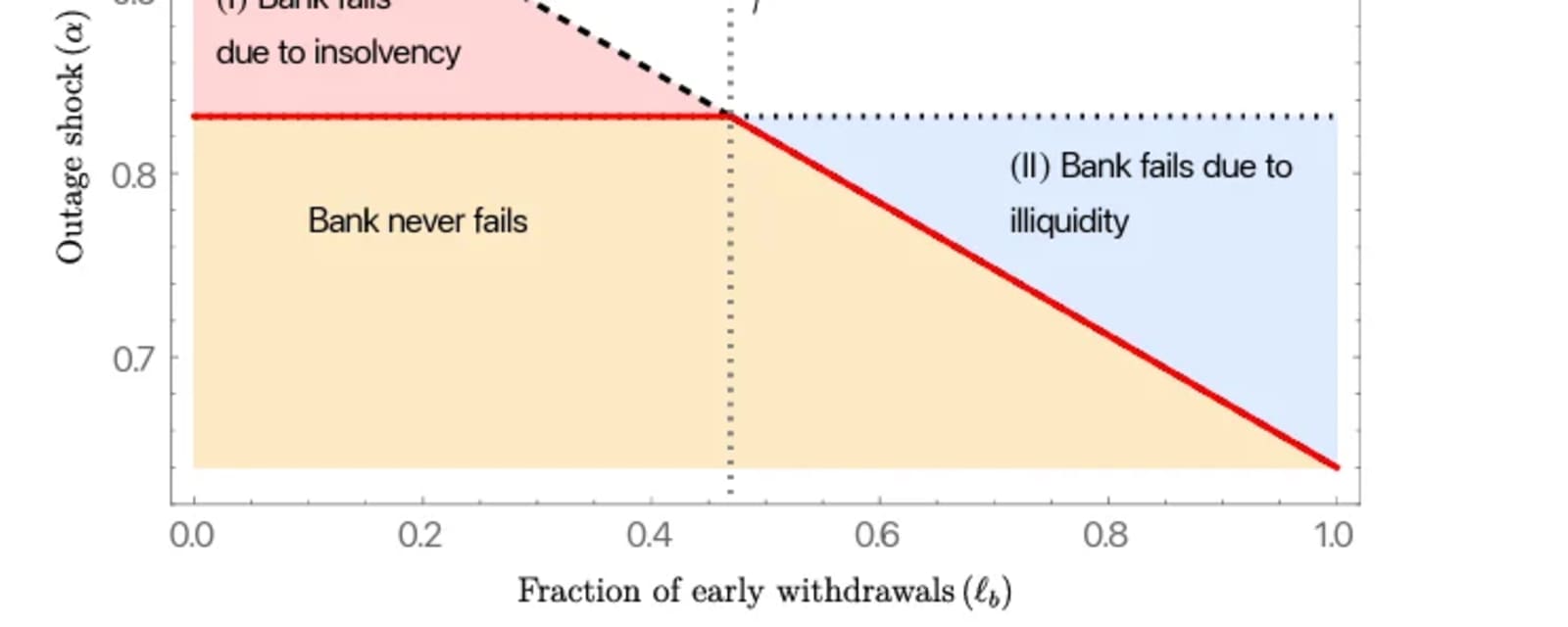
The model also identifies a countervailing force. The possibility of a bank run can encourage stronger defenses, since a successful attack may disrupt operations and prompt depositors or creditors to withdraw funds or refuse to renew financing. The authors describe free-riding as discouraging investment and rollover risk as encouraging it, and find that when rollover risk is sufficiently high, banks may invest more in cybersecurity than is socially optimal.
The paper separates prevention from resilience. Cybersecurity reduces the likelihood of a successful intrusion, while backup systems and recovery procedures help institutions keep operating after an attack. Banks must allocate resources between the two. According to the summary, more intense cyber threats encourage resilience investment, while higher rollover risk strengthens incentives for prevention. The abstract adds that cybersecurity entails lower balance-sheet returns, and that the socially optimal level differs from the private choice, so corrective instruments must target either the protection or resilience margin.
On policy, the authors examine minimum cybersecurity standards, negligence rules, cyber hygiene requirements, and regulation of bank funding structures. They also highlight mapping dependencies between banks and technology providers to support cybersecurity stress tests. For advisors, the article recommends adding cybersecurity governance, technology dependencies, and business continuity to institutional risk assessments, recognizing that diversification may not offset exposure to a shared critical provider, and treating cyber-driven operational shocks as a possible financial stability scenario. The article notes that its purpose is not to predict a cyber-induced crisis but to show how technological disruption could amplify existing vulnerabilities. The research is hypothetical and modeled, and the article is provided for educational purposes.
The paper frames cybersecurity as a weakest-link public good. Investments by one bank can protect peers, while weak defenses at one institution can weaken the network. This creates a free-riding problem: because not all benefits of a bank's cybersecurity spending accrue to that bank, individual decisions can be rational yet leave the system under-protected. The authors note that decentralized decisions may produce inefficient outcomes, and that the inefficiency does not always take the form of underinvestment.
The model also identifies a countervailing force. The possibility of a bank run can encourage stronger defenses, since a successful attack may disrupt operations and prompt depositors or creditors to withdraw funds or refuse to renew financing. The authors describe free-riding as discouraging investment and rollover risk as encouraging it, and find that when rollover risk is sufficiently high, banks may invest more in cybersecurity than is socially optimal.
The paper separates prevention from resilience. Cybersecurity reduces the likelihood of a successful intrusion, while backup systems and recovery procedures help institutions keep operating after an attack. Banks must allocate resources between the two. According to the summary, more intense cyber threats encourage resilience investment, while higher rollover risk strengthens incentives for prevention. The abstract adds that cybersecurity entails lower balance-sheet returns, and that the socially optimal level differs from the private choice, so corrective instruments must target either the protection or resilience margin.
On policy, the authors examine minimum cybersecurity standards, negligence rules, cyber hygiene requirements, and regulation of bank funding structures. They also highlight mapping dependencies between banks and technology providers to support cybersecurity stress tests. For advisors, the article recommends adding cybersecurity governance, technology dependencies, and business continuity to institutional risk assessments, recognizing that diversification may not offset exposure to a shared critical provider, and treating cyber-driven operational shocks as a possible financial stability scenario. The article notes that its purpose is not to predict a cyber-induced crisis but to show how technological disruption could amplify existing vulnerabilities. The research is hypothetical and modeled, and the article is provided for educational purposes.
Go deeper than the headline
Research every firm in this story, track the ones that matter and get the daily briefing — free for 7 days.