
Key Takeaways
- • Managed futures strategies are positioned to benefit from market volatility rather than suffer from it, offering portfolio diversification during periods of elevated uncertainty and macro uncertainty.
- • The VIX (Chicago Board Options Exchange Volatility Index) serves as a key measure of expected S&P 500 volatility over a 30-day forward period; a VIX reading of 25 implies an annualized volatility expectation of 25%, or approximately 1.88% daily market movement.
- • Historical volatility patterns show increased expected market turbulence in recent years compared to the 1990s baseline; the monthly VIX exceeded 20% above its historical average of 21 only 13% of the time during the 1990s.
- • Time series momentum (TSMOM) is identified as a primary driver of managed futures returns, enabling these strategies to generate returns during macro volatility events through systematic trend-following approaches.
- • Market-neutral and trend-following strategies are common approaches within managed futures, with institutional investors considering a 5% to 10% allocation range as optimal for balanced portfolios seeking long-term diversification benefits.
Summary
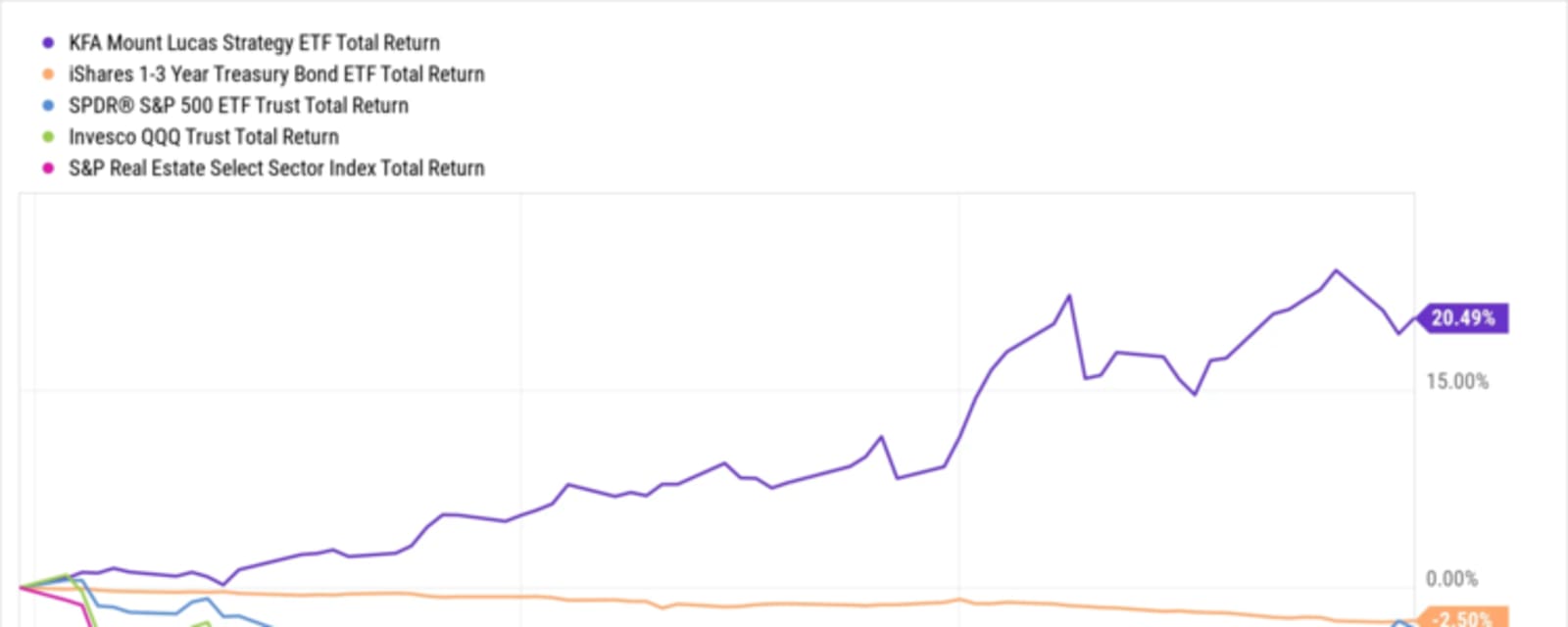
The sustained elevation in market volatility during the first quarter of 2022—driven by inflationary concerns, geopolitical tensions, and rising U.S. interest rates—has renewed focus on portfolio construction strategies that can withstand or profit from market dislocations. Managed futures strategies have emerged as a relevant tool for institutional portfolios precisely because they are structured to generate returns during periods of heightened volatility rather than merely endure them passively.
The VIX remains the primary barometer for near-term expected volatility in equity markets. The index measures implied volatility embedded in S&P 500 index option prices over a 30-day forward horizon on an annualized basis. At a VIX level of 25, the market is pricing in an expected annualized volatility of 25%, which translates to approximately 1.88% of potential daily movement in either direction. Critically, elevated VIX readings do not necessarily indicate directional bearishness; rather, they signal increased expected price movement in both directions, creating trading opportunities for strategies designed to capture trend reversals and momentum shifts.
Historical analysis reveals that market volatility expectations have intensified materially over the past decade relative to the 1990s baseline. The average monthly VIX from 1990 through 2011 stood at approximately 21. However, when comparing volatility patterns across decades, the incidence of elevated volatility has increased significantly; the monthly VIX exceeded 20% above its historical average only 13% of the time during the 1990s, suggesting a structural shift in market dynamics.
Managed futures employ systematic approaches, with time series momentum (TSMOM) identified as a primary return driver, enabling these strategies to profit across multiple asset classes and market regimes. The most common implementations include market-neutral and trend-following strategies. Institutional investors have increasingly considered managed futures allocations in the 5% to 10% range as the practical sweet spot for balanced portfolios, balancing diversification benefits against implementation costs and strategy constraints. These allocations provide exposure to alternative return sources without introducing excessive complexity or concentration risk to traditional equity-fixed income core portfolios.
Go deeper than the headline
Research every firm in this story, track the ones that matter and get the daily briefing — free for 7 days.