
Key Takeaways
- • The Fundamental Law of Active Management (Grinold 1989) establishes that risk-adjusted performance is a mathematical function of skill and the square root of breadth, with breadth defined as the number of securities multiplied by the number of trades executed by a manager.
- • Managed futures markets present significant portfolio optimization challenges, including mathematical complications with large correlation matrices and periods of elevated correlation across certain futures markets, despite offering extreme diversification potential.
- • For portfolio optimization purposes, the Sharpe ratio can substitute for information coefficient when measuring absolute performance rather than benchmark-relative returns, with the Sharpe ratio quantifying excess return relative to volatility incurred.
- • Practitioners willing to address the technical complexities of futures-based optimization can unlock material portfolio improvements through the diversity inherent in futures markets, making the effort economically justified.
- • Industry research suggests a 5% to 10% allocation to managed futures represents an optimal balance for most balanced portfolio investors seeking long-term portfolio benefits.
Summary
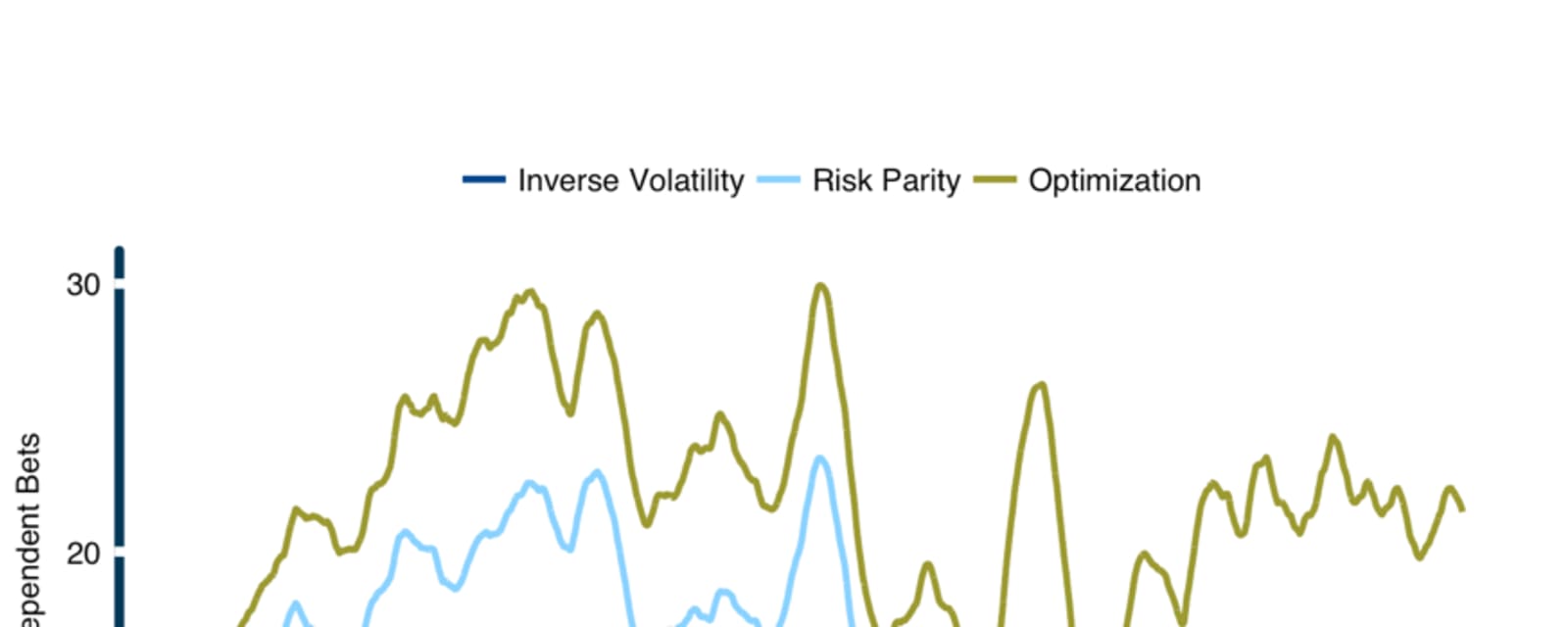
Portfolio optimization within the managed futures space presents distinct mathematical and practical challenges that reward disciplined practitioners with substantial diversification benefits. According to Advisor Perspectives, futures markets exhibit features that complicate optimization—particularly issues with large correlation matrices and periods of elevated cross-market correlation—yet simultaneously offer an "extreme diversity" that justifies the analytical effort required to optimize positioning.
The theoretical foundation for diversification benefits rests on the Fundamental Law of Active Management, articulated by Grinold in 1989. This framework establishes that risk-adjusted strategy performance equals a mathematical function of skill multiplied by the square root of breadth, where breadth represents the total number of independent investment decisions (calculated as the number of securities times the number of trades). When applied to absolute performance measurement rather than benchmark-relative returns, practitioners can substitute Sharpe ratio for information coefficient—a methodological adaptation that proves particularly relevant in managed futures contexts where managers operate without explicit benchmarks.
Information coefficient serves as the quantifiable measure of manager skill by calculating the correlation between strategy signals and subsequent results. Understanding this relationship becomes critical for futures-based strategies, where the breadth of available markets and trading opportunities substantially exceeds those available in traditional equity or fixed-income portfolios. The mathematical rigor required to navigate correlation matrices in futures optimization is non-trivial, yet industry participants recognize that successful implementation delivers material portfolio enhancements.
Research suggests that a 5% to 10% allocation to managed futures represents a practical optimal range for balanced portfolio investors. This allocation range reflects an empirical sweet spot that balances the diversification and Sharpe ratio improvement benefits of futures exposure against implementation complexity and cost considerations. The case for managed futures integration rests fundamentally on the diversity mathematics outlined in modern portfolio theory—breadth multiplication effects amplify risk-adjusted returns when uncorrelated or negatively correlated asset exposures are properly optimized.
The theoretical foundation for diversification benefits rests on the Fundamental Law of Active Management, articulated by Grinold in 1989. This framework establishes that risk-adjusted strategy performance equals a mathematical function of skill multiplied by the square root of breadth, where breadth represents the total number of independent investment decisions (calculated as the number of securities times the number of trades). When applied to absolute performance measurement rather than benchmark-relative returns, practitioners can substitute Sharpe ratio for information coefficient—a methodological adaptation that proves particularly relevant in managed futures contexts where managers operate without explicit benchmarks.
Information coefficient serves as the quantifiable measure of manager skill by calculating the correlation between strategy signals and subsequent results. Understanding this relationship becomes critical for futures-based strategies, where the breadth of available markets and trading opportunities substantially exceeds those available in traditional equity or fixed-income portfolios. The mathematical rigor required to navigate correlation matrices in futures optimization is non-trivial, yet industry participants recognize that successful implementation delivers material portfolio enhancements.
Research suggests that a 5% to 10% allocation to managed futures represents a practical optimal range for balanced portfolio investors. This allocation range reflects an empirical sweet spot that balances the diversification and Sharpe ratio improvement benefits of futures exposure against implementation complexity and cost considerations. The case for managed futures integration rests fundamentally on the diversity mathematics outlined in modern portfolio theory—breadth multiplication effects amplify risk-adjusted returns when uncorrelated or negatively correlated asset exposures are properly optimized.
Go deeper than the headline
Research every firm in this story, track the ones that matter and get the daily briefing — free for 7 days.