
Key Takeaways
- • New Mountain Capital manages approximately $60 billion in assets and has deployed private credit as a core investment strategy alongside traditional private equity, with a publicly traded BDC vehicle (New Mountain Finance Company) showing 95% of positions rated favorably with extremely low historical loss rates.
- • Steve Klinsky, founder and CEO of New Mountain Capital, articulated an optimistic outlook on both private equity and private credit investment opportunities in the current 2026 market environment, positioning both asset classes as attractive for institutional investors.
- • New Mountain Finance Company maintains transparent loan-level reporting with color-coded risk indicators (green, yellow, red lights), demonstrating disciplined underwriting practices that have historically generated strong risk-adjusted returns in the private credit market.
- • Klinsky assessed that publicly traded BDCs faced oversold valuations in 2025 following specific asset-backed loan failures unrelated to traditional BDC lending, suggesting market sentiment may have been excessively pessimistic across the sector.
- • The regulatory environment for private credit is expected to remain supportive in 2026, with potential banking sector regulatory relief unlikely to adversely impact private credit opportunities and no anticipated government clampdown on private capital deployment.
Summary
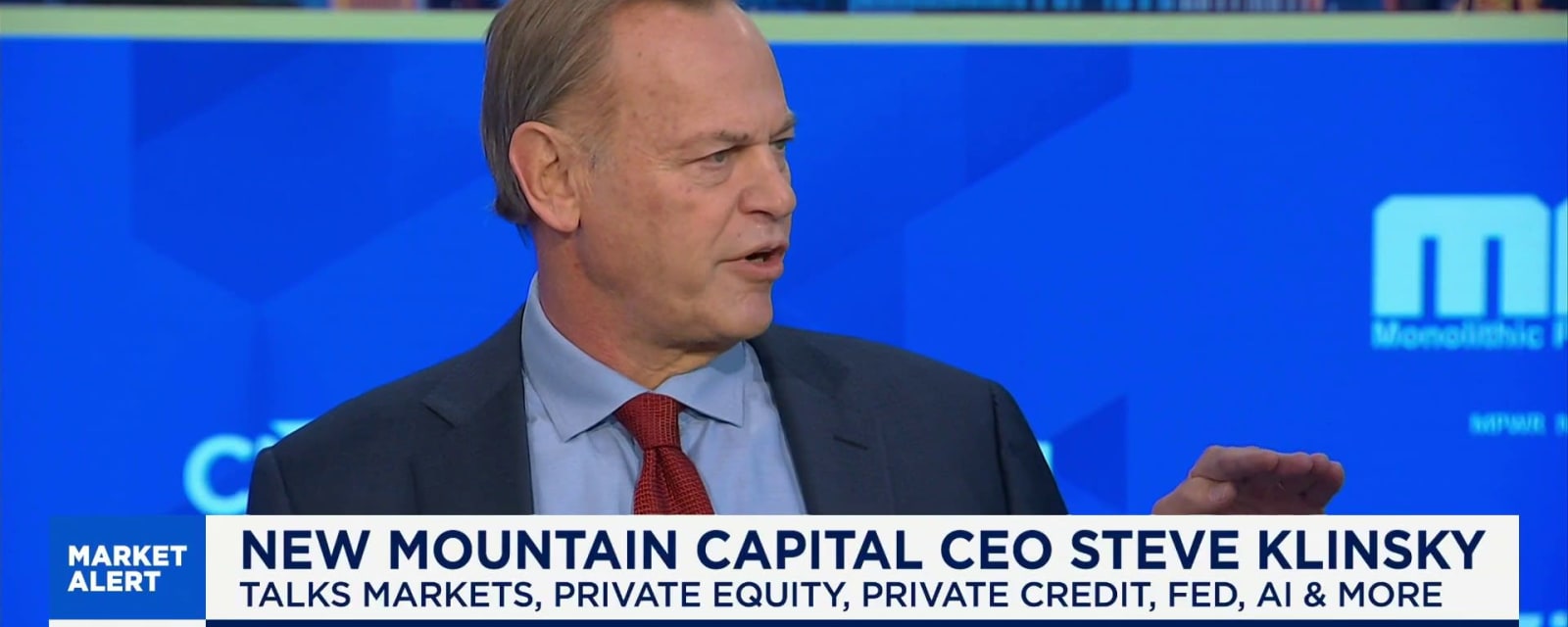
Steve Klinsky, founder and CEO of New Mountain Capital, conveyed a constructive view on private equity and private credit investing opportunities during remarks in February 2026. Speaking on Goldman Sachs' Exchanges platform, Klinsky emphasized that the current market environment presents a favorable entry point for capital deployment across both segments of the alternative asset class landscape.
New Mountain Capital, which manages approximately $60 billion in assets, has established itself as a disciplined institutional investor with particular expertise in private credit markets. The firm operates a publicly traded BDC vehicle, New Mountain Finance Company, through which it provides transparent investor communication on portfolio composition and performance. According to Klinsky, 95% of the firm's positions maintain favorable green-light ratings under its proprietary risk assessment framework, while the portfolio has sustained extremely low loss rates over an extended period. This performance record reflects New Mountain's emphasis on defensive growth and high-quality business selection rather than financial engineering—an evolution Klinsky noted as characteristic of the broader private equity industry's maturation over his 25-year career.
Regarding the private credit sector's recent challenges, Klinsky contextualized 2025's BDC underperformance as a market overreaction to specific asset-backed loan failures that were not representative of traditional BDC lending practices. He noted that investor confusion regarding loan classification and portfolio composition contributed to indiscriminate selling pressure across the publicly traded BDC space. As a significant personal investor in his own firm's public vehicle, Klinsky positioned himself as a buyer rather than seller, signaling confidence in mean reversion and sector recovery prospects.
On the regulatory front, Klinsky assessed that the 2026 regulatory environment would remain neutral to supportive for private credit strategies. While banking sector entities may benefit from potential regulatory relief under the current administration, Klinsky explicitly stated that such developments would not negatively impact private credit investment opportunities. Bloomberg Intelligence survey data cited by Klinsky indicated that while institutional investors cited macroeconomic and rate volatility as primary concerns, fund managers themselves identified regulatory tightening as a greater threat—a calculus that appears to have shifted favorably for private capital deployment given the current political and regulatory backdrop.
New Mountain Capital, which manages approximately $60 billion in assets, has established itself as a disciplined institutional investor with particular expertise in private credit markets. The firm operates a publicly traded BDC vehicle, New Mountain Finance Company, through which it provides transparent investor communication on portfolio composition and performance. According to Klinsky, 95% of the firm's positions maintain favorable green-light ratings under its proprietary risk assessment framework, while the portfolio has sustained extremely low loss rates over an extended period. This performance record reflects New Mountain's emphasis on defensive growth and high-quality business selection rather than financial engineering—an evolution Klinsky noted as characteristic of the broader private equity industry's maturation over his 25-year career.
Regarding the private credit sector's recent challenges, Klinsky contextualized 2025's BDC underperformance as a market overreaction to specific asset-backed loan failures that were not representative of traditional BDC lending practices. He noted that investor confusion regarding loan classification and portfolio composition contributed to indiscriminate selling pressure across the publicly traded BDC space. As a significant personal investor in his own firm's public vehicle, Klinsky positioned himself as a buyer rather than seller, signaling confidence in mean reversion and sector recovery prospects.
On the regulatory front, Klinsky assessed that the 2026 regulatory environment would remain neutral to supportive for private credit strategies. While banking sector entities may benefit from potential regulatory relief under the current administration, Klinsky explicitly stated that such developments would not negatively impact private credit investment opportunities. Bloomberg Intelligence survey data cited by Klinsky indicated that while institutional investors cited macroeconomic and rate volatility as primary concerns, fund managers themselves identified regulatory tightening as a greater threat—a calculus that appears to have shifted favorably for private capital deployment given the current political and regulatory backdrop.
Go deeper than the headline
Research every firm in this story, track the ones that matter and get the daily briefing — free for 7 days.