
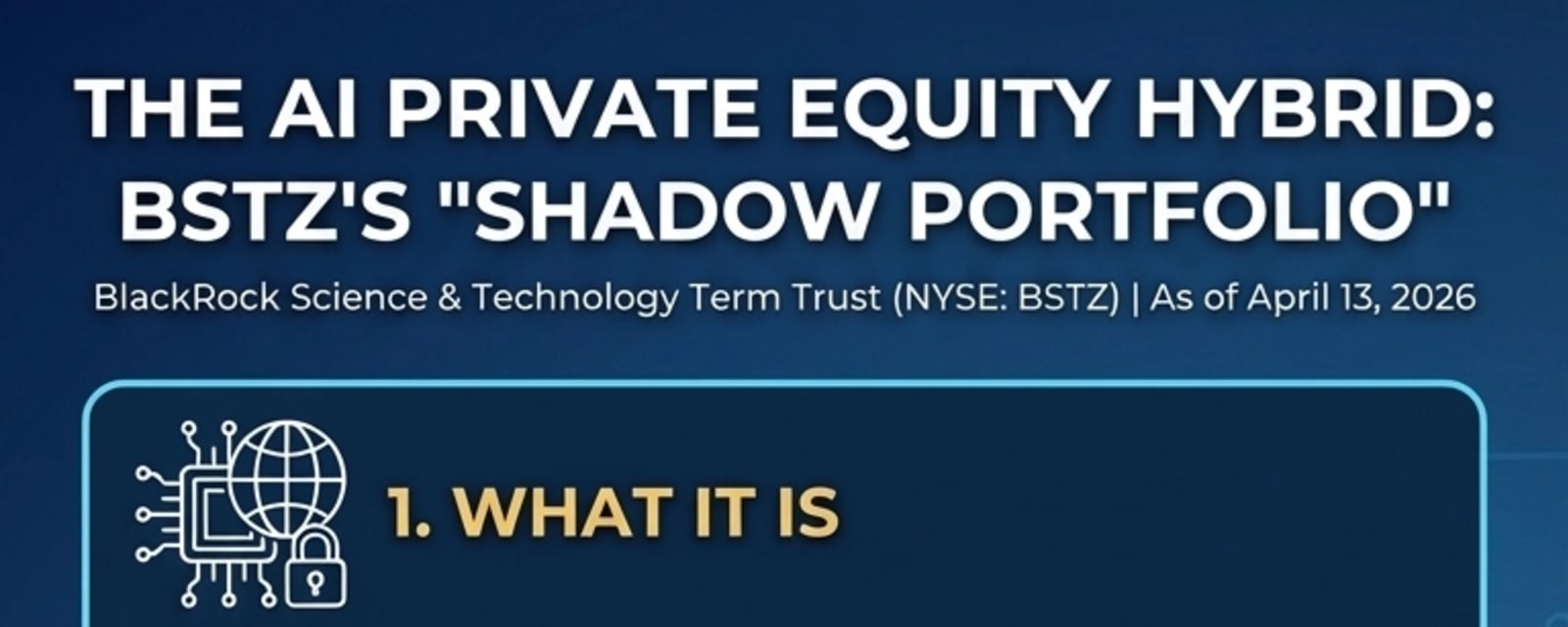
Key Takeaways
- • BlackRock Science and Technology Term Trust (BSTZ) offers an 11.77% annual dividend yield ($2.64 per share), significantly higher than typical equity fund distributions, positioning it as an income-focused closed-end fund in the technology sector.
- • BSTZ holds a 13.88% position in private company Databricks as its largest holding, leveraging BlackRock's regulatory ability as a closed-end fund to invest directly in private equities—a capability unavailable to traditional ETFs.
- • The fund invests approximately 80% of assets in publicly traded US and non-US technology companies across all market capitalizations, with discretion to pursue growth opportunities beyond traditional tech indices like the Nasdaq-100.
- • BlackRock's $15+ trillion in assets under management provides the capital base and risk management infrastructure to support private company investments while maintaining appropriate liquidity and disclosure standards for institutional investors.
- • The elevated yield masks exposure to concentrated private equity risk and potential valuation fragility, as the fund's income generation depends on performance of both public tech holdings and illiquid private stakes in companies like Databricks.
Summary
BlackRock Science and Technology Term Trust (NYSE: BSTZ) is a closed-end fund managed by BlackRock under the leadership of Co-Founder, Chairman, and CEO Laurence Fink. The fund offers an annual dividend yield of 11.77% ($2.64 per share), substantially higher than conventional equity fund distributions. This elevated yield reflects the fund's mandate to invest in technology companies with substantial growth potential, with approximately 80% of assets allocated to publicly traded US and non-US technology equities across all market capitalizations.
A distinguishing feature of BSTZ is its ability to invest directly in private companies—a structural advantage unavailable to exchange-traded funds, which are prohibited from private company investment and must access such opportunities only through publicly traded private equity vehicles or similar intermediaries. The fund's largest holding, representing 13.88% of the portfolio, is Databricks, a private artificial intelligence firm. This concentrated private equity exposure highlights both the fund's unique investment flexibility and the concentration risk embedded in its yield profile.
BlackRock's substantial asset base—exceeding $15 trillion under management—provides the capital base and institutional infrastructure necessary to invest in private companies while maintaining appropriate risk mitigation and investor disclosures. However, the reliance on private equity stakes, combined with growth-focused technology positioning, creates vulnerabilities. The 11% dividend yield may reflect capital returns dependent on eventual liquidity events in private holdings and continued valuation support in a technology sector subject to market cyclicality. The fund's income engine is therefore partially contingent on the performance trajectory and exit timing of illiquid private investments rather than solely on distributions from mature public equities, introducing execution risk alongside the inherent concentration risk of large private stakes in a single portfolio company.
Go deeper than the headline
Research every firm in this story, track the ones that matter and get the daily briefing — free for 7 days.