
Key Takeaways
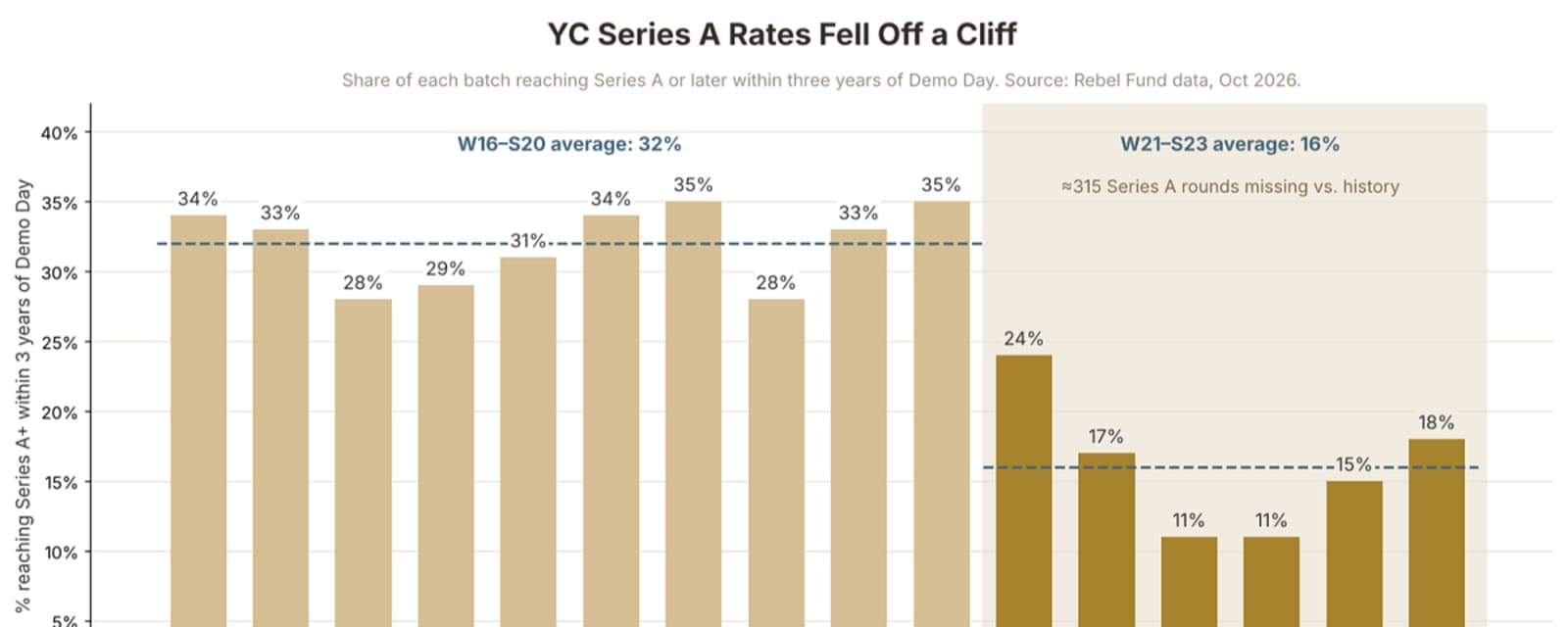
- • Rebel Fund attributes the sharp drop in Series A rates for Y Combinator startups beginning roughly five years ago to macroeconomic conditions, not weaker founders or admissions quality.
- • According to Rebel's data, raising a Series A cuts a YC company's odds of shutting down by nearly 3x, and companies reaching Series C+ show a 10-year survival rate above 95%.
- • Series A rates slowed for every YC cohort in 2023 regardless of admission year, and actual graduation rates fell well below Rebel's model predictions starting at the end of 2020.
- • Carta counted 808 Series A rounds in 2023, down about 50% from 1,612 in 2022, while global early-stage funding in late 2022 was down 39% year over year.
- • Early signs of recovery appeared in 2025: 4.2% of YC companies one year past Demo Day and 7.3% two years past raised a first Series A, up from 1.5% and 3.0% at the trough, though still roughly half the pre-2021 norm.
Summary
Rebel Fund, which says it invests in the top 10% of Y Combinator startups each batch and tracks a portfolio of more than 300 YC companies, reports that Series A rates for YC startups fell sharply starting about five years ago. The firm's Rebel Theorem 5.0 machine-learning model is used to test explanations for the decline, including whether later batches were weaker or whether founder quality had deteriorated.
Rebel's analysis points away from those explanations. Series A rates slowed for every YC startup in 2023, regardless of whether a company had gone through YC one, two, or three-plus years earlier, which Rebel argues rules out a drop in admissions quality around 2021. The firm also reports that its model, which scores founders across hundreds of dimensions, predicted Series A rates by batch that held steady until the end of 2020, after which actual rates fell far below predictions. The slowdown affected every tier of founder quality about equally; Rebel notes that a top-quintile team from 2022 had worse odds of raising a Series A than a bottom-quintile team from 2018.
Rebel attributes the decline to the macroeconomic environment. The slowdown coincided with rising interest rates through 2022 and 2023, and global early-stage funding in late 2022 was down 39% year over year. As Series B and growth investors pulled back, Series A investors became less confident that their companies could raise the following round. Carta counted 808 Series A rounds in 2023, down about 50% from 1,612 the prior year.
Rebel says there are early signs of a thaw. In 2025, 4.2% of young YC companies raised a first Series A one year past Demo Day and 7.3% two years past, up from 1.5% and 3.0% at the bottom. The firm characterizes this as still roughly half the pre-2021 norm. Looking ahead, Rebel questions whether AI-driven efficiency will reduce the need for Series A capital, noting strong revenue growth, capital efficiency, and profitability in its recent vintages, though it also points to more ambitious technical undertakings that could sustain venture appetite. Rebel's conclusions are its own analysis and are based on proprietary model outputs that have not been independently verified.
Go deeper than the headline
Research every firm in this story, track the ones that matter and get the daily briefing — free for 7 days.